
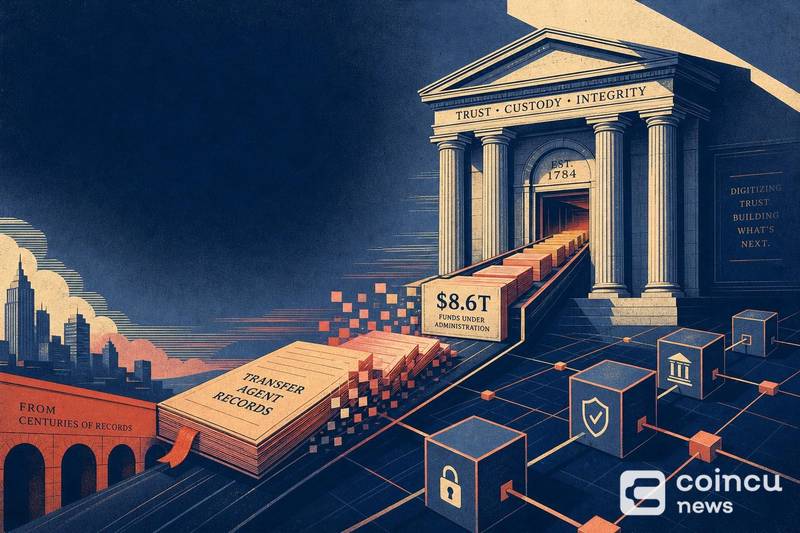

BNY Mellon is migrating transfer-agent records for its $8.6 trillion fund business to blockchain, a back-office overhaul that places core fund recordkeeping onto distributed-ledger infrastructure rather than legacy systems.
The move applies to transfer-agent records, the master registers that document who owns shares in a fund and how those holdings change over time. It is a change at the recordkeeping layer, not a declaration that the underlying funds themselves have been tokenized.
At the reported scale of $8.6 trillion in fund assets, the migration reframes how one of the world’s largest custodians maintains shareholder ownership data. BNY has publicly described its work on the next generation of transfer agency as a rethinking of that recordkeeping function.

Why Transfer-Agent Records Matter in Fund Operations
A transfer agent maintains the authoritative record of fund ownership: shareholder registers, share issuance and redemption, and the reconciliation that keeps a fund’s books accurate. These records sit behind the scenes but underpin every subscription and payout.
Moving this layer to blockchain means the ledger that tracks ownership and supports fund administration is being rebuilt on newer rails. It is infrastructure modernization, distinct from the public token trading that dominates crypto market coverage.
Because the change is operational rather than consumer-facing, its significance is easy to understate. A firm handling trillions in fund assets altering its core register carries weight regardless of whether end investors ever notice it directly.
What the Move Signals for Institutional Adoption
A global custodian applying blockchain to authoritative records points to growing enterprise willingness to use the technology for regulated financial plumbing rather than experiments. It fits a broader pattern of established institutions adopting distributed ledgers incrementally.

BNY has been building adjacent capabilities, including tokenized deposits on a blockchain platform and a broader push into tokenized products. The bank has also outlined plans for 24/7 tokenized Treasury settlement targeted for 2027, signaling a staged approach rather than a single leap.
The recordkeeping migration could support future settlement efficiencies or tokenization workflows, but the available evidence does not confirm those are deployed today. The convergence of traditional finance and digital assets is proceeding through operational steps like this one.
That direction is visible across the industry. Baillie Gifford introduced a tokenized fund with BNY on Solana and Ethereum, while BlackRock deepened its tokenization push with new onchain fund offerings.
Key Questions the Announcement Leaves Open
The available context does not specify several material details. Readers should avoid assuming answers that the evidence does not provide.
- Network: No specific blockchain or ledger is confirmed.
- Timing: No rollout schedule or completion date is stated.
- Scope: Whether every fund process moves onchain is not confirmed.
- Regulatory and client impact: No details are given on regulatory treatment or effects on investors.
Migrating records is not the same as tokenizing the funds themselves. Related BNY fund filings, such as those submitted to the SEC’s EDGAR system, sit alongside this operational change but do not by themselves confirm chain choice or scope. Keeping that distinction clear matters for accurate reporting.
FAQ: BNY Mellon and Blockchain Fund Records
What are transfer-agent records?
They are the authoritative registers of fund ownership, tracking shareholders, share issuance and redemption, and the reconciliation that keeps a fund’s books accurate.
Does this mean BNY Mellon tokenized its funds?
No. The reported change concerns recordkeeping infrastructure. It does not confirm that the funds have been tokenized.
Why is blockchain useful for fund recordkeeping?
A shared, tamper-resistant ledger can streamline ownership tracking and reconciliation, potentially supporting future settlement efficiencies, though the brief does not confirm those benefits are live.
Why does the $8.6 trillion figure matter?
The scale indicates the change touches a very large fund business, giving the move broader industry relevance even as a back-office update.
Disclaimer: This article is for informational purposes only and does not constitute financial or investment advice. Cryptocurrency and digital asset markets carry significant risk. Always do your own research before making decisions.

