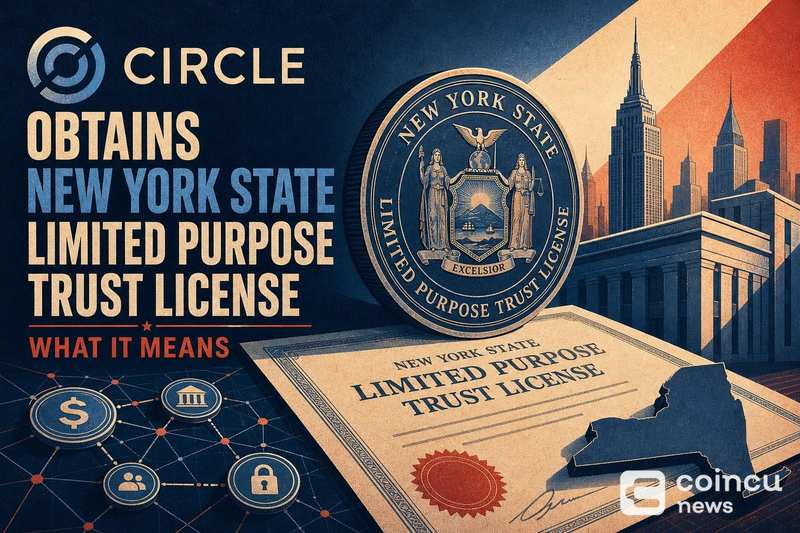

Circle has obtained a New York State Limited Purpose Trust License, with the New York State Department of Financial Services now listing Circle Internet Trust Company, LLC as a regulated entity holding a Limited Purpose Trust Charter. The grant marks a significant state-level regulatory milestone for the issuer of USDC, the second-largest stablecoin.
The New York State Department of Financial Services (NYDFS) lists Circle Internet Trust Company, LLC as holding a Limited Purpose Trust Charter, according to the regulator’s public register of virtual currency businesses. The listing places Circle’s trust entity directly under New York’s dedicated crypto supervisory framework.
The regulator’s regulated-entities table shows the charter grant date as 2026-07, identifying the month the New York limited purpose trust charter was granted. That entry is the clearest state-level proof of Circle’s expanded regulatory standing.

This qualifies as a regulatory milestone because New York’s licensing regime is widely treated as one of the higher compliance bars in U.S. crypto. The charter formalizes Circle’s supervised status for virtual currency activity in the state.
What a Limited Purpose Trust License Typically Signals
A limited purpose trust company charter is a trust-based regulatory framework rather than a generic registration. In plain terms, it authorizes a chartered entity to hold and administer assets under fiduciary standards, subject to ongoing supervision.
NYDFS states that a New York state limited purpose trust company charter can exercise fiduciary powers and can operate without a separate New York money transmitter license. The regulator treats such a charter as a New York alternative to a BitLicense for virtual-currency activity.
New York regulation carries outsized weight in crypto coverage because NYDFS was among the first agencies to build a dedicated licensing regime for digital assets. A charter granted there is often read as a signal of compliance readiness. The exact permissions and scope, however, depend on the specific terms of the regulator’s approval.
Why the License Matters for Circle’s Position in the Crypto Market
A state trust license can strengthen perceptions of institutional legitimacy for a company whose core product is a dollar-pegged token. Circle is widely associated with regulated digital asset infrastructure, which makes each new charter strategically relevant to its market positioning.
The compliance and oversight angle is direct: the NYDFS charter subjects Circle Internet Trust Company, LLC to fiduciary standards and continuous state supervision. That layer of oversight can matter to institutions weighing counterparty and custody risk in stablecoins like USDC, whose growth has been tracked through events such as Circle’s large USDC mints on Solana.
The charter also has federal company. Circle announced on July 10, 2026 that it received OCC approval to establish First National Digital Currency Bank, N.A., operating as Circle National Trust, according to the company’s press release. The two approvals together give Circle parallel state and federal trust structures.
Circle Chief Executive Jeremy Allaire framed the federal approval as a governance benchmark for the company’s infrastructure.
“Federal oversight of our trust bank sets a new standard for transparency, governance, and scale for Circle’s infrastructure.”
Jeremy Allaire, CEO of Circle, as reported by CoinDesk.
What This Could Mean for Stablecoin and Payments Expansion
Licensing developments matter largely because they can support future custody, reserve, or payments activity. Circle’s press release says the OCC charter is designed to enable future USDC reserve-management capabilities under federal oversight, a forward-looking capability rather than a live service.
Reporting has pointed to a division of roles between the two structures. CoinDesk reported that USDC issuance will transfer to a separate New York limited-purpose trust company rather than the national trust bank, suggesting the New York charter is positioned as the issuance vehicle.
The scale behind that structure is substantial. USDC’s market capitalization stood at roughly $71.85 billion in the research snapshot, with circulating supply near the same level.
USDC held its peg through the news, trading at $0.9996 with a 24-hour move of about 0.24% and around $10.99 billion in daily volume. Broader risk appetite stayed weak, with the crypto Fear and Greed Index reading 25, in Extreme Fear territory.
Any expansion beyond issuance and custody remains conditional on how each charter’s approved scope is exercised. Circle’s regulatory footprint has grown alongside moves such as its reported acquisition of a blockchain patent portfolio, but the licenses themselves confirm supervision, not specific new products.
FAQ About Circle’s New York State Limited Purpose Trust License
What is a New York State Limited Purpose Trust License? It is a charter from NYDFS authorizing a trust company to exercise fiduciary powers for a defined set of activities. NYDFS states this type of charter can serve as an alternative to a BitLicense for virtual-currency activity and does not require a separate New York money transmitter license.
Why did Circle’s license approval attract attention? Because NYDFS supervision is treated as a high compliance bar, and because the charter now formally covers the entity tied to USDC, a stablecoin with a market cap near $71.85 billion. It also arrived alongside Circle’s federal OCC trust-bank approval.
Does this change what Circle can do immediately? The charter confirms Circle Internet Trust Company, LLC’s supervised, fiduciary standing in New York. Capabilities such as USDC reserve management are described as future functions, and their exact scope depends on the terms of each regulator’s approval. Context on USDC’s ongoing supply activity is visible in Circle’s recent large USDC minting.
Disclaimer: This article is for informational purposes only and does not constitute financial or investment advice. Cryptocurrency and digital asset markets carry significant risk. Always do your own research before making decisions.