
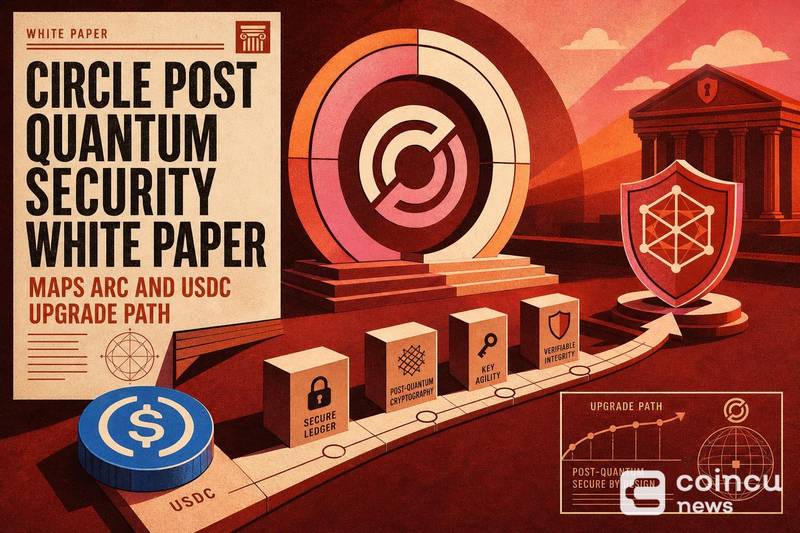

Circle has published a post-quantum security white paper that outlines a potential upgrade path for its Arc platform and USDC stablecoin, signaling the company’s intent to prepare its infrastructure against future quantum computing threats.
The white paper, detailed in Circle’s Arc documentation, addresses how cryptographic systems underpinning stablecoin infrastructure could be vulnerable as quantum computing capabilities advance. The publication positions Circle among the first major stablecoin issuers to formally map out a transition strategy.
What post-quantum security means for stablecoin infrastructure
Post-quantum security refers to cryptographic methods designed to resist attacks from quantum computers. Current blockchain systems, including those securing stablecoins like USDC, rely on elliptic curve cryptography, which theoretical quantum algorithms could eventually break.

The distinction matters for digital asset infrastructure. While large-scale quantum computers capable of cracking today’s encryption do not yet exist, the cryptographic transition requires years of planning, testing, and coordination across protocols. Circle’s white paper addresses this lead time directly by proposing a phased approach.
The move comes as broader conversations around quantum resilience gain traction across technology sectors, including among firms operating critical financial infrastructure. For stablecoin issuers, whose systems handle billions in daily transaction volume, the stakes of a late transition could be significant, a concern that has also prompted discussions in AI and security-focused summits globally.
Circle’s proposed upgrade path for Arc and USDC
According to the Arc project blog, Circle’s roadmap envisions anti-quantum protections as a forward-looking upgrade rather than an immediate overhaul. The white paper frames the transition as a multi-phase process that would allow Arc and USDC to adopt quantum-resistant cryptographic primitives over time.
Arc, Circle’s blockchain infrastructure layer, is named alongside USDC as a system that would need to migrate its underlying security assumptions. The upgrade path described in the white paper suggests that both the platform’s consensus mechanisms and its key management systems would eventually incorporate post-quantum algorithms.

This is a strategic signal, not a product launch. Circle has not announced a timeline for deploying quantum-resistant changes to USDC in production. The white paper instead serves as a technical blueprint, outlining what a migration could look like and what dependencies it would involve.
Implications for stablecoin issuers and blockchain developers
A public white paper from a major stablecoin issuer carries weight beyond Circle’s own ecosystem. USDC is one of the most widely integrated stablecoins across DeFi protocols, centralized exchanges, and payment systems. Any change to its cryptographic foundation has downstream effects on every platform that interacts with it.
For competing stablecoin issuers, including Tether, which has been expanding across AI, payments, and compliance, Circle’s publication may accelerate internal conversations about quantum readiness. A public roadmap creates implicit pressure for peers to disclose their own preparedness.
Blockchain developers building on infrastructure that supports USDC will need to monitor Circle’s upgrade path closely. Interoperability between quantum-resistant and legacy cryptographic systems is a known challenge, and early coordination could reduce friction during any eventual migration.
The white paper also raises questions about standards. If Circle adopts specific post-quantum algorithms, such as those recently standardized by NIST, it could influence which cryptographic primitives the broader stablecoin ecosystem converges on. Discussions at events like the Cyber Revolution Summit have highlighted similar standardization concerns across digital finance.
FAQ: Key questions about Circle’s post-quantum roadmap
What is Circle’s post-quantum security white paper?
It is a technical document published by Circle that examines how quantum computing could threaten current cryptographic systems and proposes a phased upgrade path for Arc and USDC to adopt quantum-resistant protections.
What is the anti-quantum upgrade path for Arc and USDC?
The white paper describes a multi-phase transition strategy that would update the cryptographic foundations of both Arc’s infrastructure layer and USDC’s security model to incorporate post-quantum algorithms over time.
Does this mean USDC is changing immediately?
No. The white paper is a planning document, not a product announcement. Circle has not disclosed a specific timeline for deploying quantum-resistant changes to USDC in production environments.
Why does post-quantum security matter for crypto?
Most blockchain systems rely on cryptographic methods that quantum computers could theoretically break. Preparing migration paths now is considered essential because transitioning cryptographic infrastructure across decentralized systems requires extensive coordination and testing.
Disclaimer: This article is for informational purposes only and does not constitute financial or investment advice. Cryptocurrency and digital asset markets carry significant risk. Always do your own research before making decisions.

