
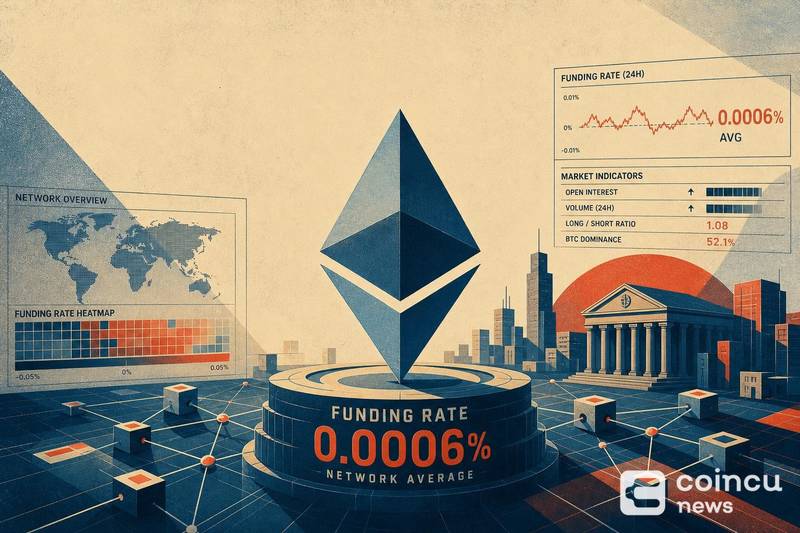
Ethereum’s 8-hour average funding rate across perpetual futures exchanges currently sits at 0.0006%, a near-flat reading that signals restrained leverage positioning among derivatives traders.
The figure represents a network-wide average rather than a single exchange print. Funding rates on perpetual contracts are periodic payments exchanged between long and short traders, typically settled every eight hours. Aggregators such as Coinglass compile these rates across major venues to produce a composite view of directional sentiment in the ETH perpetuals market.
A 0.0006% reading confirms one narrow fact: the cost of holding long ETH perpetual positions is marginally positive, meaning longs are paying shorts. It does not, on its own, constitute a broad directional verdict on Ethereum’s price trajectory.

Low positive funding points to balanced positioning
When the funding rate hovers near zero, it typically reflects a market where neither bulls nor bears hold dominant leverage. A mildly positive print like 0.0006% suggests a slight lean toward long positioning, but the magnitude is too small to indicate crowded trades or aggressive directional bets.
This contrasts sharply with periods of elevated funding, where rates can climb above 0.01% per eight-hour interval during speculative rallies, or turn deeply negative during liquidation cascades. The current reading falls well below those thresholds.
For context, sustained high positive funding often precedes long squeezes when overleveraged positions get flushed out. The absence of that signal here suggests the derivatives market is not currently pricing in extreme short-term momentum for ETH in either direction.
Confirmation metrics traders should watch
A funding rate in isolation provides limited signal. Traders and analysts typically cross-reference it against several other metrics before drawing positioning conclusions.

Open interest is the first confirmation layer. Rising open interest alongside flat funding would suggest new positions are being opened without directional consensus. Falling open interest with flat funding would point to traders closing positions and stepping to the sidelines.
Spot price and trading volume form the second layer. A divergence between spot price movement and flat funding can indicate that price action is being driven by spot market flows rather than leveraged derivatives activity. Funding rate trackers that overlay these metrics provide a more complete picture than any single data point.
On-chain activity and institutional flow data, including ETH ETF movements, represent a third layer of context. However, none of these supplementary metrics were verified in the current data set, and readers should consult those sources independently before forming directional views.
Ethereum’s broader ecosystem continues to draw institutional attention. Events like the recent Founders Table VIP Dinner during ETHConf 2026 reflect sustained developer and investor engagement with the network. Meanwhile, entities such as Eightco Holdings have disclosed positions exceeding 16,000 ETH, underscoring continued accumulation by publicly listed companies.
What remains unclear from available evidence
The 0.0006% figure cannot be attributed to a specific catalyst based on current data. No exchange-by-exchange breakdown was verified, meaning the average could mask significant variance between venues.
No confirmed 24-hour ETH spot price movement or volume figure accompanies this derivatives reading. Without that pairing, the funding rate exists as an isolated data point rather than part of a complete market narrative.
Projects building on top of Ethereum’s infrastructure continue to attract capital, as demonstrated by Renaiss raising $1.5 million in a seed round led by YZi Labs. Whether ecosystem fundraising momentum correlates with derivatives positioning is a question that requires deeper analysis beyond the scope of current evidence.
ETH funding rate FAQ
What is the ETH funding rate?
The funding rate is a periodic payment mechanism in perpetual futures contracts. When positive, traders holding long positions pay those holding short positions. When negative, shorts pay longs. It keeps the perpetual contract price tethered to the underlying spot price by incentivizing the less popular side of the trade.
Is a 0.0006% funding rate bullish or bearish for Ethereum?
Neither, in isolation. A 0.0006% rate is marginally positive, indicating a very slight long bias in the perpetuals market. This reading is too close to zero to serve as a reliable directional indicator. It suggests balanced positioning rather than conviction in either direction.
What should traders watch after a low positive funding print?
Open interest changes are the most immediate follow-up metric. If open interest rises while funding stays flat, new market participants may be entering without strong directional bias. Spot volume, liquidation data, and broader market sentiment indicators provide additional context for interpreting what a near-zero funding rate means for near-term ETH price action.
Disclaimer: This article is for informational purposes only and does not constitute financial or investment advice. Cryptocurrency and digital asset markets carry significant risk. Always do your own research before making decisions.

