
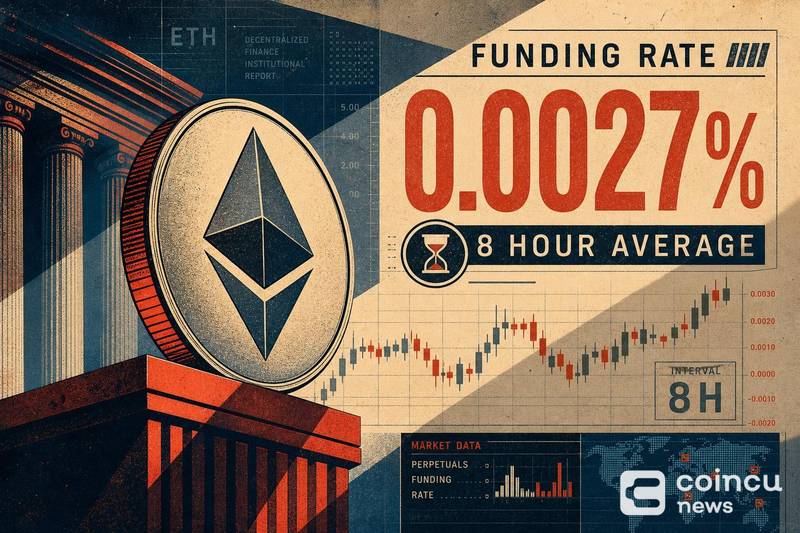

Ethereum’s network-wide 8-hour average funding rate currently stands at 0.0027%, a mildly positive reading that points to a slight long bias across perpetual futures markets without signaling excessive leverage or speculative euphoria.
The figure, tracked across major exchanges via aggregated funding rate dashboards, reflects the cost that long position holders pay short holders every eight hours on perpetual swap contracts. A positive rate means buyers are willing to pay a premium to maintain their positions.
What a 0.0027% 8-Hour Funding Rate Actually Tells Traders
Funding rates are the mechanism perpetual futures exchanges use to keep contract prices anchored to the spot market. Every eight hours, one side of the trade pays the other. When the rate is positive, longs pay shorts; when negative, shorts pay longs.

At 0.0027% per 8-hour interval, the annualized cost of holding a long ETH perpetual position works out to roughly 2.96%. That is modest by crypto standards, where funding rates during peak bull runs can spike above 0.05% per interval or higher.
The reading reflects derivatives positioning specifically, not spot demand. Spot buyers and on-chain activity can tell a different story, which is why funding rate trackers are best used alongside other indicators rather than in isolation.
Mild Long Bias, Not Euphoria
A 0.0027% rate suggests that traders hold a cautiously bullish posture. Longs slightly outnumber shorts in terms of aggregate positioning, but the premium they are paying is small enough that it does not indicate crowded or overleveraged conditions.
When funding rates climb well above 0.01% per interval, it often signals that speculative long positioning has become stretched, raising the probability of a liquidation-driven correction. The current level sits far below that threshold.

Conversely, deeply negative funding rates tend to emerge during aggressive sell-offs when short sellers dominate. The fact that ETH funding is positive but close to neutral suggests a market that is leaning constructive without committing aggressively in either direction.
Positioning Risk From Here
For traders watching ETH derivatives, the direction of funding matters more than any single snapshot. A gradual drift higher in the rate would indicate growing long-side conviction, which can precede either a breakout or a squeeze if price reverses.
Stable low-positive funding, on the other hand, tends to accompany grinding price action rather than dramatic moves. It reflects a market where participants are positioned but not stretched, a backdrop that can support sustained trends without the fragility of high-leverage regimes.
The risk scenario to monitor is a sudden spike in funding alongside rising open interest. That combination typically signals rapid leveraged inflows and increases the chance that a sharp price move triggers cascading liquidations. For now, the 0.0027% reading does not suggest that dynamic is in play.
Why Funding Rate Needs Companion Metrics
No single derivatives metric offers a complete market picture. Open interest, which measures the total value of outstanding perpetual contracts, shows whether new money is entering or leaving the market. A rising funding rate paired with flat open interest can mean something very different from one accompanied by surging new positions.
Spot trading volume and price action serve as confirmation tools. If spot volume is declining while funding drifts positive, the long bias may be built on thin foundations. Developments in the broader Ethereum ecosystem, from tokenized asset initiatives on major exchanges to shifting DeFi activity, can also influence how derivatives traders position.
Liquidation data adds a stress dimension. Even at low funding rates, concentrated positions at specific price levels can create pockets of vulnerability. Monitoring broader market momentum across major tokens helps contextualize whether ETH-specific positioning is an outlier or part of a wider trend.
The current 0.0027% reading is a data point, not a verdict. Paired with open interest trends, spot volume, and liquidation maps, it becomes one piece of a more reliable positioning framework.
FAQ About ETH Funding Rates
What is the ETH funding rate?
The ETH funding rate is a periodic payment exchanged between long and short holders of Ethereum perpetual futures contracts. It keeps the perpetual contract price aligned with the spot market price. Most exchanges calculate and settle this rate every eight hours.
Is a 0.0027% funding rate bullish for Ethereum?
It indicates a mild long bias, meaning slightly more traders are betting on ETH price increases than decreases. However, the reading is too small to be considered a strong directional signal on its own. It reflects cautious optimism rather than aggressive bullishness.
Why do traders track funding rates?
Funding rates reveal how derivatives traders are positioned in real time. Extreme positive rates can warn of overleveraged longs vulnerable to liquidation. Extreme negative rates can signal excessive bearishness that may precede a short squeeze. Traders use the metric alongside open interest and risk-reward dynamics across markets to gauge positioning risk before entering trades.
Disclaimer: This article is for informational purposes only and does not constitute financial or investment advice. Cryptocurrency and digital asset markets carry significant risk. Always do your own research before making decisions.