
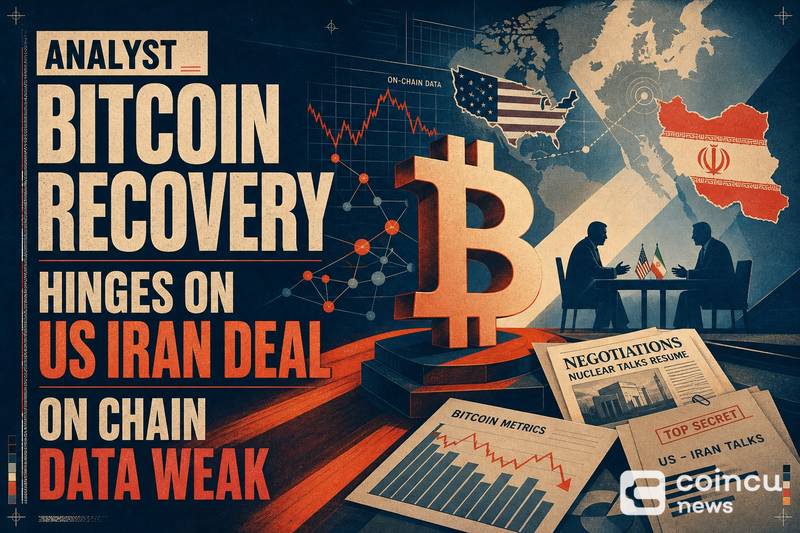

Bitcoin’s next sustained move higher may depend on whether the United States and Iran finalize a widely anticipated agreement, according to market analysts, even as on-chain data suggests the current recovery lacks conviction.
Traders have been taking profits across Bitcoin, Ether, and Solana as the market waits for a formal signing between the two nations. The pause in buying pressure highlights how dependent near-term sentiment has become on a single geopolitical catalyst.
Why analysts tie Bitcoin’s recovery to a US-Iran agreement
The logic connecting a diplomatic deal to crypto prices runs through risk appetite. A successful agreement would ease tensions in a region that influences energy markets and global trade flows, encouraging capital rotation into risk assets like Bitcoin.
Earlier this year, Bitcoin extended a recovery as optimism grew around a potential US-Iran deal, establishing a pattern where progress in negotiations correlated with short-term price strength. That pattern has persisted into June.
However, a geopolitical catalyst is a sentiment trigger, not a guarantee of sustained upside. Diplomatic negotiations can stall, collapse, or produce outcomes that fall short of market expectations. Bitcoin has historically reacted faster than traditional markets to headline-driven shifts, but those moves often reverse if structural confirmation does not follow.
What weak on-chain momentum signals about the current bounce
Despite the price recovery, on-chain indicators have not confirmed a durable trend shift. A CoinDesk report from early June noted that while Bitcoin’s momentum gauge hinted at recovery, experts remained cautious about the signal’s reliability.
On-chain momentum encompasses metrics like active addresses, transaction volume, exchange flows, and holder behavior. When these indicators lag behind price, it typically suggests that the rally is driven more by speculative positioning or short covering than by genuine accumulation.

Weak on-chain participation does not mean prices must fall, but it does cap the probability of a sustained breakout. Without growing network activity and evidence of long-term holders adding to positions, a price rebound can stall or reverse once the immediate catalyst fades.
This dynamic is particularly relevant for traders tracking Bitcoin spot ETF flows, which serve as another confirmation layer alongside blockchain-native signals. A disconnect between ETF demand and on-chain weakness would add further uncertainty.
Can macro headlines overpower weak blockchain signals?
In the short term, yes. Crypto markets frequently front-run macro developments, pricing in expected outcomes before on-chain fundamentals catch up. The current profit-taking across major tokens suggests that traders are already positioned for a binary event around the Iran signing.
A Bitwise Investments analysis framed the current macro environment as a transition from sovereign stress to monetary support, a backdrop that could amplify any positive resolution on the geopolitical front.
The tension between headline-driven momentum and structural weakness creates conditions for elevated volatility. If the agreement materializes, a rapid move higher is plausible even without strong on-chain confirmation, but such moves tend to be fragile and prone to sharp reversals.
Past episodes in crypto markets show that durable trends form when macro tailwinds and on-chain accumulation align. When only one side of that equation is present, the resulting price action tends to be choppy and short-lived, a pattern that has played out repeatedly in markets sensitive to regulatory and geopolitical developments.
Key risks that could invalidate the recovery thesis
The most direct risk is a failed or delayed agreement. If negotiations break down or the signing is postponed indefinitely, the primary catalyst supporting bullish sentiment disappears. Markets that have priced in a positive outcome would need to reprice quickly.
Persistent weak on-chain participation represents the second major risk. Even if the agreement is signed, a lack of follow-through in network activity and accumulation patterns would suggest the rally has a limited ceiling. Traders watching for trend confirmation would likely remain sidelined.
A third factor is broader market positioning. With profit-taking already underway across Bitcoin, Ether, and Solana, a negative surprise could accelerate selling. Leveraged positions built in anticipation of a deal would amplify downside volatility, similar to dynamics seen during previous exchange-driven volatility events.
FAQ: Bitcoin recovery, US-Iran agreement, and on-chain weakness
Why would a US-Iran agreement affect Bitcoin?
A diplomatic resolution reduces geopolitical risk, which encourages investors to move capital into higher-risk assets like Bitcoin. It also eases energy market uncertainty, which can improve broader economic sentiment.
What does weak on-chain momentum mean?
It means that blockchain activity metrics, such as active addresses, transaction counts, and holder accumulation patterns, are not rising alongside price. This gap suggests the recovery may be speculative rather than supported by fundamental demand.
Can Bitcoin rise even if on-chain signals remain soft?
Yes, particularly in the short term. Macro headlines and speculative flows can drive prices higher without on-chain confirmation. However, rallies without structural support tend to be shorter and more vulnerable to reversal.
Disclaimer: This article is for informational purposes only and does not constitute financial or investment advice. Cryptocurrency and digital asset markets carry significant risk. Always do your own research before making decisions.

