
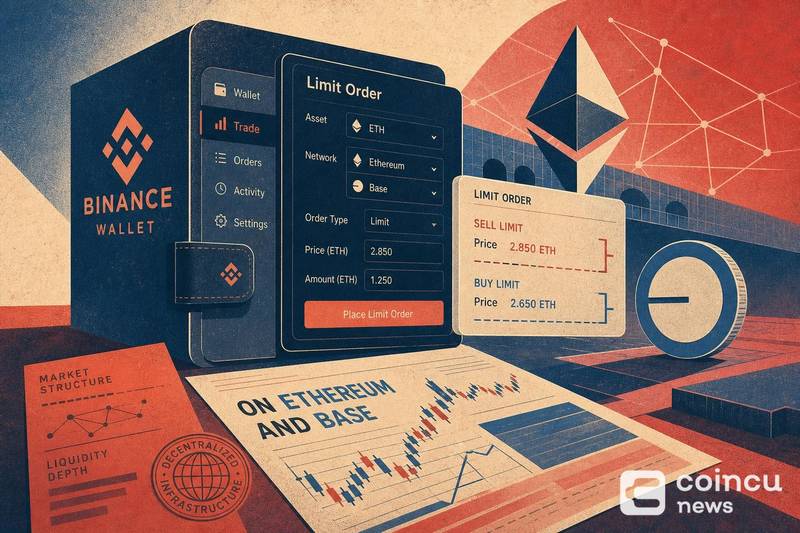

Binance Wallet now supports limit orders on Ethereum and Base across both its web and mobile app interfaces, according to an update announced by the official Binance Wallet account on July 12, 2026. The feature includes an auto-retry mechanism for orders placed on both networks.
The announcement was part of a broader set of updates to the Binance Wallet platform, which also included new filtering options for social tracker posts and a second quick buy preset for faster purchases.
🫡 Check out the latest updates in #Binance Wallet!

• View real-time company news on Tokenized Securities detail page
• Place Limit Order on ETH and Base with Auto-Retry
• Configure a second Quick Buy preset for faster purchase
• Filter Social Tracker posts by token contract… pic.twitter.com/hp019sBLrx
— Binance Wallet (@BinanceWallet) July 12, 2026
Source: @BinanceWallet on X
Limit Orders Come to Binance Wallet on Two Networks
The update allows Binance Wallet users to place limit orders when trading tokens on Ethereum and Base. A limit order lets a trader set a specific price at which they want to buy or sell a token, rather than executing immediately at the current market price.
This type of order is standard on centralized exchanges but has been less common in self-custody wallet environments. By adding limit order functionality directly within Binance Wallet, users can set target prices for token swaps without leaving the wallet interface.
The auto-retry feature included in the update means that if a limit order fails to execute on the first attempt, the system will automatically reattempt the trade. This is particularly relevant for on-chain environments where transactions can fail due to network congestion or rapid price movements.
Why Ethereum and Base Are the First Supported Networks
Ethereum remains the largest smart contract network by usage and developer activity, making it a natural first choice for any new trading feature. Base, the layer-2 network incubated by Coinbase, has grown as a lower-cost alternative for on-chain transactions while still settling to Ethereum.
Supporting both networks gives Binance Wallet users access to limit orders across two distinct fee environments. Ethereum transactions typically carry higher gas costs, where precise entry and exit prices become more important to offset fees. Base offers lower transaction costs, making smaller trades more viable.
The move comes as major market participants continue to interact with Ethereum-based assets on Binance, reflecting sustained demand for on-chain trading tools tied to the Ethereum ecosystem.
Web and App Parity Expands User Access
The announcement specifies that the limit order feature is available on both the web version and the mobile app of Binance Wallet. This means users are not restricted to a single platform when managing their orders.
Interface parity is significant for active traders who may set limit orders on a desktop and monitor or adjust them from a mobile device. Many wallet providers roll out features on one platform first, creating gaps in functionality that can disrupt trading workflows.
Binance Wallet has been expanding its feature set across both interfaces in recent months. The platform also recently launched a Web3 API for developers seeking access to on-chain data and transaction capabilities.
What Limit Orders Mean for Wallet-Based Trading
On centralized exchanges, limit orders are a basic feature. In self-custody wallets, they require more complex infrastructure because trades execute on-chain rather than through a centralized order book.
For Binance Wallet users, the practical benefit is the ability to set a buy or sell price and walk away. Without limit orders, wallet-based traders must manually monitor prices and execute swaps at the exact moment their target price is reached.
The addition of auto-retry addresses a common pain point in decentralized trading. On-chain transactions can fail if gas prices spike or if the price moves outside a slippage tolerance window before the transaction confirms. Automatic retries reduce the chance of a missed trade due to these transient failures.
The broader context around Binance’s on-chain wallet activity has seen notable volume recently, with the exchange recording significant USDT inflows and sustained stablecoin movement across its platforms.
FAQ
Which Binance Wallet interfaces support limit orders?
Both the web version and mobile app of Binance Wallet support limit orders as of the July 12, 2026 update.
Which networks support limit orders on Binance Wallet?
Ethereum and Base are the two networks where limit orders are currently available.
What is a limit order?
A limit order is an instruction to buy or sell a token at a specific price or better. Unlike a market order, which executes immediately at the current price, a limit order only fills when the market reaches the trader’s specified price.
What does auto-retry mean for limit orders?
Auto-retry means the system will automatically reattempt a limit order if the initial on-chain transaction fails, reducing the risk of missed trades due to network congestion or price volatility.
Disclaimer: This article is for informational purposes only and does not constitute financial or investment advice. Cryptocurrency and digital asset markets carry significant risk. Always do your own research before making decisions.