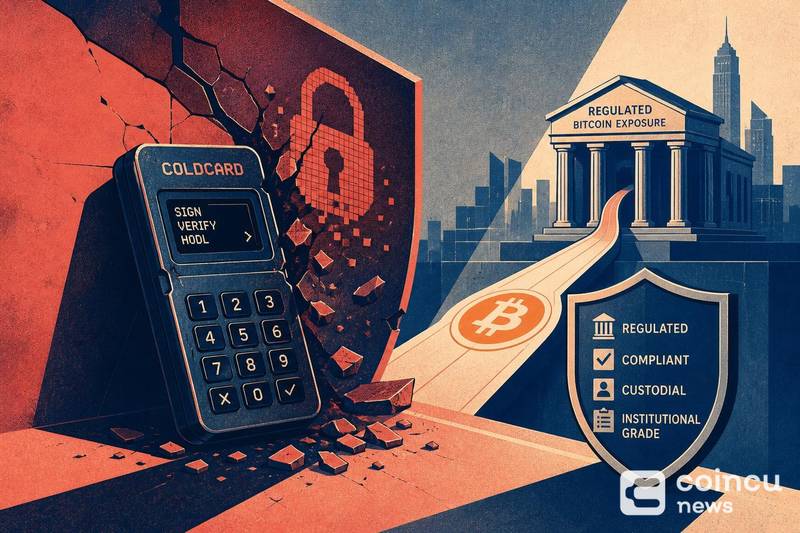

A newly disclosed Coldcard hardware wallet flaw is prompting analysts to argue that heightened self-custody anxiety could steer some investors toward regulated Bitcoin exposure, meaning supervised products such as spot ETFs, listed vehicles, and institutional custodians rather than direct control of private keys.
The concern stems from a weakness in Coldcard’s early firmware. Coinkite has published a seed-generation warning for the Coldcard Mk3, while Block’s engineering team detailed a predictable RNG fallback and 32-bit reseed issue in the firmware that can undermine how wallet seeds are generated.
The framing here is analyst interpretation, not a confirmed market outcome. The argument is that a security scare can shift product preference even when Bitcoin’s underlying thesis is unchanged, because the fear attaches to how coins are held, not to the asset itself.

What “regulated Bitcoin exposure” actually means
In this context, regulated Bitcoin exposure refers to investment access through supervised or listed products rather than direct wallet control. The distinction is between price exposure and direct coin ownership.
The categories investors most commonly associate with this route include spot Bitcoin ETFs, publicly listed Bitcoin-related vehicles, and institutional custodial platforms. Each delivers exposure to Bitcoin’s price while outsourcing key management to a regulated intermediary.
That tradeoff is the crux. Holding Bitcoin directly means controlling private keys and bearing the full weight of operational security, exactly the surface area exposed by the Coldcard Mk3 seed risk warning. A regulated wrapper removes that burden but replaces sovereignty with counterparty trust.
Why a wallet scare can redirect flows
Analysts see the potential demand effect arising from perceived self-custody risk. For newer entrants, hardware-wallet setup and seed management already represent a barrier, and a headline about a seed-generation flaw can harden that hesitation.
The appeal of regulated wrappers is trust and compliance: a familiar brokerage or fund structure feels safer to a retail buyer than managing a device. That convenience comes at the cost of self-sovereignty, the core property many Bitcoiners value most.
Fear narratives can accelerate onboarding into familiar financial products precisely because they lower the perceived complexity of participating. The reported scale of exposure, with potential losses tied to the Coldcard issue approaching nine figures, sharpens that psychology.
What it could mean for issuers, with caveats
If appetite for direct custody softens, regulated exposure products are the likely beneficiaries. The Coldcard disclosure points to a wallet-implementation problem, not a protocol flaw in Bitcoin, so the plausible consequence analysts are watching is demand reallocation rather than a repricing of the asset.
That would favor issuers with brand and compliance advantages. The effect, if it materializes, would likely be stronger among newer investors than among Bitcoin natives, who tend to view self-custody as non-negotiable.
Analyst expectations do not guarantee measurable flows. ETF demand is volatile in both directions, as shown when U.S. spot Bitcoin ETFs logged a second straight day of net outflows, and even established products face pressure, illustrated by the decision to shut down the Hashdex Bitcoin ETF after asset struggles.
FAQ: Does this change the case for self-custody?
Does the exploit undermine Bitcoin or just wallet confidence? The disclosed issue concerns firmware seed generation, per Coinkite and Block’s engineering write-up, not the Bitcoin protocol. It affects confidence in one wallet implementation.
Does regulated exposure remove all risk? No. It trades key-management and operational risk for counterparty and custodial risk, and product-level risk remains, as ETF outflows and closures show.
Who may still prefer self-custody? Investors who prioritize sovereignty and direct control are likely to keep holding their own keys, treating the disclosure as a firmware issue to patch rather than a reason to hand custody to an intermediary.
Disclaimer: This article is for informational purposes only and does not constitute financial or investment advice. Cryptocurrency and digital asset markets carry significant risk. Always do your own research before making decisions.