
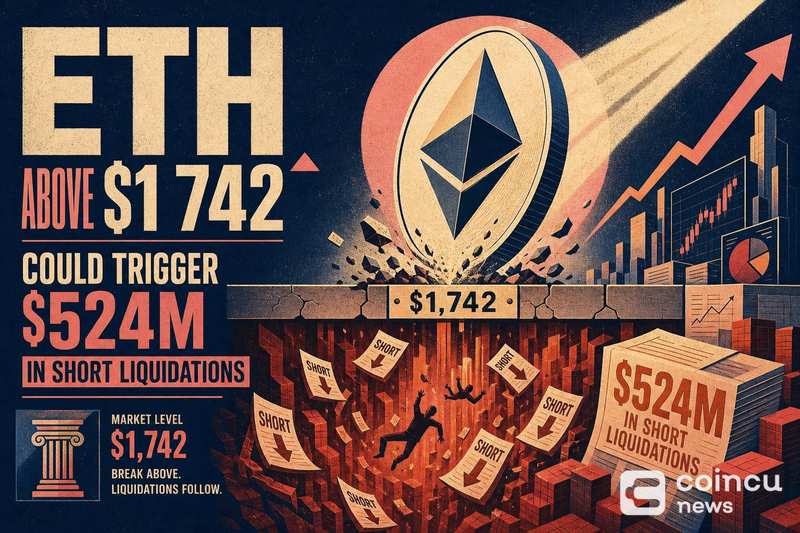
Ethereum could face a wave of forced short covering if its price rises above $1,742, with data indicating that cumulative short order liquidation intensity across mainstream centralized exchanges would reach $524 million at that level.
Why $1,742 Is the Critical ETH Liquidation Threshold
The $1,742 price level represents a concentrated liquidation zone for leveraged short positions on ETH. A “break through” in market terms means ETH would need to sustain price action above this level, not simply wick through it momentarily.
At that trigger, cumulative short liquidation intensity on major centralized exchanges would hit $524 million. This figure represents the aggregate value of short positions that would be forcibly closed as exchange risk engines execute margin calls against underwater bearish bets.

The data reflects positioning across multiple mainstream CEXs rather than a single venue, suggesting broad-based bearish leverage has accumulated just above current price levels.
How Concentrated Short Liquidations Can Accelerate ETH Upside
Short liquidation occurs when a trader holding a leveraged bearish position gets closed out by the exchange because the price has moved too far against them. The exchange automatically buys the asset to close the position, adding buying pressure to the market.
When hundreds of millions in short positions cluster near the same price zone, the forced buybacks from liquidations compound. Each liquidation adds buy pressure, pushing price higher and triggering more liquidations. This feedback loop is commonly called a short squeeze.
Liquidation cascades do not guarantee sustained price increases, however. A rapid spike driven by forced covering can reverse once the cluster is absorbed, particularly if no fresh spot demand follows. Recent network-wide liquidation events show that both longs and shorts have faced significant forced closures in recent sessions, underscoring the volatile environment around ETH.

Why Aggregated CEX Data Carries More Weight
The liquidation figure references mainstream CEXs collectively. A liquidation cluster on a single exchange could reflect idiosyncratic positioning by that platform’s user base, while aggregated data across multiple venues signals broader market-wide leverage exposure.
Cross-exchange positioning data gives a more reliable picture of where leveraged traders are concentrated. When multiple exchanges show short exposure clustering near the same level, it suggests that the $1,742 zone is a consensus resistance level that bearish traders are defending with leverage.
This type of aggregated derivatives signal is worth watching alongside spot market fundamentals. Similar dynamics play out across the crypto derivatives market; for instance, BTC’s 8-hour average funding rate recently standing at -0.0001% highlights how derivatives metrics across major assets can reveal shifts in trader sentiment before spot prices move.
What Traders Should Watch if ETH Tests $1,742
A brief wick above $1,742 and a sustained breakout are fundamentally different events. A wick may trigger some liquidations but often reverses quickly, leaving the broader cluster intact. A sustained break, where ETH holds above the level on multiple candle closes, is more likely to work through the full liquidation stack.
Immediate signals to monitor include trading volume at the level, the speed of price movement through the zone, and whether spot buying accompanies the derivatives-driven move. Heavily leveraged zones tend to coincide with sharper intraday volatility, meaning wider price swings in both directions become more likely as ETH approaches the threshold.
Funding rates after any liquidation event also matter. A sharp move higher driven purely by short covering, without a corresponding shift in funding rates or open interest rebuilding on the long side, would suggest the move lacks conviction beyond the mechanical squeeze. Broader market positioning, including large institutional holdings disclosures like those tracked by Michael Saylor, can also shift sentiment across the crypto market rapidly.
FAQ: ETH Short Liquidations at the $1,742 Level
What does “short liquidation intensity” mean?
Liquidation intensity measures the cumulative dollar value of leveraged short positions that would be forcibly closed at a given price level. It reflects the density of bearish bets clustered near that price, weighted by position size and leverage.
Would the full $524 million liquidate instantly?
Not necessarily. The cumulative exposure unfolds at slightly different prices depending on each trader’s entry point, leverage ratio, and margin balance. The process can play out over minutes to hours rather than in a single block.
Why do CEX liquidation clusters matter for ETH price action?
Centralized exchanges remain the primary venues for leveraged crypto trading. When a large concentration of short positions faces liquidation, the forced buying creates a mechanical price impulse independent of fundamental sentiment. This can amplify moves beyond what organic supply and demand would produce. Even seemingly unrelated asset classes, such as tokenized assets seeing surging on-chain volume, reflect the broader speculative appetite that influences how aggressively traders use leverage on platforms like these.
Disclaimer: This article is for informational purposes only and does not constitute financial or investment advice. Cryptocurrency and digital asset markets carry significant risk. Always do your own research before making decisions.

