
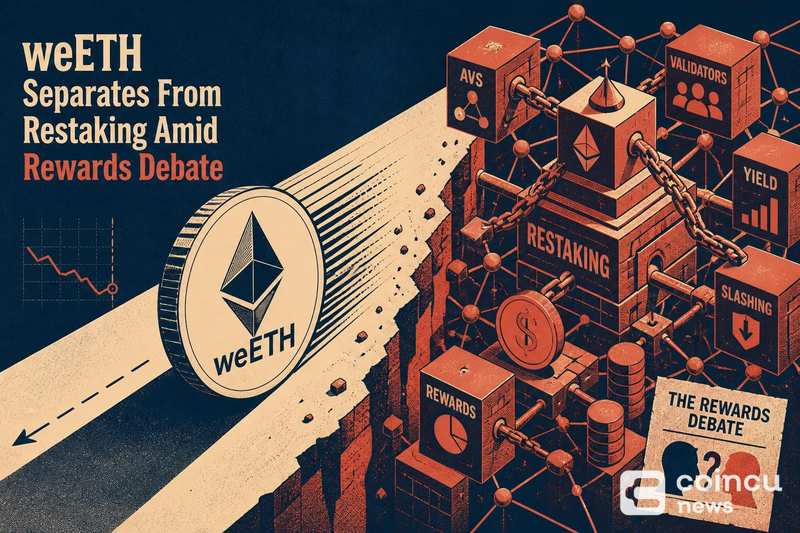

Ether.fi is moving to separate its weETH staking token from restaking, a change that repositions one of Ethereum’s larger liquid staking assets as reward design becomes the center of debate. The shift matters for holders who bought weETH expecting bundled staking and restaking exposure in a single token.
What changed for weETH
weETH is the wrapped, non-rebasing version of ether.fi’s staked ether position, a token that represents staked ETH and accrues rewards through its exchange rate rather than through balance changes, per ether.fi’s own documentation.
Separating weETH from restaking means the token’s core value is being framed around base Ethereum staking rather than the additional layer of restaking rewards that liquid restaking tokens were originally built to capture. In practice, that narrows what the token is designed to do.

Ether.fi signaled the direction of the change through its account on X, where the project addressed how weETH is positioned relative to restaking. The framing ties the token more closely to staking users who prioritize predictable, verifiable yield over experimental reward streams.
Why the rewards debate triggered the move
The catalyst is a dispute over how rewards should be structured, and whether restaking-linked incentives were delivering what holders expected. When the reward layer is uncertain, the case for bundling it into a widely held token weakens.
Ether.fi has publicly argued for weETH as a durable, core holding, laying out that reasoning in a post on its blog explaining why weETH is treated as a core holding. That positioning leans on staking fundamentals rather than the variable upside restaking can add.
The holders most affected are those who chose weETH specifically for combined staking-plus-restaking exposure. Separating the two changes the risk and reward profile they signed up for, which is why the debate extends beyond short-term sentiment.

How the separation affects holders and yield strategies
For current holders, the practical consequence is clarity: a token weighted toward plain staking exposure carries a different yield expectation than one that also routes restaking rewards. The trade is simpler risk for potentially narrower upside.
The distinction is straightforward. Plain staking exposure earns Ethereum’s base consensus rewards, while restaking exposure adds rewards, and additional risk, from securing external services on top of staked ETH. Separating weETH pushes it toward the former.
Users who specifically want restaking exposure will need to watch how ether.fi routes that layer going forward, since it may no longer be embedded in weETH by default.
What this means for the wider restaking narrative
One token-specific decision is not a sector verdict. But repositioning a prominent liquid staking token away from restaking, driven by a rewards dispute, reflects pressure on how restaking incentives are designed and communicated.
It also fits a cautious reading in which some Ethereum yield products drift toward simpler, more legible structures. Whether other issuers follow is not established by the available evidence, and should not be assumed.
FAQ
What is weETH? weETH is the wrapped, non-rebasing token representing staked ETH through ether.fi, with rewards reflected in its exchange rate, according to ether.fi’s help documentation.
What is the difference between staking and restaking? Staking secures Ethereum and earns base consensus rewards; restaking reuses staked ETH to secure additional services for extra rewards and extra risk.
Why are rewards being debated? The debate centers on whether restaking-linked reward design met holder expectations, which is the stated catalyst behind repositioning weETH.
Does separating from restaking change user risk or yield? It shifts the token toward base staking exposure, which generally means simpler risk and a yield profile tied to staking rather than added restaking rewards.
Disclaimer: This article is for informational purposes only and does not constitute financial or investment advice. Cryptocurrency and digital asset markets carry significant risk. Always do your own research before making decisions.