
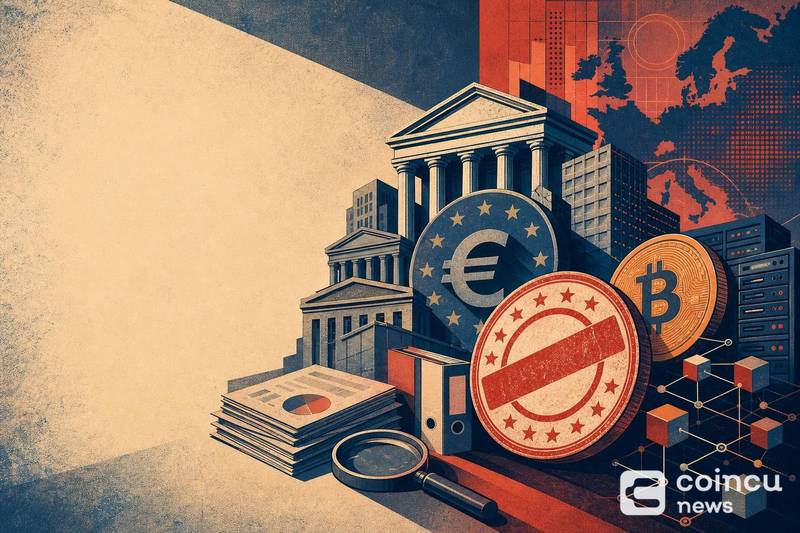

The European Union has moved to sanction more than 100 banks and crypto operators as part of its latest package targeting Russia, extending financial restrictions across both traditional banking and digital-asset infrastructure.
The measure was announced by the European Commission, which framed the action as part of its ongoing sanctions regime against Russia, according to the Commission’s own statement. The headline figure of over 100 entities is the core of the story because it spans two categories at once: conventional financial institutions and crypto-related operators.
That pairing matters. Rather than treating digital-asset firms as a separate enforcement track, the package places banks and crypto operators inside the same measure, signaling that the EU views cross-sector financial access as a single compliance problem, as reflected in the Council’s overview of the sanctions against Russia.

Why banks and crypto operators are grouped together
Banks and crypto operators intersect at the point of payment and settlement. Crypto firms typically rely on banking partners to convert fiat, hold reserves, and move funds, so a sanctions action that reaches both sides can close off the on- and off-ramps that connect the two systems.
Sanctions policy has increasingly extended to digital-asset businesses precisely because they can serve as an alternative channel when traditional banking access is restricted. The EU’s inclusion of crypto operators alongside banks fits a broader pattern of enforcement expanding across financial rails rather than staying confined to one sector.
This is not the first time regulators have pushed sanctions obligations onto crypto intermediaries. In a comparable move, the UK ordered crypto exchanges to report sanctions violations, and Russia’s own central bank has tightened controls by routing crypto investor verification through banks and brokers.
Immediate implications for exchanges and users
For crypto operators named in a sanctions action, the most direct consequences are access-related: banking partners may withdraw services, counterparties may pause dealings, and platforms may face pressure to restrict or delist affected entities.

Exchanges and trading platforms operating in the EU will need to screen against the updated designations. The practical effect is heavier due diligence on counterparties and, potentially, frozen access for any business or wallet tied to a listed entity, consistent with how the EU describes the mechanics of its restrictions in its explainer on the sanctions framework.
The action forms part of a wider EU package aimed at Russia, which broader reporting has described as targeting Russian financial and energy interests, as covered by Yahoo Finance. Coverage of the diplomatic context around the package has also been tracked in The Guardian’s live reporting.
What compliance teams and users should watch
Sanctions announcements usually evolve through follow-up guidance, platform notices, and enhanced due diligence. Screening obligations, asset freezes, and stricter onboarding checks are the likely near-term themes for firms with EU exposure.
The broader tightening of anti-money-laundering expectations reinforces this direction, with the FATF urging stronger crypto AML enforcement as illicit stablecoin activity rises. Users should watch for jurisdiction-specific compliance updates and platform announcements rather than assuming all exposure is direct or immediate.
Not every EU user or crypto firm is affected by default. The restrictions apply to designated entities and those transacting with them, so the first step for traders and businesses is verifying whether any counterparty appears on the updated EU list.
Disclaimer: This article is for informational purposes only and does not constitute financial or investment advice. Cryptocurrency and digital asset markets carry significant risk. Always do your own research before making decisions.