
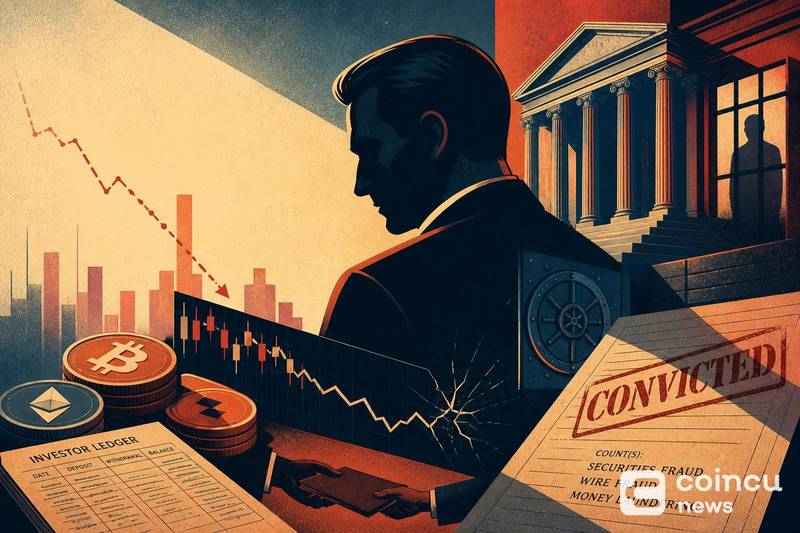

The founder of a cryptocurrency trading fund has been convicted of defrauding investors, a federal jury outcome that reinforces how U.S. prosecutors continue to pursue criminal charges against digital-asset fund operators who mislead the people who back them.
The conviction was announced by the U.S. Attorney’s Office for the Northern District of California, which framed the case as one centered on the founder of a cryptocurrency trading fund defrauding investors, according to the Department of Justice. The available record confirms the legal outcome, that a conviction was secured, while further procedural specifics beyond that outcome are not detailed in the material reviewed for this report.
A separate account of the matter, published as a report that a Block Bits founder was found guilty after a roughly $960,000 crypto bot pitch collapsed, appeared via Bitcoin.com News. That figure and the automated-trading framing come from a single secondary report and should be treated as unconfirmed against the primary announcement rather than as an established court finding.

What Is Confirmed and What Remains Unclear
What is confirmed is narrow: a founder tied to a cryptocurrency trading fund has been convicted in a matter involving investor fraud, per the Department of Justice announcement. A criminal conviction establishes that wrongdoing was proven to the applicable legal standard, distinct from any later sentencing, penalties, or restitution decisions, which are not documented in the material reviewed here.
What remains unclear from the primary source reviewed includes the sentencing date, the precise loss amount charged, and how any victim recovery would be handled. Parallel civil enforcement in fund-fraud matters is common, and a related SEC litigation release sits in the same enforcement landscape, though its direct connection to this specific conviction is not established in the evidence available.
Why the Conviction Matters for Crypto Investors
For investors, a criminal conviction in a crypto trading-fund case signals that enforcement bodies will treat misrepresentation to fund backers as prosecutable conduct, not merely a civil dispute. That enforcement posture is consistent with the broader regulatory push visible as the SEC has charged crypto platforms with fraud and unregistered-securities violations, underscoring that fund operators face scrutiny on both disclosure and conduct.
The case also arrives while regulators weigh how digital-asset offerings should be structured, an area where the SEC has prepared alternatives to standard securities registration for crypto projects. Clearer fundraising pathways do not lessen the obligation to disclose accurately, and this conviction illustrates the consequence when investor-facing claims diverge from reality.

Red Flags Investors Can Watch in Trading Funds
Because this matter falls squarely in scam-prevention territory, the more durable takeaway is diligence. The following patterns are general warning signs in cryptocurrency trading funds and are not specific findings from this case:
- Claims of unusually consistent or guaranteed returns that do not fluctuate with market conditions.
- Opaque custody, unexplained trading strategies, or reporting that cannot be independently verified.
- Pressure to invest quickly, restricted or delayed withdrawals, and vague risk disclosures.
- Absence of independent audits, unclear licensing, or no verifiable track record.
The concrete milestone worth watching next is any published sentencing outcome and whether civil or restitution proceedings accompany the criminal conviction, details that were not available in the Department of Justice announcement reviewed for this report.
Disclaimer: This article is for informational purposes only and does not constitute financial or investment advice. Cryptocurrency and digital asset markets carry significant risk. Always do your own research before making decisions.