
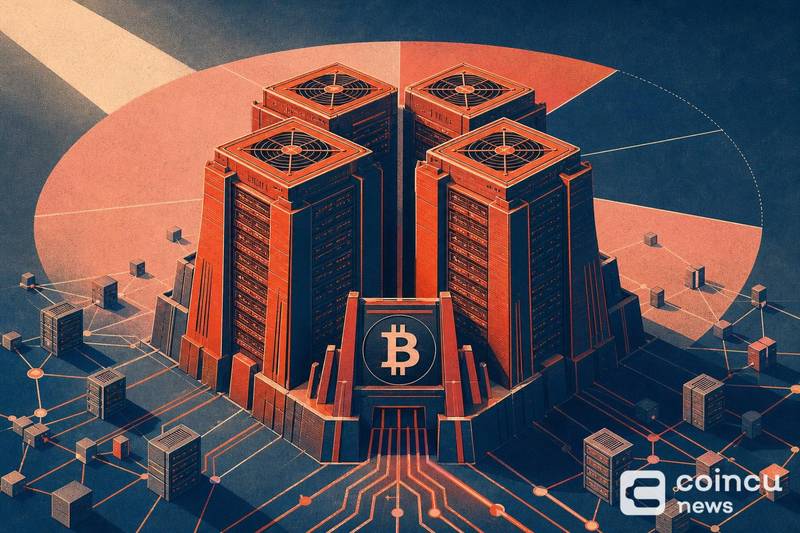

Data on Bitcoin mining pool distribution indicates that the four largest Bitcoin mining pools now control more than 70% of the network’s total hash rate, renewing long-running questions about how concentrated Bitcoin’s block production has become.
The concentration figure describes the combined share of aggregate network hash rate attributed to the top four pools, not the market position of four individual mining companies. Public pool-distribution dashboards such as mempool.space’s mining pools chart track this by grouping the blocks each pool has produced over a recent window and expressing that as a percentage of all blocks mined.
How hash-rate share is measured
Hash-rate share in practical reporting is inferred from blocks found, not from direct measurement of every machine on the network. Because block discovery is probabilistic, these figures are rolling estimates over a defined lookback period and can shift between snapshots.

What sits behind the top-four figure
The headline claim depends entirely on the combined share of the leading pools rather than any single operator. Pool concentration of this kind can exist even when no individual pool alone holds a majority of hash rate, a distinction detailed in independent research on Bitcoin mining centralization.
That research also stresses a key qualifier: the entity that operates a pool is not the same as the many independent miners who point their hardware at it. A pool’s share on a dashboard reflects coordination of block templates, not ownership of the underlying machines.
Why a 70%+ share raises decentralization questions
Bitcoin’s security model is strongest when hash power is spread across many independent actors. When a handful of pools coordinate a large majority of block production, it introduces governance, censorship-resistance, and coordination concerns that exist well below the widely cited 51% attack threshold.
Structural risk versus proven behavior
Concentration is a structural risk indicator, not evidence of malicious activity. The mining-centralization analysis frames the concern as one of capability and coordination rather than any demonstrated attack, and the miners behind a pool can redirect their hash power if an operator behaves against their interests.
What the trend means for miners and users
Pool concentration influences where miners choose to direct hash power, since operators compete on fees, payout schemes, and reliability. If dominance becomes a larger concern, miners retain the option to migrate toward smaller pools, which is one of the network’s built-in correction mechanisms.
For users and investors, decentralization metrics often serve as a proxy for network resilience, and a concentrated pool landscape tends to resurface as a recurring narrative in Bitcoin coverage. That narrative sits alongside broader debates about the asset, including why some institutions still resist Bitcoin allocation and how the market reacts when Bitcoin’s price comes under pressure.
Any concentration reading is a snapshot. Because these shares are derived from a rolling window of blocks, the picture can look different from one measurement period to the next.
FAQ about Bitcoin mining pool concentration
Does this mean Bitcoin is centralized?
Not directly. The figure describes coordination of block production among a few pools; it does not mean four entities own the hardware or control the protocol, which is enforced by nodes and users independently.
Can miners switch pools quickly?
Yes. Individual miners can redirect their hardware to a different pool at will, which is why pool shares can change and why pool dominance is not equivalent to permanent control.
Are mining pools the same as public mining companies?
No. A mining pool aggregates hash power from many participants, while a public mining company is one operator that may run its own machines and may also contribute to one or more pools.
Disclaimer: This article is for informational purposes only and does not constitute financial or investment advice. Cryptocurrency and digital asset markets carry significant risk. Always do your own research before making decisions.