
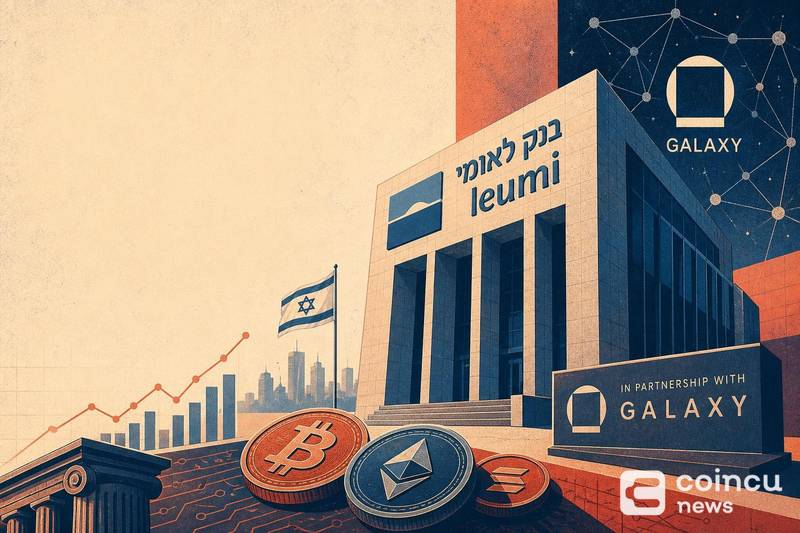

Bank Leumi, Israel’s largest bank, plans to offer crypto trading with Galaxy, becoming the first bank in the country to give customers direct access to buy, hold, and sell digital assets through its own banking interface, with the service expected to launch in early 2027.
The two companies announced the partnership on August 14, 2026, a move that would make Bank Leumi the first bank in Israel to offer digital asset trading services directly to customers, according to Galaxy’s newsroom.
Rather than routing users to a standalone exchange, the offering will live inside Leumi Trade, the bank’s capital markets application. Galaxy will supply the trading and custody infrastructure behind the front end, positioning the deal as a regulated finance rollout instead of a generic crypto tie-up.

Leumi and PEPPER customers are slated to trade Bitcoin, Ether, and Solana once the service goes live, the companies said in their distributed release. This is a similar three-asset launch scope to the one described in coverage of how Israel’s largest bank tapped Galaxy for Bitcoin, Ether and Solana trading.
Maya Ravia, an executive tied to the partnership, said the goal is to provide customers with simple, secure, and regulated access to trading digital assets.
How the Bank-Galaxy Crypto Trading Model Could Work
The structure splits into two layers: Bank Leumi owns the customer-facing experience through Leumi Trade, while Galaxy runs the execution and safekeeping in the background. Customers would interact with a familiar banking app rather than open an account on an offshore venue.
On the backend, the bank plans to use GalaxyOne Institutional for trading services and Galaxy’s custody infrastructure, formerly known as GK8, to hold and secure the assets, CoinDesk reported.

That division places the compliance, order routing, and custody responsibilities on institutional-grade rails while keeping identity, onboarding, and the user interface within the bank’s regulated perimeter. Final product mechanics, however, depend on the official rollout, and several operational details remain undisclosed.
Why This Matters for Crypto Adoption in Israel
A domestic bank of Leumi’s scale embedding crypto trading into its main app lowers the friction for mainstream users who have avoided standalone exchanges. Access delivered through a licensed bank typically carries stronger trust and compliance framing than an offshore platform.
Being the first bank in Israel to offer this kind of service also sets a competitive marker. If the launch succeeds, other Israeli financial institutions face pressure to match bank-linked digital asset access rather than cede the segment.
The convergence of traditional finance and crypto is the through-line here: the same customers who hold checking accounts and securities in Leumi Trade would gain a regulated path into Bitcoin, Ether, and Solana without leaving the bank’s environment.
The Market Backdrop When the Deal Landed
The announcement arrived during a cautious session rather than a euphoric one. Bitcoin traded at $62,984, down slightly over 24 hours, with Ether at $1,875.71 and Solana at $75.10, all three modestly lower on the day.
Total crypto market capitalization stood near $2.25 trillion with Bitcoin dominance around 56.2%, signaling that capital remained concentrated in the largest asset even as adoption headlines built.
Sentiment reinforced the risk-off tone. The Fear and Greed Index registered 29, in Fear territory, underscoring that the partnership headline landed in a guarded market rather than a rally, unlike periods when broader macro shocks such as US-Iran tensions sent crypto sliding.
What Users and the Market Should Watch Next
The clearest near-term marker is timing: the service is expected to become available in early 2027, leaving a multi-month window before customers can trade. Eligibility is framed around Leumi and PEPPER customers, though full onboarding criteria have not been detailed.
Supported assets are confirmed as Bitcoin, Ether, and Solana at launch, a narrower list than many exchanges. Notably, commercial terms, customer fees, limits, and custody specifics were not disclosed in the announcement, so those remain open questions worth tracking as the rollout nears.
The sources reviewed also did not include a separate Israeli regulatory approval document or fee schedule, meaning the “regulated access” framing rests on the bank’s existing licensing and Galaxy’s infrastructure rather than a newly published rulebook. Broader institutional listings momentum, such as Coinbase adding new assets for spot trading, offers context for how quickly access is expanding across the sector.
FAQ
What bank is offering the service? Bank Leumi, Israel’s largest bank, which is partnering with Galaxy to become the first bank in the country to offer digital asset trading directly to customers.
What is Galaxy’s role? Galaxy provides the backend infrastructure, using GalaxyOne Institutional for trading services and its custody infrastructure, formerly GK8, to support the bank’s digital asset operations.
Will customers buy crypto directly through the bank? Yes. Leumi and PEPPER customers are expected to buy, hold, and sell Bitcoin, Ether, and Solana inside the Leumi Trade capital markets application rather than through a separate exchange account.
Why is this significant for Israel’s crypto market? It would mark the first time a bank in Israel offers regulated, bank-integrated crypto trading, potentially lowering barriers for mainstream users and pressuring rival institutions to follow.
Disclaimer: This article is for informational purposes only and does not constitute financial or investment advice. Cryptocurrency and digital asset markets carry significant risk. Always do your own research before making decisions.

