
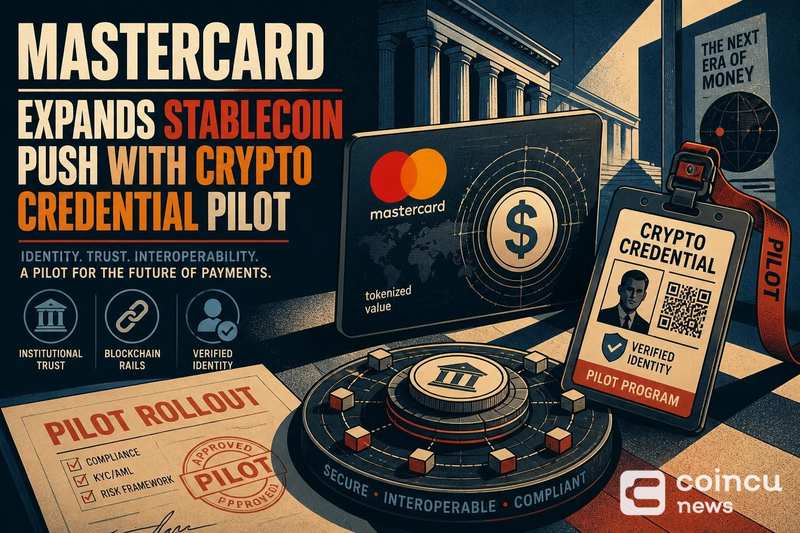

Mastercard is deepening its stablecoin push, tying the effort to its Crypto Credential system as the payments network moves to bring regulated digital-dollar activity into its rails. The Mastercard stablecoin push builds on a run of initiatives the card giant has rolled out over the past two years, framing the work as a pilot-stage expansion rather than a completed global rollout.
The direction is consistent with capabilities Mastercard began detailing in 2025, when it unveiled end-to-end tools to power stablecoin transactions spanning wallets through checkout. That announcement positioned the company to support stablecoin activity across the full payment flow, not just at a single point in the chain.
Crypto Credential is the identity and trust layer underpinning that ambition. Mastercard first described the system as a way of bringing more trust to blockchain transactions, using verified credentials so participants can transact with greater confidence about who is on the other side.

What the Crypto Credential Pilot Is Meant to Do
In practical terms, Crypto Credential replaces long, error-prone wallet addresses with verified identifiers and checks that both sides of a transaction meet defined standards before value moves. That verification layer is designed to reduce friction and cut the risk of funds being sent to the wrong or non-compliant destination.
For stablecoins, that trust layer is the connective tissue. A credential that confirms identity and compliance can make dollar-pegged tokens more usable inside regulated payment channels, which is the gap Mastercard’s broader stablecoin tooling is aiming to close.
The company has not published exact technical specifications, jurisdictions, or counterparties for every element of the current pilot, and this article does not assume them. The confirmed thread is the pairing of stablecoin capability with Crypto Credential’s verification model.
Why Mastercard’s Stablecoin Move Matters for Payments
Mastercard is one of the world’s largest card networks, so its participation carries institutional signal weight for stablecoin adoption. When an incumbent of that scale invests in stablecoin rails, it lends credibility to the underlying infrastructure for merchants, wallets, and exchanges evaluating whether to build on it.
The practical stakes are settlement speed, reach, and operational trust. Mastercard’s stablecoin work has extended into cross-border flows through a tie-up with Borderless.xyz, which the firms framed as advancing trusted cross-border stablecoin payment flows.
That collaboration reinforces a pattern of pairing traditional network reach with crypto-native settlement, a pattern echoed in Mastercard’s stablecoin payments partnership with OKX and its move to build out an on-chain settlement network for round-the-clock stablecoin fund settlement.
How This Fits Into the Broader Stablecoin Competition
The phrase “expands stablecoin push” reflects an already-running trajectory rather than a standing start. Mastercard has been layering credential, settlement, and cross-border pieces onto a strategy that other payment networks and crypto-native firms are pursuing in parallel.
Traditional-finance participation is often read as a marker of infrastructure maturity, and Mastercard is not alone among incumbents. Circle has named Visa, Mastercard, and BlackRock as validators for its Arc launch, underlining how established institutions are moving closer to stablecoin infrastructure.
The details of the cross-border effort were also documented by PYMNTS, which reported on the Mastercard and Borderless.xyz collaboration on cross-border stablecoin payments.
FAQ About Mastercard’s Crypto Credential Stablecoin Pilot
What is Mastercard Crypto Credential? It is Mastercard’s system for verifying identities and compliance standards in blockchain transactions, designed to bring more trust to on-chain payments.
Why is Mastercard using it for stablecoins? The credential layer adds identity and compliance checks that can make stablecoin transactions safer to route through regulated payment channels.
Is this a full rollout? No. The current effort is described as a pilot-stage expansion of Mastercard’s existing stablecoin strategy, not a completed global launch.
Disclaimer: This article is for informational purposes only and does not constitute financial or investment advice. Cryptocurrency and digital asset markets carry significant risk. Always do your own research before making decisions.

