
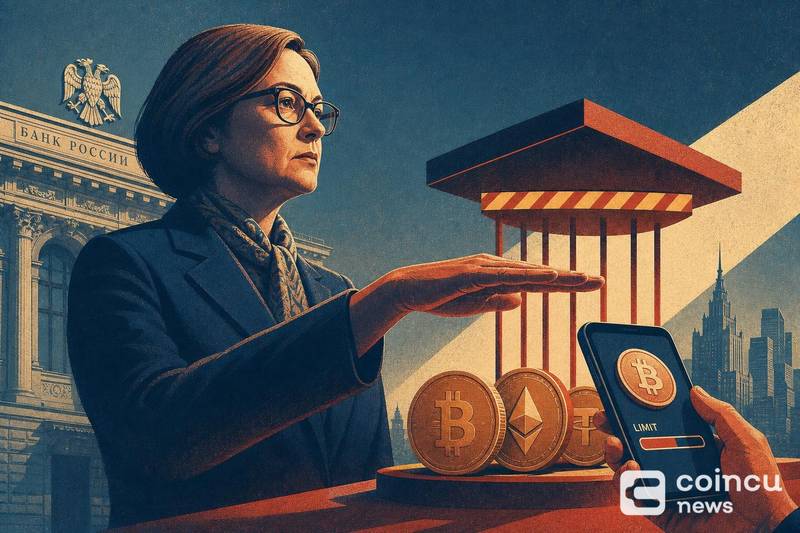

Russia’s central bank governor has said that proposed crypto purchase caps for non-qualified investors are designed to protect them, framing the limits as an investor-safety measure rather than a broad ban. The Russian crypto purchase caps for non-qualified investors would restrict how much digital assets less experienced retail buyers can acquire.
The comments center on a differentiated-access framework that treats sophisticated and retail participants differently. The Bank of Russia has positioned the caps as a way to limit retail exposure to a volatile asset class rather than to prohibit ownership outright.
The measure targets non-qualified investors specifically, not the entire market. That distinction is central to how the policy is being presented, and it mirrors the bank’s earlier push to identify investor categories through financial intermediaries, as seen in its move to verify crypto investors via banks and brokers.

Who non-qualified investors are and how the caps would affect them
Defining the affected group
Non-qualified investors are generally retail participants who do not meet the wealth, income, or experience thresholds that classify someone as a qualified or accredited investor. They make up the largest share of everyday buyers.
The practical impact
A purchase cap would limit how much crypto this group can buy rather than block access completely. The governor’s framing describes a restriction on buying capacity, not a full prohibition, though the exact thresholds have not been detailed in the available materials.
Why the central bank frames the move as investor protection
The investor-protection argument
The stated rationale is protecting investors from the risks tied to a highly volatile and complex asset class. Limiting the size of retail positions is presented as a way to contain potential losses for buyers who may not fully understand the products.
The approach reflects a difference between restricting access and rejecting the market. Russia has continued to advance digital-asset infrastructure elsewhere, including its plan to bring the digital ruble to a 2026 rollout, even as it tightens retail crypto exposure.

What this could mean for Russia’s crypto market in the near term
Because the caps focus on non-qualified investors, the most direct effect would fall on retail demand and on how trading platforms onboard those users. A differentiated-access model points to tighter controls rather than a universal ban.
Policy signals from a central bank can shape sentiment before detailed rules are published. The direction is consistent with other recent tightening, such as Russia’s planned 2026 crypto mining restrictions in Moscow and other areas. Exact implementation details of the purchase caps are not provided in the available reporting.
Coverage of Russia’s evolving retail crypto framework has also referenced legislative caps on retail purchases, according to Russian state media.
FAQ
What are crypto purchase caps?
They are limits on how much cryptocurrency a defined class of investors is permitted to buy. In this case, the caps would apply to non-qualified investors as an investor-protection measure.
Who counts as a non-qualified investor?
Broadly, retail buyers who do not meet the wealth, income, or experience criteria used to classify qualified investors. Specific legal thresholds are not detailed in the available materials.
Why does the Russian central bank support the measure?
The central bank’s governor has said the caps aim to protect investors, tying the limits to the volatility and complexity of crypto rather than to a rejection of the market itself.
Disclaimer: This article is for informational purposes only and does not constitute financial or investment advice. Cryptocurrency and digital asset markets carry significant risk. Always do your own research before making decisions.