
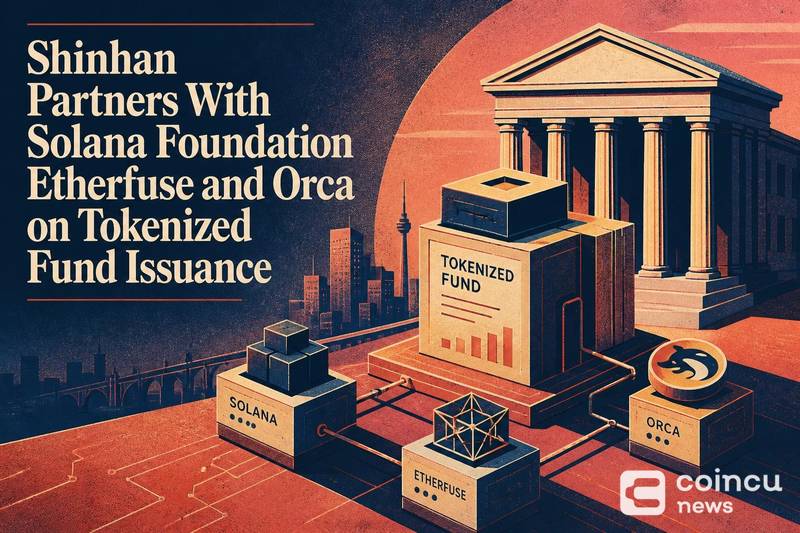

Shinhan has entered a four-way partnership with the Solana Foundation, Etherfuse and Orca to test tokenized fund issuance, marking another institutional use case built around Solana infrastructure in South Korea.
The collaboration brings together a major Korean asset manager and three Solana-native participants around the issuance of tokenized funds, according to reporting on the four-way pact. The agreement is structured as a pilot to test tokenized instruments rather than a fully launched product.
The reporting frames the effort around testing a tokenized won, positioning the arrangement within regulated finance rather than a purely crypto-native launch. No fund size or firm launch date has been confirmed in the available disclosures.

Why Solana sits at the center of the issuance
The Solana Foundation is named directly as a partner, placing the pilot inside Solana’s broader real-world asset narrative. The network has been positioned as infrastructure for institutional real-world assets, which is the category tokenized funds fall under.
Tokenized fund issuance requires a blockchain layer to record ownership, settle transfers and support on-chain distribution. Choosing Solana as that base layer is what ties this Korean institutional pilot to the wider tokenization trend, without any specific throughput or fee metric being claimed here.
What Etherfuse and Orca add to the framework
Etherfuse and Orca are listed alongside the Solana Foundation as direct participants in the same announcement. Their inclusion signals that the pilot spans issuance tooling and on-chain market infrastructure rather than a single vendor relationship.
Orca operates as a decentralized exchange on Solana, and the project publicly referenced the collaboration on its official account. Beyond that acknowledgment, the specific division of responsibilities between issuance, tooling and liquidity has not been detailed in the available sources, so those roles should be read as context rather than confirmed mandates.

Why a bank-linked pilot matters for Asian tokenization
Shinhan is the institutional anchor in the arrangement, and a bank-affiliated asset manager testing tokenized funds carries more regulatory weight than a crypto-native issuer. Tokenized fund issuance points to a regulated finance use case, which is where much of the recent institutional interest has concentrated.
The move sits alongside other regulated tokenization efforts, including the way Securitize tied a tokenized fund to a major fixed-income platform. It also fits a pattern of Korean institutions engaging blockchain rails, echoing earlier moves such as Daesung Private Equity’s tokenization-adjacent fund and the regulatory scrutiny seen when Korean authorities pressed banks on virtual asset partners.
Separate reporting has also linked Shinhan Asset Management to a tokenized fund pilot with Plume, indicating the manager is exploring multiple tokenization tracks in parallel. No regional-first or regulatory-breakthrough claim is supported by the current evidence.
FAQ
What was announced? Shinhan signed a four-way pact with the Solana Foundation, Etherfuse and Orca to test tokenized fund issuance.
Why is Solana involved? The Solana Foundation is a direct partner, and the network is being used as the blockchain layer for the tokenized instruments.
What does tokenized fund issuance mean? It is the process of representing fund ownership as blockchain tokens, allowing units to be recorded and transferred on-chain.
Why do Orca and Etherfuse matter? Both are named Solana participants in the pilot, contributing on-chain market and issuance infrastructure to the collaboration.
Disclaimer: This article is for informational purposes only and does not constitute financial or investment advice. Cryptocurrency and digital asset markets carry significant risk. Always do your own research before making decisions.

