
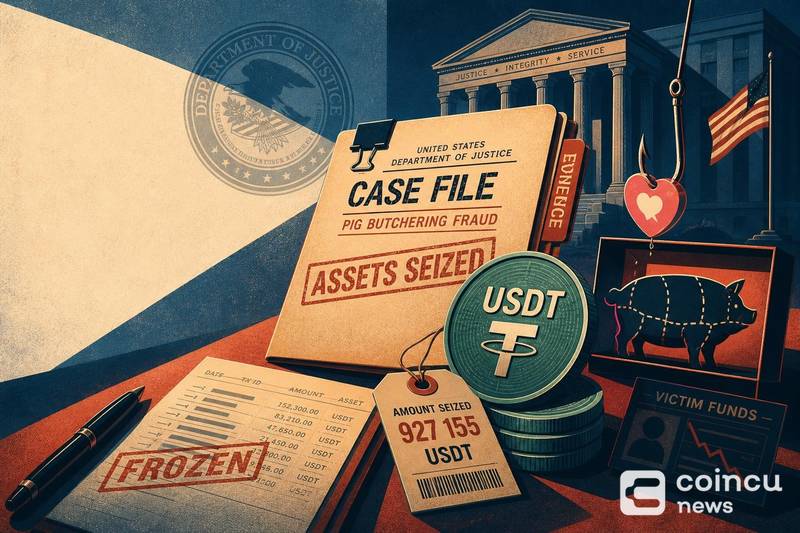

The US Department of Justice has secured a default judgment to seize 927,155 USDT tied to a pig-butchering cryptocurrency fraud scheme, a civil forfeiture outcome that converts traced stablecoin proceeds into a completed legal recovery rather than a temporary wallet freeze.
What the Default Judgment Actually Seized
The action targets a fixed pool of Tether’s dollar-pegged stablecoin, USDT, rather than a volatile asset whose recovery value shifts with the market. Because the claimants named in the forfeiture action did not appear to contest it, the government took title by default judgment, the same civil route the DOJ used when it filed a forfeiture complaint against funds it identified as involved in cryptocurrency fraud.
Beyond the seized amount and the legal posture, further case specifics could not be independently verified at press time.

How Pig-Butchering Fraud Framed the Case
Pig-butchering fraud refers to long-running social-engineering scams in which perpetrators build trust with a victim over weeks or months, then steer them into fake crypto investment platforms before draining the deposited funds. The seized stablecoin is characterized as proceeds of that scheme, not ordinary market activity, which is why the case falls under fraud enforcement.
The pattern echoes prior DOJ recoveries in the same category, including a case where the department seized crypto tied to a transnational fraud network and a separate action against a global investment fraud operation.
Why the Default Judgment Detail Matters
Tracing, freezing, and legally seizing are three distinct stages: investigators first follow funds on-chain, prosecutors then restrain the assets, and only a judgment transfers ownership to the government. A default judgment marks that final stage, signaling the enforcement action has cleared the court rather than remaining an open investigation.
Legal finality is what distinguishes a recovery narrative from an arrest headline, because uncontested seized assets can move toward victim restitution once title is settled. Task-force efforts of this kind have pushed cumulative crypto-fraud recoveries higher, as reflected in reporting that US authorities have seen total recoveries top $800 million.

What It Signals for Stablecoin Traceability
USDT’s transparency on public ledgers is precisely what enables this kind of seizure: unlike cash, stablecoin transfers leave a permanent, auditable trail that investigators can follow across chains, a dynamic visible in the on-chain supply data tracked on the stablecoin dashboard. That traceability does not imply stablecoin usage is broadly suspect; the vast majority of USDT volume is legitimate, and enforcement targets identified fraud proceeds specifically.
For holders and builders, the case reinforces that placing scam proceeds into a widely monitored stablecoin does not insulate them from recovery. The next concrete milestone to watch is whether the seized funds are earmarked for victim restitution, the typical downstream step once a default judgment is entered.
FAQ
What is pig-butchering crypto fraud?
A confidence scam in which fraudsters cultivate a relationship with a victim, then lure them into fraudulent crypto investment platforms and steal the deposits.
Why did the DOJ seize the USDT?
The government identified the stablecoin as proceeds of the pig-butchering scheme and forfeited it through a civil action.
What does a default judgment mean?
It is a court ruling entered when the opposing party fails to contest the case, letting the government take legal title to the assets.
Can USDT transactions be traced and recovered?
Yes. Because USDT settles on public blockchains, transfers are permanently recorded, which allows investigators to trace and, after judgment, seize them.
Disclaimer: This article is for informational purposes only and does not constitute financial or investment advice. Cryptocurrency and digital asset markets carry significant risk. Always do your own research before making decisions.