
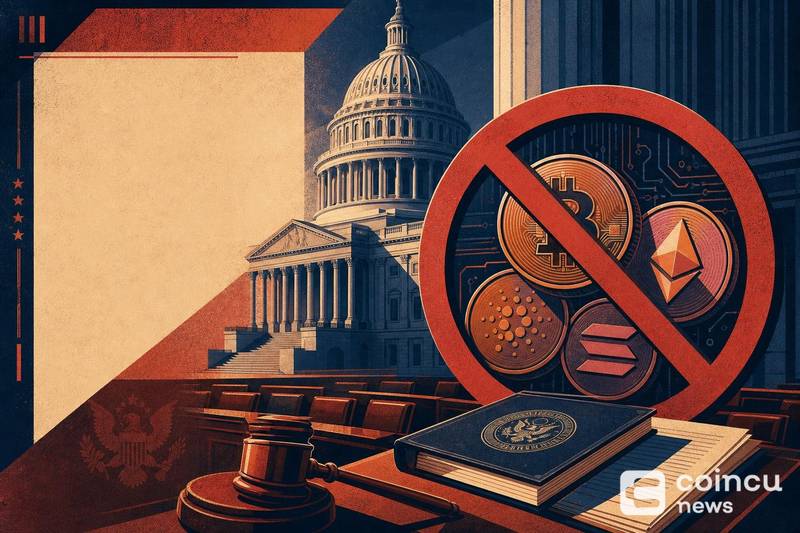

A U.S. Senate bill would bar the president, vice president, members of Congress, and other senior federal officials from issuing, endorsing, or profiting from digital assets while in office, targeting what its backers describe as crypto-related conflicts of interest in government.
The measure was introduced in the Senate as S. 1668, framing the restriction around officeholders issuing digital assets rather than a blanket ban on crypto ownership. At this stage, the confirmed detail is the restriction itself; the bill is positioned as a government-ethics measure applied to the digital asset space.
Sponsors led by Senator Jeff Merkley and Senator Chuck Schumer presented the effort as an attempt to end crypto corruption by elected officials, according to their office. Senator Mark Kelly and colleagues separately described the legislation as an effort to stop crypto profiteering by government officials.

Which officials and activities could be covered
The proposal explicitly names the president and other federal officials. The exact list of covered officeholders, and how far down the federal hierarchy the restriction reaches, would be defined by the bill text itself.
The phrase “other federal officials” remains a scope question until the statutory definitions are confirmed. How the bill defines “issuing digital assets,” including whether endorsements, licensing, or family-linked ventures are captured, is likely to be central once the full text is parsed.
This is not the first ethics-focused restriction aimed at officeholders and crypto-adjacent markets. Lawmakers have advanced a separate effort to ban the president and members of Congress from prediction markets, signaling a broader push to wall off senior officials from emerging financial products.
Why lawmakers may want to block officials from issuing digital assets
A restriction targeting senior public officials points to conflict-of-interest concerns, where an officeholder could benefit financially from an asset whose value they may influence through policy. The framing centers on official conduct rather than ordinary crypto ownership.

The stated goal is to reduce the appearance of self-dealing and protect public trust. Public Citizen has separately renewed calls for investigations into crypto corruption, reflecting outside pressure aligned with the bill’s ethics rationale.
What this could mean for crypto regulation and political ethics
The measure sits at the intersection of digital asset policy and federal ethics rules. It concerns how officials conduct themselves, not a prohibition on the digital asset industry as a whole.
The bill also carries a signaling effect for future federal crypto oversight debates, which have already drawn heavy industry engagement around market structure legislation and reviews such as the CLARITY Act’s stance on federal crypto bailouts. Enforcement mechanisms, penalties, and implementation timelines are not detailed in the available materials and remain open questions.
FAQ about the Senate bill and digital asset restrictions
What would the bill ban? It would bar the president and other federal officials from issuing digital assets while in office, according to the sponsors’ descriptions of the legislation.
Who does it target? The president and other senior federal officials. The precise list of covered officeholders depends on the bill’s definitions.
Does it affect the broader crypto market or only officials? As described, it addresses the conduct of federal officials rather than imposing a general ban on digital assets.
What is still unknown? Enforcement, penalties, and the full definition of “issuing digital assets” are not confirmed in the currently available materials.
Disclaimer: This article is for informational purposes only and does not constitute financial or investment advice. Cryptocurrency and digital asset markets carry significant risk. Always do your own research before making decisions.