
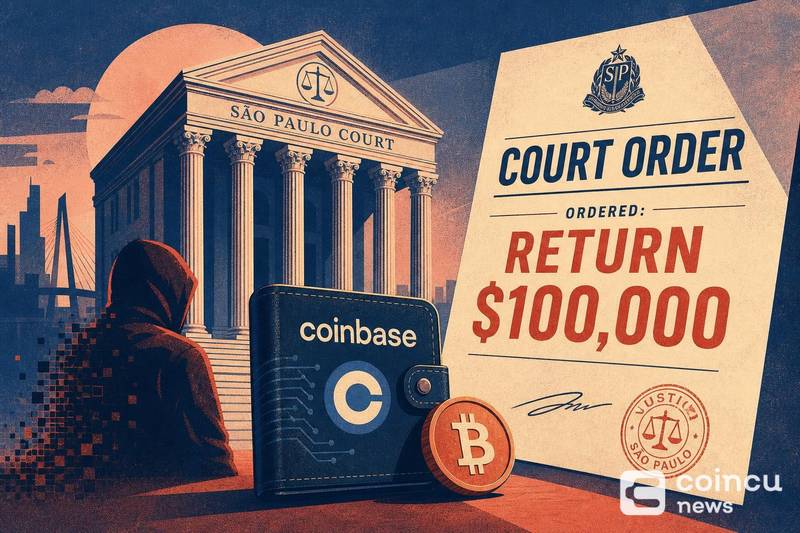

A São Paulo state court has ordered Coinbase to return nearly $100,000 to users who lost funds in a self-hosted wallet theft, rejecting the exchange’s argument that it bore no responsibility for assets held outside its custody.
What the São Paulo Court Ordered
The ruling, handed down by a court in Brazil’s São Paulo state, requires Coinbase to reimburse approximately R$500,000 (roughly $100,000) to affected users. The court found that the exchange’s defense based on the concept of self-custody did not absolve it of liability in this case, according to Brazilian legal outlet Estrato.
The decision is notable because it directly addresses a core tension in crypto: whether exchanges can disclaim responsibility once users move assets to wallets the exchange does not control.

How the Self-Hosted Wallet Theft Triggered a Lawsuit
The case arose after users reported losing funds through a theft involving self-hosted wallets. A self-hosted (or self-custodial) wallet is one where the user holds private keys independently, without an exchange or third party managing access.
Coinbase argued that because the stolen funds were in wallets outside its custodial infrastructure, it should not be held liable. The court disagreed, concluding that the platform still carried obligations to the affected users under applicable consumer protection rules.
Brazil’s consumer protection framework, known as the Código de Defesa do Consumidor (CDC), broadly defines supplier liability and has been applied to digital service providers in previous disputes. The court’s reasoning appears to rest on this framework, treating the relationship between Coinbase and its users as a consumer service relationship regardless of where the assets were ultimately stored.
What This Could Mean for Coinbase Users
The ruling raises questions about how exchanges may be held accountable for losses that occur after users transfer funds to external wallets. For users who rely on platforms like Coinbase as their primary gateway to crypto, the decision suggests that the boundary between exchange responsibility and user responsibility may not be as clear-cut as platforms claim.
However, a single state-level court ruling in Brazil does not automatically set a binding precedent for other jurisdictions or even for higher Brazilian courts. The decision could be appealed, and its long-term impact remains uncertain. Users tracking how exchanges handle liability disputes, including cases involving large wallet withdrawals from major platforms, should view this as one data point rather than a settled legal standard.
Why This Case Matters for Crypto Liability in Brazil
Brazil is one of Latin America’s largest crypto markets, and its courts have increasingly been asked to resolve disputes between users and digital asset platforms. The São Paulo ruling adds to a growing body of Brazilian case law that applies traditional consumer protection principles to crypto services.
The decision is significant because it rejects a defense that many exchanges rely on globally: that self-custody means the user alone bears all risk. If this reasoning holds in higher courts or is adopted by other Brazilian judges, it could reshape how exchanges operating in Brazil structure their liability disclosures and user agreements.
The case also arrives amid broader global conversations about exchange accountability. Regulatory clarity around institutional approvals for crypto service providers continues to evolve in multiple jurisdictions, and court rulings like this one in São Paulo contribute to the patchwork of rules that govern how platforms interact with retail users.
FAQ
What is a self-hosted wallet?
A self-hosted wallet, also called a self-custodial wallet, is a crypto wallet where the user controls the private keys directly. Unlike an exchange-hosted wallet, no third party manages or has access to the funds. This gives users full control but also full responsibility for security.
Why did the court order Coinbase to return the funds?
The São Paulo court found that Coinbase’s relationship with users constituted a consumer service relationship under Brazilian law. Even though the stolen funds were in self-hosted wallets, the court concluded that the exchange’s obligations to users were not extinguished by the transfer of assets to external custody.
Does this ruling create a broader precedent for exchange liability?
Not automatically. The ruling comes from a state-level court in São Paulo and applies under Brazilian consumer protection law. It does not bind courts in other countries or even necessarily in other Brazilian states. However, it signals a judicial willingness to hold exchanges accountable beyond the boundaries of their own custodial systems, which could influence future cases in Brazil and attract attention from regulators elsewhere.
Disclaimer: This article is for informational purposes only and does not constitute financial or investment advice. Cryptocurrency and digital asset markets carry significant risk. Always do your own research before making decisions.

