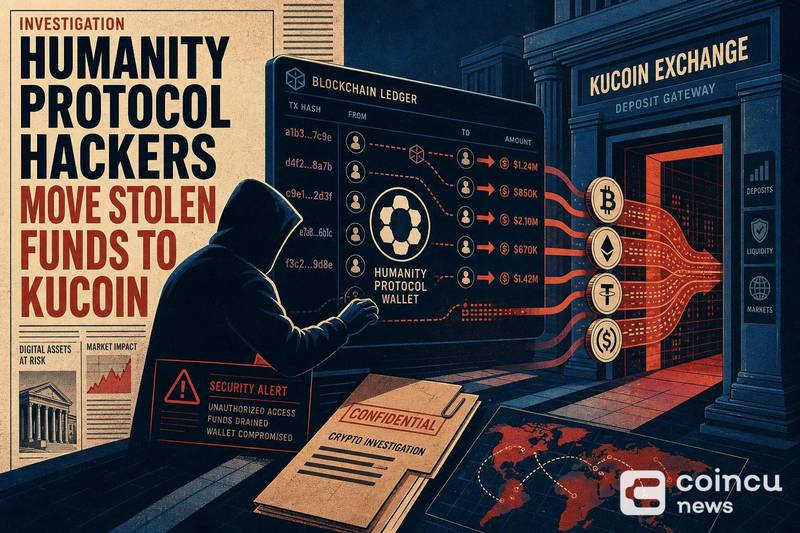

Humanity Protocol’s public claim portal at claim.humanity.org and its Notion-based H-Token incident update establish that the project is handling an active incident, while the narrower allegation carried by the brief’s linked Beosin post is that attackers converted part of the stolen funds into USDC and deposited that tranche to KuCoin; the amount moved, the transaction trail, and any exchange response are not established in the supplied evidence.
The usable evidence supports only a narrow version of the story
Humanity Protocol has, at minimum, published a public claim portal and an H-Token Incident Update, which is the clearest official confirmation in the brief that the team is responding to a token incident. Neither official page, as captured in the research artifact, gives a moved amount, attacker identity, or recovery figure.
Within that limited record, the reported post-exploit route comes from Beosin’s X post: part of the stolen funds was converted into USDC and deposited to KuCoin. Because the brief contains no block-explorer URL, this draft cannot independently present wallet addresses, transaction hashes, or a precise transfer timestamp.

The USDC leg changes the transfer medium, not the proven outcome
The USDC leg matters because the evidence set names a stablecoin rather than leaving the asset path undefined. Based on the route described in the Beosin post, the narrow conclusion is that the reported movement shifted into a liquid dollar-pegged asset, but that does not by itself prove a final cash-out, a completed laundering cycle, or the end state of the funds.
That distinction is why the post-KuCoin step matters more than broad market commentary. A centralized venue can become a compliance checkpoint, the same reason custody controls and service-provider licensing matter in Coincu’s recent coverage of Conio Obtains MiCAR CASP License for Digital Asset Custody Services and Conio Obtains MiCAR Crypto-Asset Service Provider License, but neither the claim portal nor the incident update says whether any freeze request or recovery action has followed.
The KuCoin mention is material because it is the clearest monitoring point
The reported KuCoin deposit is the most consequential checkpoint in the brief because it places the alleged trail at a centralized exchange rather than only across self-custody wallets. Even so, the official claim page and the Notion incident update do not establish whether the exchange acted on the deposit or whether more of the stolen funds moved afterward.
What the brief does establish is the reporting gap that follows that exchange leg. Without an explorer entry or a direct KuCoin statement, readers are left with an incident narrative rather than a verifiable settlement trail, which is why adjacent Coincu coverage such as Venus Protocol Launches Tokenized Stock Lending on BNB Chain is useful only as context for how quickly liquid on-chain instruments can move between venues, not as confirmation of what happened in this case beyond the route described in the Beosin post.

The next concrete trigger is an updated H-Token Incident Update, an amended notice on claim.humanity.org, or a public statement from KuCoin that adds addresses, timestamps, or recovery actions. Until one of those specific sources adds that detail, the evidence in the brief supports only a narrower publication line: Humanity Protocol is responding to an incident, and part of the stolen funds was reportedly moved into USDC and then to KuCoin.
Disclaimer: This article is for informational purposes only and does not constitute financial or investment advice. Cryptocurrency and digital asset markets carry significant risk. Always do your own research before making decisions.