
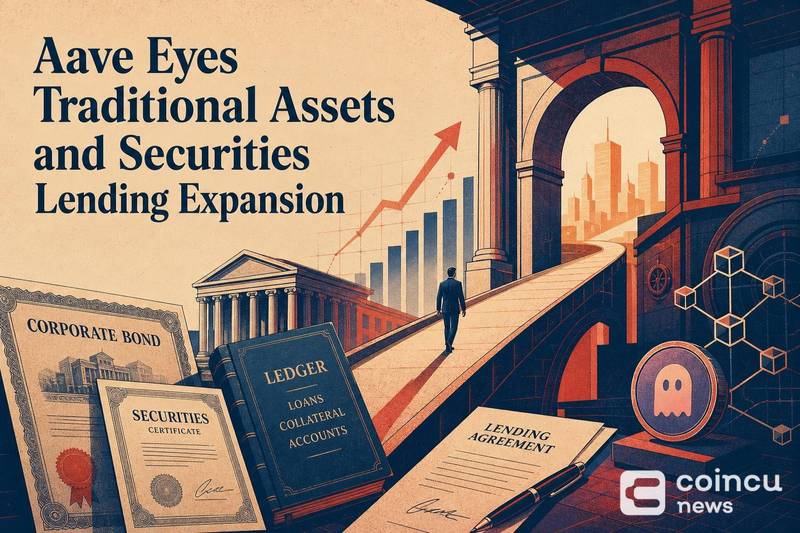

Aave, the largest decentralized lending protocol by total value locked, has signaled plans to expand beyond crypto-native assets into traditional finance territory, including securities lending. The move, centered on a product called Horizon, positions the protocol to compete for institutional capital by bridging DeFi infrastructure with tokenized real-world assets.
The initiative was outlined in an official blog post describing Horizon as built for institutions, marking one of the clearest signals yet that Aave’s leadership views traditional asset markets as core to the protocol’s next phase of growth.
What Aave Is Signaling With Horizon
Horizon represents Aave’s institutional-facing product line, designed to bring traditional financial assets onto DeFi rails. The product targets regulated entities and institutional participants who require compliance frameworks that differ from Aave’s permissionless lending pools.

The distinction matters. Aave’s existing protocol allows anyone to supply or borrow crypto assets without intermediaries. Horizon, by contrast, appears designed with gatekeeping mechanisms that could satisfy regulatory requirements around know-your-customer and anti-money-laundering standards.
This is a plan-stage signal rather than a fully launched product suite. Aave has not disclosed a complete list of supported traditional assets, specific launch timelines, or detailed partnership arrangements for custody and compliance infrastructure.
Why Traditional Assets Fit Aave’s Direction
For a lending protocol, expanding collateral types directly expands the addressable market. Traditional assets, including tokenized bonds, equities, and money market instruments, represent trillions of dollars in value that currently sit outside DeFi’s reach.
Aave’s core lending architecture, which matches suppliers and borrowers through algorithmic interest rate models, is conceptually transferable to tokenized versions of traditional instruments. The protocol already manages multi-asset lending pools across multiple blockchain networks.

The broader DeFi sector has seen growing interest in real-world asset tokenization. Aave’s move aligns with this trend, as Aave founder Stani Kulechov has previously emphasized the protocol’s resilience and capacity to handle large-scale capital flows.
The U.S. Securities and Exchange Commission has also weighed in on the tokenized securities space. A statement from the SEC’s Division of Corporation Finance on tokenized securities addressed how existing securities laws apply to blockchain-based representations of traditional financial instruments, signaling regulatory attention to this emerging market.
How Securities Lending Could Work on Aave
Securities lending is a well-established mechanism in traditional finance. In its simplest form, one party temporarily lends securities to another, typically in exchange for collateral and a fee. Banks, hedge funds, and asset managers use it to generate yield, facilitate short selling, and improve market liquidity.
Aave’s existing model already mirrors this structure in crypto markets. Users deposit assets into lending pools, borrowers post collateral to access those assets, and interest rates adjust based on supply and demand. Extending this to tokenized securities would be a conceptually aligned step.
The practical challenges, however, are significant. Securities lending involves counterparty risk management, regulatory reporting obligations, and custody requirements that differ substantially from holding crypto tokens in smart contracts. Any Aave product touching securities would likely need to integrate with licensed custodians and comply with jurisdiction-specific regulations.
Settlement mechanics present another layer of complexity. Traditional securities lending involves T+1 or T+2 settlement cycles, corporate action processing, and dividend or coupon handling, none of which exist in Aave’s current smart contract infrastructure.
Market Implications and Execution Risks
If Aave successfully bridges DeFi lending with traditional asset markets, the protocol could attract a new class of institutional users who have so far remained on the sidelines of decentralized finance. Institutional participation could deepen liquidity, stabilize borrowing rates, and increase protocol revenue.
The competitive landscape is also shifting. Several DeFi protocols and centralized platforms are pursuing tokenized asset strategies. Aave’s brand recognition and existing infrastructure give it an advantage, but the protocol’s positioning relative to competitors will depend on execution speed and regulatory clarity.
Regulatory risk remains the most significant obstacle. Products that touch securities, even tokenized versions, fall under the jurisdiction of securities regulators in most major markets. The SEC’s existing guidance on tokenized securities suggests that compliance obligations carry over regardless of the underlying technology.
Operational risk is equally important. Smart contract vulnerabilities, oracle failures, or liquidation mechanism errors in a system handling tokenized securities could expose Aave to legal liability beyond what the protocol faces with crypto-only markets. Past events, such as liquidation incidents involving Aave loans, illustrate the operational complexity inherent in DeFi lending.
Reputational considerations also apply. If a securities-linked product fails or faces enforcement action, the fallout could affect confidence in Aave’s core crypto lending business, which currently operates independently of traditional finance constraints.
FAQ: Key Questions About Aave’s Push Into Traditional Assets
What does “traditional assets” mean in this context?
Traditional assets refers to financial instruments that originate outside the crypto ecosystem, including government bonds, corporate debt, equities, and money market funds. In Aave’s case, these would likely be tokenized representations of such instruments, brought on-chain through partnerships with issuers or custodians.
Is securities lending already live on Aave?
No. Aave’s Horizon initiative signals an intention to move into this area, but securities lending is not currently available on any Aave deployment. The product appears to be in a planning or early development phase, with no confirmed launch date publicly available.
What could this mean for existing Aave users?
For current Aave users, the immediate impact is minimal. Horizon appears to target institutional participants through a separate product track rather than modifying the existing permissionless lending pools. Over time, however, institutional liquidity flowing into the Aave ecosystem could improve borrowing conditions and expand the range of available assets across all Aave markets.
How does this relate to the broader DeFi sector?
Aave’s move reflects a wider trend among DeFi protocols seeking to capture value from traditional finance markets through tokenization. If successful, it could accelerate institutional adoption of DeFi infrastructure and encourage other protocols to pursue similar strategies. The outcome will depend heavily on how regulators respond to large-scale capital movements between DeFi and centralized platforms as the lines between these systems continue to blur.
Disclaimer: This article is for informational purposes only and does not constitute financial or investment advice. Cryptocurrency and digital asset markets carry significant risk. Always do your own research before making decisions.