
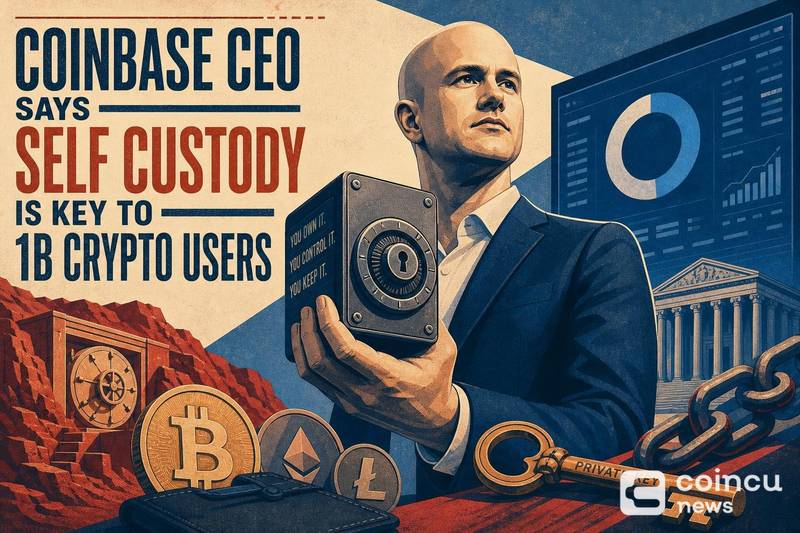
Coinbase CEO Brian Armstrong said self-custody is the only way for crypto to reach more than 1 billion users, arguing that direct user control of assets, not custodial access, is the path to mass adoption.
Armstrong made the claim in a post on X, framing self-custody as the decisive factor for scaling crypto beyond the 1 billion user threshold. The statement is his opinion on how the industry should grow, not a demonstrated outcome.
The remark carries weight because it comes from the head of one of the largest crypto exchanges, a company whose business has historically been built around custodial services. Armstrong has recently steered public attention toward Coinbase’s other priorities, including a shift on Base toward payments and transactions.

Why self-custody is framed as the path to mass adoption
Self-custody means users hold their own private keys and control their assets directly, rather than trusting a third party to hold funds on their behalf. Coinbase distinguishes its self-custody product, Coinbase Wallet, from its custodial exchange accounts, where the company holds the keys.
The difference between the two is central to Armstrong’s argument. Coinbase’s own support material explains that with the main exchange the platform manages your crypto, while a self-custody wallet gives you sole control, as detailed in its help documentation.
Positioning direct ownership as a growth driver ties adoption to a core crypto value proposition: users owning and moving assets without a gatekeeper. Reaching more than 1 billion users on that basis implies infrastructure and trust operating at global scale.
What could slow the self-custody path
The absolutist framing of self-custody as the “only way” invites obvious counterpoints. For mainstream, non-technical users, managing private keys and seed phrases remains a significant hurdle.

Onboarding friction and the responsibility of key management are the practical barriers. If a user loses their keys, there is no customer support line to recover funds, a risk that custodial products are designed to remove.
Coinbase itself has tried to address this usability gap. Its smart wallet effort aims to simplify onboarding by removing seed phrases and app downloads, according to the company’s product announcement.
What it could mean for exchanges and wallets
Because Armstrong leads a major exchange, the statement reads as more than personal opinion; it signals how a large custodial business publicly frames its own future. Coinbase has been vocal on broader industry direction, including its support for clearer U.S. crypto rules.
For wallet and exchange strategy, the comment suggests self-custody products may be framed as the front door to adoption rather than a niche feature. Whether that translates into a real shift in how platforms position themselves remains an open question, not a confirmed change.
FAQ
What is self-custody in crypto? Self-custody means a user holds their own private keys and controls their assets directly, without a third party such as an exchange holding the funds on their behalf.
Why did the Coinbase CEO connect self-custody to 1 billion users? Armstrong argues that direct user control of assets is the only way crypto can scale past 1 billion users, treating ownership as the foundation for mass adoption.
Does this mean custodial platforms are no longer relevant? No. The statement is an opinion about the path to scale, and custodial services, including Coinbase’s own exchange, continue to operate alongside self-custody wallets.
Disclaimer: This article is for informational purposes only and does not constitute financial or investment advice. Cryptocurrency and digital asset markets carry significant risk. Always do your own research before making decisions.

