
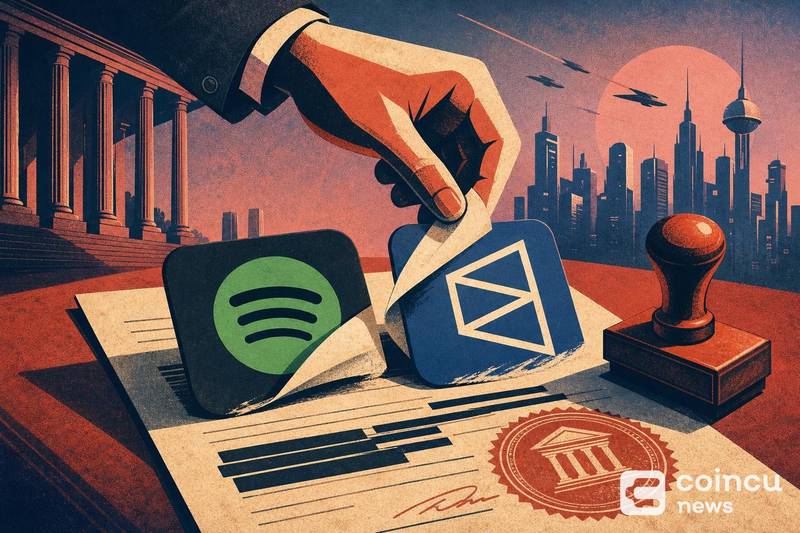

Spotify has asked prediction market platforms Kalshi and Polymarket to remove its brand logos from their interfaces, as a streaming-manipulation incident raises questions about how related prediction markets should settle.
The request marks an unusual collision between the music streaming industry and the fast-growing prediction market sector, where contracts tied to Spotify streaming data have attracted trader interest on both regulated and decentralized platforms.
Spotify’s logo-removal request and the market controversy
Spotify’s objection centers on the use of its brand imagery by Kalshi and Polymarket on market listings tied to streaming performance. Kalshi, a CFTC-regulated prediction market, has offered contracts based on daily global Spotify song rankings, while Polymarket has hosted similar streaming-related prediction contracts.

The dispute is not a partnership update or licensing negotiation. Spotify is pushing back against the visual association its logo creates on these platforms, particularly as a streaming-manipulation incident has drawn scrutiny to how these markets operate.
According to reporting by Wired, the incident involves suspicious streaming activity that appears connected to prediction market positions, creating a feedback loop where traders may have artificially inflated streams to influence market outcomes.
How streaming manipulation complicates market settlement
Prediction markets settle based on verifiable, objective outcomes. When the underlying event, in this case streaming performance on Spotify, is subject to manipulation, the integrity of the settlement process comes into question.
The core problem is straightforward: if streams used to determine a market’s outcome were artificially inflated, the settlement data itself may be unreliable. Traders who placed positions based on organic streaming trends face potential losses driven not by genuine music consumption but by coordinated manipulation.
Music Business Worldwide reported that Spotify slashed streams of a hit song after identifying suspicious activity linked to Kalshi prediction market contracts. This stream adjustment directly affects which side of a prediction market contract wins, creating uncertainty for traders who had already placed bets based on pre-adjustment figures.
For platforms like Kalshi that operate under CFTC oversight, ambiguity in settlement criteria introduces regulatory and operational risk. If the data source (Spotify) retroactively adjusts the numbers that determine contract outcomes, the platform must decide whether to settle on original figures, adjusted figures, or void the market entirely.
Why logo usage creates reputational and compliance pressure
Spotify’s logo-removal request goes beyond a routine trademark enforcement action. Displaying a company’s brand marks on a prediction market listing can imply endorsement, data-sharing agreements, or official partnership where none exists.
For users browsing Kalshi or Polymarket, seeing Spotify’s recognizable green logo next to a market contract could reasonably suggest that Spotify has sanctioned or cooperates with these listings. In the context of a manipulation scandal, that implied association becomes a reputational liability for Spotify.
There is an important distinction between referencing a public company in a prediction market description and prominently displaying its trademarked logos. The former is standard practice in event markets; the latter crosses into brand usage territory that companies routinely police.
The logo dispute also adds compliance pressure on the prediction market platforms themselves. If a major brand publicly objects to its imagery being used on a market that is simultaneously under scrutiny for manipulation, the platform faces questions about its listing standards and brand-usage policies. This type of scrutiny is relevant to the broader fintech regulatory landscape that continues to evolve across jurisdictions.
What traders and observers should watch next
The most immediate question is how Kalshi and Polymarket will handle settlement for affected contracts. Whether they settle on Spotify’s adjusted stream counts, original counts, or cancel markets altogether will set a precedent for how prediction platforms deal with manipulated underlying data.
Traders holding open positions on Spotify-related contracts should monitor both platforms for official settlement guidance. Any delay or dispute in resolution timing could affect liquidity and pricing on adjacent markets as well.
Interface changes are another signal to watch. If Kalshi and Polymarket comply with Spotify’s logo-removal request, it may indicate a broader reassessment of how these platforms present third-party brand assets across all their market listings, not just Spotify-related ones.
The incident also raises questions about whether streaming platforms will begin restricting API access or public data availability if that data is being used to create prediction markets susceptible to manipulation. Such a move could affect the viability of entertainment-related prediction contracts more broadly, similar to how trading platforms have adapted their product offerings in response to changing market conditions.
FAQ on Spotify, Kalshi, Polymarket, and the settlement dispute
Did Spotify object to just the logos or to the prediction markets themselves?
Spotify’s publicly reported request specifically targeted the use of its brand logos on Kalshi and Polymarket. Whether Spotify has also formally objected to the existence of the markets themselves has not been confirmed.
Why is settlement affected by the streaming-manipulation incident?
Prediction markets settle based on verifiable outcomes. When Spotify adjusted stream counts after identifying suspicious activity, the data that determines which side of a contract wins changed retroactively, creating a dispute over which figures should govern settlement.
What should traders watch before considering resolution final?
Traders should look for official settlement announcements from Kalshi and Polymarket specifying which data source and which version of stream counts will be used. Until both platforms publish final resolution criteria for affected contracts, outcomes remain uncertain.
Disclaimer: This article is for informational purposes only and does not constitute financial or investment advice. Cryptocurrency and digital asset markets carry significant risk. Always do your own research before making decisions.