
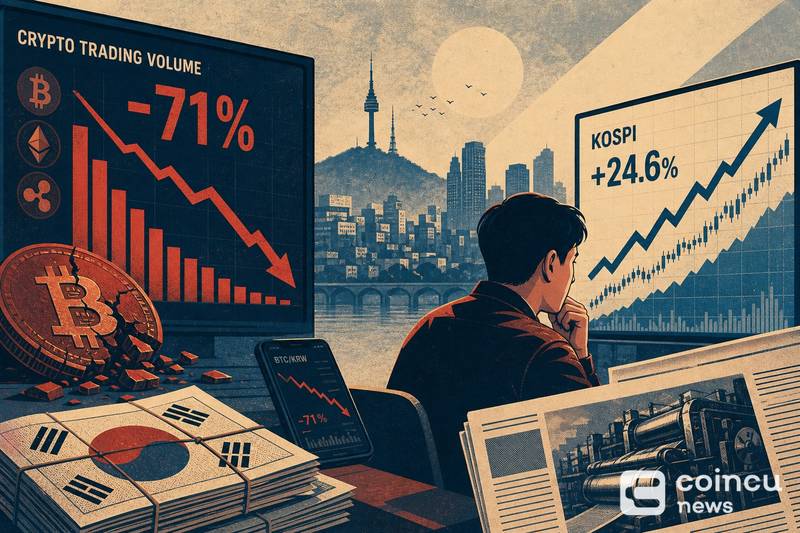
South Korea’s five major cryptocurrency exchanges saw average monthly trading volume plunge 34% in June 2025 to 3.17 trillion won ($2.3 billion), with activity collapsing 71% from January levels as retail investors rotated capital into a surging domestic stock market, The Korea Times reported.
South Korea’s Crypto Trading Slump Was Sharpest in June
The Korea Times published the findings on July 11, 2025, citing data showing that trading volume across the country’s five major exchanges, including Upbit and Bithumb, fell to 3.17 trillion won in June.
That 34% month-over-month decline was steep on its own, but the longer-term trajectory was more striking. June volume was 71% lower than what the same exchanges processed in January 2025, when speculative interest was still elevated.

The decline was not confined to a single platform. The Korea Times framed the drawdown as a market-wide trend affecting all five major domestic exchanges, suggesting the drop reflected a broad change in retail behavior rather than a platform-specific issue.
Why South Korean Retail Traders Shifted From Crypto to Stocks
The Korea Times attributed the weakening crypto turnover to strengthening domestic stock-market performance. The KOSPI and other Korean equity benchmarks drew renewed retail interest, pulling risk capital away from digital asset exchanges.
This is a rotation story, not an exit story. South Korean retail traders have historically been among the most active crypto participants globally, and the data suggests they moved to what they saw as better short-term opportunities in equities rather than abandoning risk assets entirely.
Hong Sung-wook, commenting on the broader trend, said that “the sharp drop in domestic cryptocurrency holdings appears to have been driven by both capital flowing into the strong local stock market and declines in crypto prices.” The remark, reported by The Korea Times in a May 2026 follow-up, reinforced that the rotation had both push and pull factors.

Korea JoongAng Daily corroborated the pattern with its own data. Cumulative trading volume on the five major exchanges totaled $222.8 billion from January through March 2026, down 56.8% from $515.46 billion in the same period a year earlier.
By April 2026, monthly volume had fallen to $55.1 billion, the lowest since September 2023 and 85% below December’s $368.4 billion. The sustained nature of this decline underscores that June 2025 was not a one-off dip but the start of a multi-quarter downtrend.
Why Weak Korean Volumes Matter Even If Bitcoin Stays Firm
The June 2025 volume collapse happened while Bitcoin remained resilient globally. That disconnect, muted Korean participation against a backdrop of broader crypto market stability, highlights a structural shift in where retail liquidity originates.
South Korea has long punched above its weight in crypto trading. The so-called “Kimchi premium,” where Korean exchange prices traded above global benchmarks, became a widely watched indicator of retail euphoria. When Korean volumes dry up, the global market loses a historically important source of speculative demand.
For exchanges like Upbit and Bithumb, which derive revenue primarily from trading fees, falling volume translates directly into earnings pressure. The competitive environment for exchanges is shifting on multiple fronts, as stablecoin regulation continues to develop globally, with U.S. senators pushing Treasury to preserve state-level oversight in the GENIUS Bill.
The Korea Times follow-up from May 2026 added further context: domestic investors’ crypto holdings fell to 60.6 trillion won at the end of February 2026, down from 121.8 trillion won at the end of January 2025. Average daily trading volume dropped from 17.1 trillion won in December 2025 to around 4.5 trillion won by the end of February 2026.
These are not marginal declines. A 50% drop in holdings and a 74% drop in daily volume over roughly a year signal a meaningful reallocation of household capital away from crypto.
What Traders Should Watch Next in South Korea’s Crypto Market
Several concrete catalysts could determine whether Korean crypto volumes stabilize or continue falling. Tougher anti-money laundering rules are due in August 2026, adding compliance costs for exchanges already under revenue pressure.
A proposed 22% crypto tax planned for 2027 is generating intense debate. If implemented without exemptions, it could further dampen retail appetite. The tax debate intersects with broader questions about how South Korea classifies digital assets; cryptocurrencies are still not legally recognized as eligible underlying assets for ETFs under Korea’s Financial Investment Services and Capital Markets Act, limiting institutional participation.
According to a single source cited by The Korea Times, Matrixport said the sharp decline in South Korean crypto trading volume reflected fading retail interest and a need for a new catalyst to reignite participation. Whether that catalyst comes from regulatory clarity, a shift in relative equity-to-crypto returns, or innovation from high-throughput blockchain networks remains an open question.
Regulatory developments elsewhere could also reshape the landscape. Ongoing debate over stablecoin oversight frameworks in the United States may set precedents that influence how South Korean regulators approach digital asset classification and exchange licensing.
Monthly volume prints from the five major exchanges will be the clearest near-term barometer. If volumes fail to recover through the second half of 2026, it would confirm that the June 2025 drop was the beginning of a structural shift in Korean retail behavior, not a cyclical pause.
FAQ About South Korea’s Crypto Trading Decline
Why is crypto trading falling in South Korea?
The primary driver is a rotation of retail capital from crypto into the domestic stock market. The KOSPI and other Korean equity benchmarks strengthened, drawing risk-seeking investors who had previously favored crypto exchanges. Declining crypto prices also reduced the appeal of digital asset trading.
How much did trading volume drop in June 2025?
Average monthly trading volume across South Korea’s five major crypto exchanges fell 34% month over month to 3.17 trillion won (approximately $2.3 billion). Compared to January 2025, the drop was 71%.
Does lower Korean trading activity mean crypto demand is weakening globally?
Not necessarily. Bitcoin maintained its price level globally even as Korean volumes collapsed. The decline reflects a country-specific capital rotation rather than a worldwide retreat from digital assets. However, South Korea’s outsized historical role in crypto trading means its reduced participation removes an important source of retail liquidity from the broader market.
Disclaimer: This article is for informational purposes only and does not constitute financial or investment advice. Cryptocurrency and digital asset markets carry significant risk. Always do your own research before making decisions.

