Senators Urge Treasury to Preserve State Stablecoin Oversight in GENIUS Bill
A bipartisan group of U.S. senators is pressing the Treasury Department to ensure that state-level regulatory authority over stablecoins is preserved as the GENIUS Act moves toward implementation, reigniting the debate over how federal and state oversight should coexist in the rapidly expanding digital asset market.
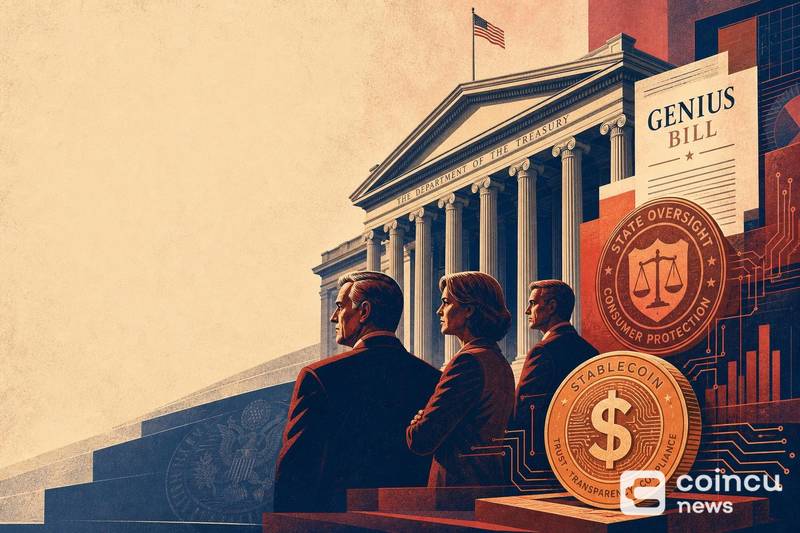
The senators’ request centers on a specific jurisdictional question: whether state regulators, who have historically supervised money transmitters and payment instruments, should retain meaningful oversight of stablecoin issuers even as the federal government establishes a new national framework through the GENIUS Act.
The GENIUS Act, formally known as the Guiding and Establishing National Innovation for U.S. Stablecoins Act, creates a federal licensing and supervisory structure for stablecoin issuers. The law was signed into effect as Public Law 119-27, establishing reserve requirements and consumer protection standards at the national level.
At issue is whether Treasury’s rulemaking process will interpret the law in a way that effectively preempts state regulators or, alternatively, preserves a dual-track system where states continue to license and supervise issuers operating within their borders.
Why state-level authority remains a flash point in stablecoin oversight
State-level stablecoin regulatory authority refers to the power of individual state financial regulators to license, examine, and enforce rules against companies that issue or transmit stablecoins. States like New York, through its BitLicense regime, and others through money transmitter licensing, have built compliance infrastructure over the past decade.
The concern among senators pushing for preservation of state authority is that a purely federal framework could sideline regulators who are closest to local consumers and who have developed specialized expertise in digital asset oversight. The Conference of State Bank Supervisors has been actively engaged in the GENIUS Act implementation discussion, advocating for a continued state role.
For stablecoin issuers, the distinction matters directly. A federal-only regime could simplify compliance by creating a single set of rules. A dual system, while more complex, could offer issuers flexibility in choosing their regulatory pathway and give smaller, state-chartered institutions a viable path to market entry.
Bipartisan pressure signals institutional weight behind the issue
The bipartisan nature of the senators’ request is significant. Regulatory debates in Congress frequently split along party lines, with one side favoring federal uniformity and the other defending state prerogatives. When lawmakers from both parties jointly urge an executive agency to take a specific interpretive position, it carries additional weight in the rulemaking process.
The Treasury Department’s engagement with the GENIUS Act’s implementation has drawn attention from multiple stakeholders, including state regulators, industry participants, and members of Congress. The public comment process has attracted substantial input on the question of federal versus state jurisdiction.
The senators’ letter addresses Treasury directly because the department holds significant discretion in how it writes the implementing regulations. Legislative text often leaves room for interpretation, and the allocation of authority between federal and state regulators is one of the areas where Treasury’s choices will shape the practical outcome of the law.
Compliance implications for stablecoin issuers
If Treasury preserves state-level authority, stablecoin issuers would likely need to maintain compliance programs that satisfy both federal standards under the GENIUS Act and any additional state-level requirements. This dual compliance burden is familiar to traditional financial institutions, which routinely navigate overlapping federal and state banking regulations.
The outcome matters particularly for companies operating across multiple states. Issuers already managing state money transmitter licenses, such as those facilitating USDT flows on major exchanges, would face different strategic calculations depending on whether state oversight remains a factor.
Companies planning to enter the stablecoin market are closely watching Treasury’s rulemaking timeline. The allocation of authority between federal and state regulators will influence where issuers choose to incorporate, which licenses they pursue, and how they structure their reserve management and reporting obligations.
The question also has implications for the broader digital asset ecosystem. Projects building on stablecoin infrastructure, including DeFi protocols that rely on stablecoin liquidity, could see varying regulatory treatment depending on which jurisdictions assert oversight over the underlying stablecoin issuers.
What comes next in the rulemaking process
Treasury is expected to continue accepting public comments and engaging with stakeholders as it develops the implementing regulations for the GENIUS Act. The senators’ letter adds political pressure to a process that will ultimately determine how the United States supervises a market that has grown to include multiple stablecoin issuers with billions of dollars in circulation.
The final regulatory framework will need to balance several competing priorities: consumer protection, financial stability, innovation, and the preservation of the federal-state regulatory architecture that underpins much of American financial regulation. How Treasury resolves the jurisdictional question will set a precedent that extends beyond stablecoins to the broader regulation of digital assets.
Industry participants monitoring emerging blockchain infrastructure and stablecoin adoption should expect clarity from Treasury in the coming months, though the timeline for final rules remains subject to the standard federal rulemaking process.
FAQ: Key questions about the GENIUS bill and state stablecoin regulation
What are the senators asking Treasury to do?
The bipartisan group of senators is urging the Treasury Department to interpret and implement the GENIUS Act in a way that preserves state-level regulatory authority over stablecoin issuers, rather than concentrating all oversight at the federal level.
What does state-level stablecoin regulatory authority mean?
It refers to the power of individual state financial regulators to license, examine, and enforce rules against stablecoin issuers operating within their jurisdictions. This includes existing frameworks like money transmitter licensing and specialized digital asset supervision programs.
Why does the GENIUS bill matter in this debate?
The GENIUS Act creates the first comprehensive federal framework for stablecoin regulation in the United States. How Treasury implements the law will determine whether state regulators retain a meaningful role or whether federal oversight effectively displaces existing state programs.
Disclaimer: This article is for informational purposes only and does not constitute financial or investment advice. Cryptocurrency and digital asset markets carry significant risk. Always do your own research before making decisions.
No tags available.


Other Posts








- China, US Conclude Trade Talks with Focus on Cooperation
- Court Upholds Fed’s Rejection of Custodia Bank’s Request
- Crypto Weekly: NYSE Backs OKX, Kraken Gets Fed Access, BTC Sells
- Former CFO Convicted for $35M Fraudulent Crypto Investment
- DeriW Launches Edge Hour Trading Competition Platform for Derivatives Traders
- Michael Saylor Denies Bitcoin Sell-Off Amid Large BTC Transfer
- Buy Dogecoin on eToro: Step-by-Step Guide for Beginners (2024)
- Kazakhstan Explores Crypto Reserves Backed by National Funds
- JPMorgan Increases Holdings in BlackRock’s Bitcoin ETF
- Nordea Bank Introduces Bitcoin ETP Trading for Nordic Customers
- XRP Spot ETF Launches on Nasdaq Amid Market Fluctuations
- Peter Schiff Challenges Michael Saylor on MSTR’s Business Model
- Thailand Orders Worldcoin to Delete 1.2 Million Biometric Records
- UK Proposes New DeFi Tax Framework to Ease User Burden
- WLFI Under Fire: Analyst Warns Hyperliquid Could Be Next
- Ancient Ethereum Whale Moves $1.19 Billion After Decade
- BlackRock Receives Large Crypto Transfers from Coinbase
- SEC Scrutiny on ALT5 Sigma’s Leadership Disclosure Timing
- Yala Injects $5.5 Million Amid Recovery Efforts
- Radiant Capital Faces $50M Loss in Major Security Breach
- China, US Conclude Trade Talks with Focus on Cooperation
- Court Upholds Fed’s Rejection of Custodia Bank’s Request
- Crypto Weekly: NYSE Backs OKX, Kraken Gets Fed Access, BTC Sells
- Former CFO Convicted for $35M Fraudulent Crypto Investment
- DeriW Launches Edge Hour Trading Competition Platform for Derivatives Traders
- Michael Saylor Denies Bitcoin Sell-Off Amid Large BTC Transfer
- Buy Dogecoin on eToro: Step-by-Step Guide for Beginners (2024)
- Kazakhstan Explores Crypto Reserves Backed by National Funds
- JPMorgan Increases Holdings in BlackRock’s Bitcoin ETF
- Nordea Bank Introduces Bitcoin ETP Trading for Nordic Customers
- XRP Spot ETF Launches on Nasdaq Amid Market Fluctuations
- Peter Schiff Challenges Michael Saylor on MSTR’s Business Model
- Thailand Orders Worldcoin to Delete 1.2 Million Biometric Records
- UK Proposes New DeFi Tax Framework to Ease User Burden
- WLFI Under Fire: Analyst Warns Hyperliquid Could Be Next
- Ancient Ethereum Whale Moves $1.19 Billion After Decade
- BlackRock Receives Large Crypto Transfers from Coinbase
- SEC Scrutiny on ALT5 Sigma’s Leadership Disclosure Timing
- Yala Injects $5.5 Million Amid Recovery Efforts
- Radiant Capital Faces $50M Loss in Major Security Breach
- China, US Conclude Trade Talks with Focus on Cooperation
- Court Upholds Fed’s Rejection of Custodia Bank’s Request
- Crypto Weekly: NYSE Backs OKX, Kraken Gets Fed Access, BTC Sells
- Former CFO Convicted for $35M Fraudulent Crypto Investment
- DeriW Launches Edge Hour Trading Competition Platform for Derivatives Traders
- Michael Saylor Denies Bitcoin Sell-Off Amid Large BTC Transfer
- Buy Dogecoin on eToro: Step-by-Step Guide for Beginners (2024)
- Kazakhstan Explores Crypto Reserves Backed by National Funds
- JPMorgan Increases Holdings in BlackRock’s Bitcoin ETF
- Nordea Bank Introduces Bitcoin ETP Trading for Nordic Customers
- XRP Spot ETF Launches on Nasdaq Amid Market Fluctuations
- Peter Schiff Challenges Michael Saylor on MSTR’s Business Model
- Thailand Orders Worldcoin to Delete 1.2 Million Biometric Records
- UK Proposes New DeFi Tax Framework to Ease User Burden
- WLFI Under Fire: Analyst Warns Hyperliquid Could Be Next
- Ancient Ethereum Whale Moves $1.19 Billion After Decade
- BlackRock Receives Large Crypto Transfers from Coinbase
- SEC Scrutiny on ALT5 Sigma’s Leadership Disclosure Timing
- Yala Injects $5.5 Million Amid Recovery Efforts
- Radiant Capital Faces $50M Loss in Major Security Breach

Bitcoin’s $116M Self-Custody Wake-Up Call Raises ETF Questions

SafePal Data Breach Exposes Nearly 40,000 Customers’ Order Info


BiggerZ: Building a Fairness-First Crypto Casino, Sportsbook and Prediction Markets Platform
Bitmine Immersion Technologies Announces Record and Payment Dates for Cash Dividends on 9.50% Series A Perpetual Preferred Stock