Brazil Tightens Crypto Fraud Controls With 24-Hour Wallet Delay
Brazil is moving to tighten crypto fraud controls with a new 24-hour waiting period on transfers from exchanges to self-custody wallets, a measure framed as an anti-fraud safeguard rather than a restriction on the right to hold crypto directly.
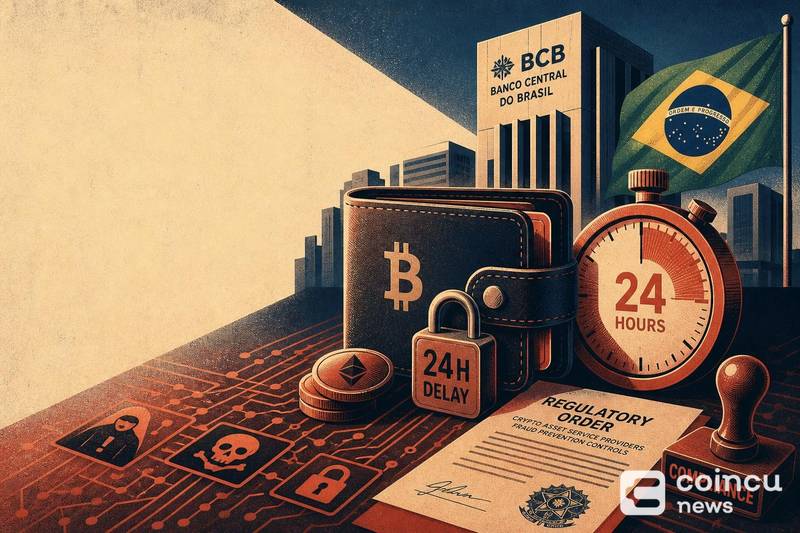
The change reflects a broader push by Brazil’s central bank to bring transfer controls to regulated crypto platforms, detailed in official documentation published by the Banco Central do Brasil. For related coverage, see Coinbase Institutional Keeps Neutral Crypto Market Outlook for Q3 2026.
What the 24-Hour Transfer Rule Changes
Under the measure, a transfer out of an exchange to a self-custody wallet would not complete immediately, but only after a 24-hour hold. A self-custody wallet is one controlled directly by the user, where the private keys are held outside any exchange or intermediary. For related coverage, see Coinbase Launches USDC-BRL Trading Pair for Users in Brazil.
The distinction matters because exchange-hosted balances remain under a regulated platform’s control, while assets sent to a self-custody wallet leave that oversight. The waiting period applies specifically to those outbound transfers to user-controlled wallets, not to internal balances. For related coverage, see UK FCA, Central Bank Advance Crypto Rules and Ease Stablecoin Limits.
The direction of travel is consistent with earlier reporting that Brazil’s central bank ordered exchanges to delay large crypto transfers abroad, signalling a focus on slowing rapid asset movement off regulated platforms.
The Anti-Fraud Logic Behind the Delay
Fraud schemes typically try to move stolen assets quickly, away from the platform where a scam originated. A short waiting period is intended to create a window for reviews, alerts, or user intervention before funds leave the exchange.
That window matters most for self-custody transfers, which are effectively irreversible once broadcast on-chain. Once assets reach a wallet the platform does not control, recovery becomes far harder, a challenge underscored when a São Paulo court ordered Coinbase to return funds after a self-hosted wallet theft.
The policy is positioned as a consumer-protection step, adding friction at the moment fraud losses are most likely to become permanent, according to the central bank’s financial-stability rulemaking.
What It Means for Exchanges and Users
For operators, the rule implies new withdrawal workflows, disclosures, and monitoring around outbound self-custody transfers. Platforms serving Brazil, including those that have expanded local products such as a USDC-BRL trading pair, would need to build the delay into their compliance stack.
For users, the practical effect is slower access when moving assets to a personal wallet. The measure adds friction to convenience rather than removing the ability to self-custody, since the transfer still completes after the hold.
FAQ
Does the rule ban self-custody wallets? No. A waiting period delays a transfer; it does not prohibit holding crypto in a self-custody wallet.
Who is affected? Regulated exchanges operating in Brazil and their users who withdraw to personal wallets, based on the central bank’s reported transfer-control measures.
When does the delay apply? On transfers out of an exchange to a self-custody wallet, which are held for 24 hours before completing.
Why target these transfers? Because on-chain transfers to user-controlled wallets are hard to reverse, making them a common route for moving funds after a scam.
Disclaimer: This article is for informational purposes only and does not constitute financial or investment advice. Cryptocurrency and digital asset markets carry significant risk. Always do your own research before making decisions.
No tags available.


Other Posts








- China, US Conclude Trade Talks with Focus on Cooperation
- Crypto Weekly: NYSE Backs OKX, Kraken Gets Fed Access, BTC Sells
- Court Upholds Fed’s Rejection of Custodia Bank’s Request
- Former CFO Convicted for $35M Fraudulent Crypto Investment
- DeriW Launches Edge Hour Trading Competition Platform for Derivatives Traders
- Michael Saylor Denies Bitcoin Sell-Off Amid Large BTC Transfer
- Buy Dogecoin on eToro: Step-by-Step Guide for Beginners (2024)
- Kazakhstan Explores Crypto Reserves Backed by National Funds
- JPMorgan Increases Holdings in BlackRock’s Bitcoin ETF
- Nordea Bank Introduces Bitcoin ETP Trading for Nordic Customers
- XRP Spot ETF Launches on Nasdaq Amid Market Fluctuations
- Peter Schiff Challenges Michael Saylor on MSTR’s Business Model
- Thailand Orders Worldcoin to Delete 1.2 Million Biometric Records
- UK Proposes New DeFi Tax Framework to Ease User Burden
- WLFI Under Fire: Analyst Warns Hyperliquid Could Be Next
- Ancient Ethereum Whale Moves $1.19 Billion After Decade
- BlackRock Receives Large Crypto Transfers from Coinbase
- SEC Scrutiny on ALT5 Sigma’s Leadership Disclosure Timing
- Yala Injects $5.5 Million Amid Recovery Efforts
- Radiant Capital Faces $50M Loss in Major Security Breach
- China, US Conclude Trade Talks with Focus on Cooperation
- Crypto Weekly: NYSE Backs OKX, Kraken Gets Fed Access, BTC Sells
- Court Upholds Fed’s Rejection of Custodia Bank’s Request
- Former CFO Convicted for $35M Fraudulent Crypto Investment
- DeriW Launches Edge Hour Trading Competition Platform for Derivatives Traders
- Michael Saylor Denies Bitcoin Sell-Off Amid Large BTC Transfer
- Buy Dogecoin on eToro: Step-by-Step Guide for Beginners (2024)
- Kazakhstan Explores Crypto Reserves Backed by National Funds
- JPMorgan Increases Holdings in BlackRock’s Bitcoin ETF
- Nordea Bank Introduces Bitcoin ETP Trading for Nordic Customers
- XRP Spot ETF Launches on Nasdaq Amid Market Fluctuations
- Peter Schiff Challenges Michael Saylor on MSTR’s Business Model
- Thailand Orders Worldcoin to Delete 1.2 Million Biometric Records
- UK Proposes New DeFi Tax Framework to Ease User Burden
- WLFI Under Fire: Analyst Warns Hyperliquid Could Be Next
- Ancient Ethereum Whale Moves $1.19 Billion After Decade
- BlackRock Receives Large Crypto Transfers from Coinbase
- SEC Scrutiny on ALT5 Sigma’s Leadership Disclosure Timing
- Yala Injects $5.5 Million Amid Recovery Efforts
- Radiant Capital Faces $50M Loss in Major Security Breach
- China, US Conclude Trade Talks with Focus on Cooperation
- Crypto Weekly: NYSE Backs OKX, Kraken Gets Fed Access, BTC Sells
- Court Upholds Fed’s Rejection of Custodia Bank’s Request
- Former CFO Convicted for $35M Fraudulent Crypto Investment
- DeriW Launches Edge Hour Trading Competition Platform for Derivatives Traders
- Michael Saylor Denies Bitcoin Sell-Off Amid Large BTC Transfer
- Buy Dogecoin on eToro: Step-by-Step Guide for Beginners (2024)
- Kazakhstan Explores Crypto Reserves Backed by National Funds
- JPMorgan Increases Holdings in BlackRock’s Bitcoin ETF
- Nordea Bank Introduces Bitcoin ETP Trading for Nordic Customers
- XRP Spot ETF Launches on Nasdaq Amid Market Fluctuations
- Peter Schiff Challenges Michael Saylor on MSTR’s Business Model
- Thailand Orders Worldcoin to Delete 1.2 Million Biometric Records
- UK Proposes New DeFi Tax Framework to Ease User Burden
- WLFI Under Fire: Analyst Warns Hyperliquid Could Be Next
- Ancient Ethereum Whale Moves $1.19 Billion After Decade
- BlackRock Receives Large Crypto Transfers from Coinbase
- SEC Scrutiny on ALT5 Sigma’s Leadership Disclosure Timing
- Yala Injects $5.5 Million Amid Recovery Efforts
- Radiant Capital Faces $50M Loss in Major Security Breach



Over 100 Crypto Projects Shut Down in 2026 as Industry Shakeout Deepens
Cashelix Launches CASX Token Presale to Fuel the Future of Blockchain P2P Transactions
Bybit Sues North Korea and Lazarus Group, Secures Preliminary Injunction Freezing Stolen Assets in Landmark Crypto Asset Recovery Effort