Liquidation heatmap data suggests that up to $632 million in long positions could face forced closure if Ethereum’s price drops below the $2,210 level across major centralized exchanges, highlighting a concentrated risk zone for leveraged traders.
Why $2,210 Is a Critical ETH Liquidation Level
A liquidation occurs when an exchange forcibly closes a leveraged trading position because the trader’s margin can no longer cover losses. Long liquidations specifically hit traders who borrowed funds to bet on rising prices.
The $2,210 price zone has emerged as a key threshold based on Coinglass liquidation heatmap data, which maps where clusters of leveraged positions would be triggered across exchanges. The $632 million figure represents conditional potential exposure, not guaranteed realized losses.
This means the full amount would only unwind if ETH actually traded through that level with sufficient depth to trigger all stacked positions. Partial fills, position adjustments, and varying exchange engines mean the real liquidation total could differ.
Where the $632M Liquidation Risk Sits Across Major CEXs
The liquidation estimate spans multiple major centralized exchanges rather than a single venue. When leverage clusters at the same price level across Binance, OKX, Bybit, and other platforms simultaneously, forced selling on one exchange can push prices lower across all of them.
Liquidity conditions at and around the $2,210 zone determine how sharply any cascade would unfold. Thin order books at the trigger level mean fewer resting buy orders to absorb forced sell pressure, potentially accelerating the move.
Liquidation heatmaps indicate pressure zones where positions are concentrated but do not guarantee that price will reach those levels. They function as risk maps, not predictions, helping traders identify where volatility is most likely to spike if a given level is breached.
What Happens If ETH Breaks Below $2,210
If ETH trades below $2,210, the initial wave of forced selling from overleveraged longs would add downside momentum beyond organic selling. This is the liquidation cascade effect, where one round of liquidations pushes prices lower, triggering the next round.
Volatility typically expands sharply after key liquidation bands are breached. Whether ETH quickly reclaims the level or continues lower often depends on whether spot buyers step in to absorb the forced selling.
A fast reclaim of the $2,210 area would suggest the move was a short-term flush of overleveraged positions. A sustained break below it could open the door to deeper downside as additional liquidation clusters beneath that level get activated.
Near-term liquidation pressure should be separated from broader trend conclusions. A liquidation flush does not inherently change Ethereum’s fundamental outlook. Stablecoin market shifts, such as the recent report that USDC circulating supply fell by $700 million in seven days to $78 billion, can offer additional context on capital flows that influence crypto leverage appetite.
Why Traders Are Watching Open Interest, Funding, and Order Books
Open interest, the total value of outstanding futures contracts, shows whether leverage remains crowded heading into the risk zone. Rising open interest alongside sideways or declining price action typically signals that a volatile move is building.
Funding rates provide a second signal. When funding is persistently positive, it means long traders are paying short traders to maintain their positions, indicating crowded bullish positioning. Elevated funding near a major liquidation cluster increases the probability that a break lower triggers outsized forced selling.
Order-book depth around the $2,210 area reveals whether resting bids can absorb liquidation flow. Thin books at the trigger level would mean faster price movement through the zone, while deep liquidity could act as a buffer.
Broader risk appetite also feeds into crypto leverage positioning. Developments in adjacent markets, including how Polymarket odds on geopolitical events shift, can signal changes in macro sentiment that ripple into derivatives positioning. Regulatory actions like Brazil’s recent ban on 27 prediction market platforms also reshape the landscape for risk-on capital flows.
Traders monitoring open interest, funding, and order-book depth together get a clearer picture of whether the liquidation setup visible on heatmaps is likely to activate or dissipate as positions adjust.
FAQ: ETH Liquidation Risk Below $2,210
What does a liquidation level mean?
A liquidation level is a price zone where a significant number of leveraged trading positions would be forcibly closed by exchanges. The $2,210 level for ETH marks where heatmap data shows concentrated long exposure that would unwind if price reaches that zone.
Does $632 million in liquidations mean traders will lose that amount?
Not necessarily. The figure represents the maximum conditional exposure if ETH trades through the $2,210 level across all major exchanges simultaneously. Actual liquidations depend on execution speed, order-book depth, and whether traders close or adjust positions before the level is reached.
Should spot ETH holders be concerned about this liquidation data?
Liquidation heatmaps are most directly relevant to leveraged futures traders. Spot holders are not at risk of forced liquidation. However, a large liquidation cascade can temporarily push spot prices lower, creating short-term volatility that affects all market participants.
Does this mean ETH will definitely drop to $2,210?
No. Liquidation data shows where risk is concentrated if price moves to a certain level. It does not predict whether price will actually reach that level. The data is a risk map, not a forecast.
Disclaimer: This article is for informational purposes only and does not constitute financial or investment advice. Cryptocurrency and digital asset markets carry significant risk. Always do your own research before making decisions.
No tags available.


Other Posts








- China, US Conclude Trade Talks with Focus on Cooperation
- Crypto Weekly: NYSE Backs OKX, Kraken Gets Fed Access, BTC Sells
- Court Upholds Fed’s Rejection of Custodia Bank’s Request
- Former CFO Convicted for $35M Fraudulent Crypto Investment
- DeriW Launches Edge Hour Trading Competition Platform for Derivatives Traders
- Michael Saylor Denies Bitcoin Sell-Off Amid Large BTC Transfer
- Buy Dogecoin on eToro: Step-by-Step Guide for Beginners (2024)
- Kazakhstan Explores Crypto Reserves Backed by National Funds
- JPMorgan Increases Holdings in BlackRock’s Bitcoin ETF
- Nordea Bank Introduces Bitcoin ETP Trading for Nordic Customers
- XRP Spot ETF Launches on Nasdaq Amid Market Fluctuations
- Peter Schiff Challenges Michael Saylor on MSTR’s Business Model
- Thailand Orders Worldcoin to Delete 1.2 Million Biometric Records
- UK Proposes New DeFi Tax Framework to Ease User Burden
- WLFI Under Fire: Analyst Warns Hyperliquid Could Be Next
- Ancient Ethereum Whale Moves $1.19 Billion After Decade
- BlackRock Receives Large Crypto Transfers from Coinbase
- SEC Scrutiny on ALT5 Sigma’s Leadership Disclosure Timing
- Yala Injects $5.5 Million Amid Recovery Efforts
- Radiant Capital Faces $50M Loss in Major Security Breach
- China, US Conclude Trade Talks with Focus on Cooperation
- Crypto Weekly: NYSE Backs OKX, Kraken Gets Fed Access, BTC Sells
- Court Upholds Fed’s Rejection of Custodia Bank’s Request
- Former CFO Convicted for $35M Fraudulent Crypto Investment
- DeriW Launches Edge Hour Trading Competition Platform for Derivatives Traders
- Michael Saylor Denies Bitcoin Sell-Off Amid Large BTC Transfer
- Buy Dogecoin on eToro: Step-by-Step Guide for Beginners (2024)
- Kazakhstan Explores Crypto Reserves Backed by National Funds
- JPMorgan Increases Holdings in BlackRock’s Bitcoin ETF
- Nordea Bank Introduces Bitcoin ETP Trading for Nordic Customers
- XRP Spot ETF Launches on Nasdaq Amid Market Fluctuations
- Peter Schiff Challenges Michael Saylor on MSTR’s Business Model
- Thailand Orders Worldcoin to Delete 1.2 Million Biometric Records
- UK Proposes New DeFi Tax Framework to Ease User Burden
- WLFI Under Fire: Analyst Warns Hyperliquid Could Be Next
- Ancient Ethereum Whale Moves $1.19 Billion After Decade
- BlackRock Receives Large Crypto Transfers from Coinbase
- SEC Scrutiny on ALT5 Sigma’s Leadership Disclosure Timing
- Yala Injects $5.5 Million Amid Recovery Efforts
- Radiant Capital Faces $50M Loss in Major Security Breach
- China, US Conclude Trade Talks with Focus on Cooperation
- Crypto Weekly: NYSE Backs OKX, Kraken Gets Fed Access, BTC Sells
- Court Upholds Fed’s Rejection of Custodia Bank’s Request
- Former CFO Convicted for $35M Fraudulent Crypto Investment
- DeriW Launches Edge Hour Trading Competition Platform for Derivatives Traders
- Michael Saylor Denies Bitcoin Sell-Off Amid Large BTC Transfer
- Buy Dogecoin on eToro: Step-by-Step Guide for Beginners (2024)
- Kazakhstan Explores Crypto Reserves Backed by National Funds
- JPMorgan Increases Holdings in BlackRock’s Bitcoin ETF
- Nordea Bank Introduces Bitcoin ETP Trading for Nordic Customers
- XRP Spot ETF Launches on Nasdaq Amid Market Fluctuations
- Peter Schiff Challenges Michael Saylor on MSTR’s Business Model
- Thailand Orders Worldcoin to Delete 1.2 Million Biometric Records
- UK Proposes New DeFi Tax Framework to Ease User Burden
- WLFI Under Fire: Analyst Warns Hyperliquid Could Be Next
- Ancient Ethereum Whale Moves $1.19 Billion After Decade
- BlackRock Receives Large Crypto Transfers from Coinbase
- SEC Scrutiny on ALT5 Sigma’s Leadership Disclosure Timing
- Yala Injects $5.5 Million Amid Recovery Efforts
- Radiant Capital Faces $50M Loss in Major Security Breach

Strategy Sells 1,690 BTC, Raises $653 Million From MSTR Shares


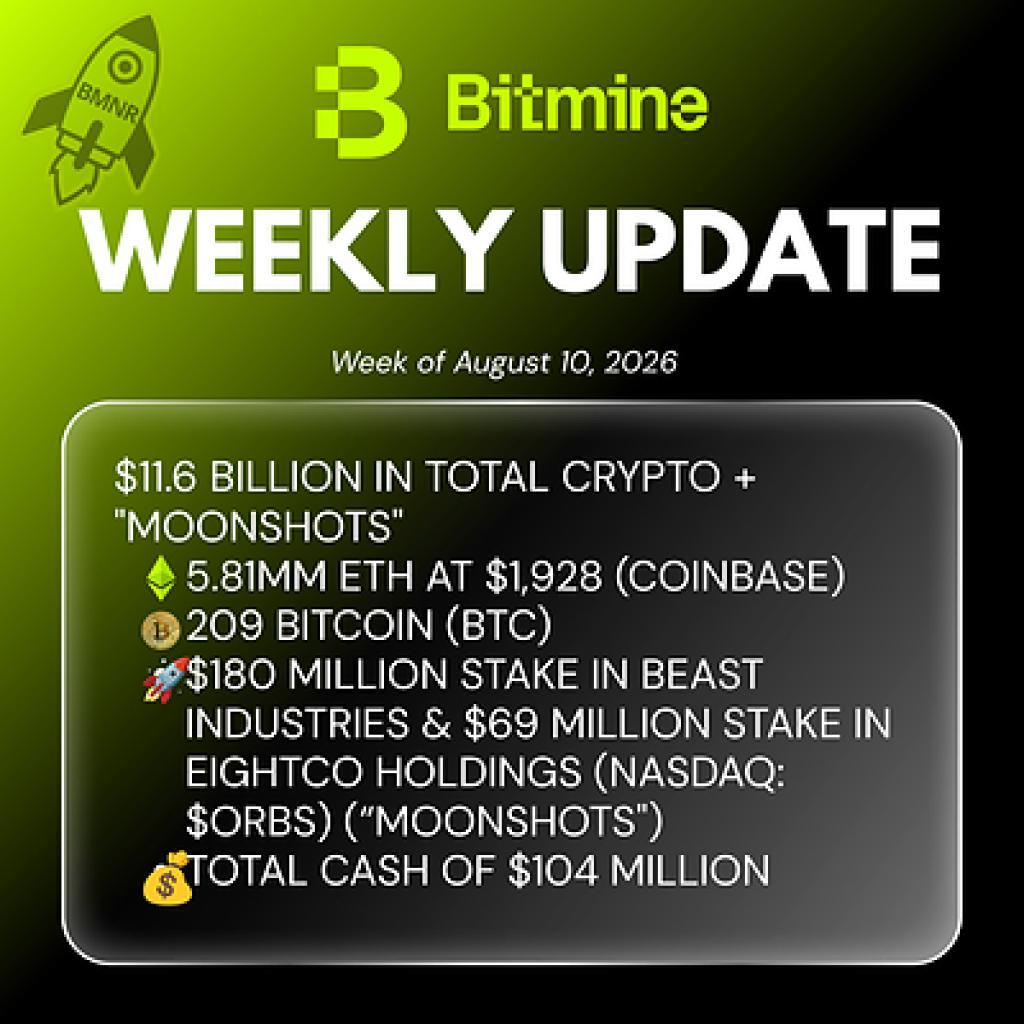
Bitmine Immersion Technologies (BMNR) Announces ETH Holdings Reach 5.81 Million Tokens, and Total Crypto and Total Cash Holdings of $11.6 Billion

Cashelix Launches CASX Token Presale to Fuel the Future of Blockchain P2P Transactions