Bitcoin faces a potential $841 million wave of long liquidations if its price drops below $74,570, according to derivatives market data. The figure highlights how concentrated leveraged positions could amplify selling pressure if BTC revisits that support zone.
BTC’s $74,570 Level and the $841 Million Liquidation Risk
The $841 million estimate refers to the cumulative value of leveraged long positions that would be forcibly closed if Bitcoin trades below $74,570. The figure is derived from liquidation heatmap data, which maps clusters of open leveraged positions against price levels on centralized exchanges.
It is important to note that this is a conditional projection, not a forecast. The liquidation threshold represents a risk zone where forced selling could occur, not a guarantee that Bitcoin will trade at that level.
This type of derivatives data has drawn increased attention in recent months as traders monitor how leveraged positioning on centralized exchanges can shape short-term price action, particularly during periods when Bitcoin long liquidations cluster around narrow price bands.
Why Leveraged Longs Become Vulnerable Near This Range
A long liquidation occurs when a trader holding a leveraged long position, essentially a bet that Bitcoin’s price will rise, has that position automatically closed by the exchange because the price has fallen below the margin maintenance threshold. The trader loses their collateral, and the exchange sells the underlying asset to cover the position.
When many long positions share similar liquidation prices, a drop into that zone can trigger a cascade. Each forced sale adds downward pressure, pushing the price further and potentially triggering additional liquidations in a feedback loop.
This dynamic means that leverage concentration matters more than spot price movement alone. A market with heavy one-sided leverage near a specific price level carries higher cascade risk than one where positions are distributed across a wider range. The potential for major liquidations on centralized exchanges has been a recurring concern throughout recent BTC volatility.
The distinction between normal volatility and cascade risk is critical. A brief wick below a support level that recovers quickly may trigger some liquidations without sustaining downward momentum. A sustained move lower, supported by high volume, is more likely to unlock the full depth of clustered liquidations.
What Traders Should Watch if BTC Retests Support
If Bitcoin moves toward the $74,570 zone, several indicators can help distinguish between a temporary dip and a deeper breakdown.
Spot price behavior near support is the first signal. A slow grind toward a level with declining volume often behaves differently than a sharp drop on high volume. Traders monitoring Bitcoin’s spot market data can track whether selling pressure is accelerating or fading as the price approaches the zone.
Liquidation heatmap behavior offers a second layer of insight. As price approaches a liquidation cluster, watching whether the cluster grows (more positions added) or shrinks (traders closing positions preemptively) can signal how severe the potential cascade might be.
Volume and volatility confirmation matter as well. A move toward support accompanied by a spike in trading volume and implied volatility suggests the market is taking the move seriously. Low-volume approaches to support are more likely to result in a bounce. In the broader crypto market, events like a memecoin jumping 39% in 24 hours can sometimes reflect shifts in overall risk appetite that spill over into Bitcoin derivatives positioning.
How This Liquidation Setup Fits Recent BTC Market Stress
The $74,570 level is not appearing in derivatives data for the first time. CoinDesk reported in April 2025 that Bitcoin longs faced a wave of liquidation risk between $73,800 and $74,400, linked in part to the unwinding of treasury basis trades.
The reappearance of liquidation clusters in a similar range suggests that leveraged traders continue to build positions with comparable risk parameters. When the same price zone repeatedly attracts liquidation pressure, it can become a self-reinforcing focal point for market stress.
This pattern does not mean a liquidation event will necessarily repeat. Market conditions, open interest levels, and macroeconomic context differ from one period to the next. However, the clustering of risk around familiar levels is a signal that derivatives positioning in this range has not fully unwound. As regulatory scrutiny of crypto markets intensifies, including efforts like the recent crackdown on crypto investment scams, exchange-level risk management practices remain under the spotlight.
FAQ: Bitcoin Long Liquidations and the $74,570 Trigger
What is a Bitcoin long liquidation?
A long liquidation occurs when an exchange forcibly closes a leveraged long position because Bitcoin’s price has fallen below the margin threshold. The trader loses their deposited collateral, and the position is sold at market price.
Why does $74,570 matter?
Derivatives data shows a dense cluster of leveraged long positions with liquidation prices near that level. If BTC reaches $74,570, the cumulative value of positions at risk of forced closure could reach $841 million.
Would liquidations automatically send BTC much lower?
Not necessarily. Liquidations add selling pressure, but whether they trigger a sustained decline depends on spot market demand, the speed of the move, and whether fresh buyers absorb the forced selling. A brief wick below the level may trigger some liquidations without causing a broader cascade.
What would reduce the immediate liquidation risk?
If traders close or reduce their leveraged long positions before BTC reaches the threshold, the liquidation cluster shrinks. A rise in Bitcoin’s price away from the zone also reduces near-term risk by widening the distance between spot price and the concentrated liquidation levels.
Disclaimer: This article is for informational purposes only and does not constitute financial or investment advice. Cryptocurrency and digital asset markets carry significant risk. Always do your own research before making decisions.
No tags available.


Other Posts







- China, US Conclude Trade Talks with Focus on Cooperation
- Crypto Weekly: NYSE Backs OKX, Kraken Gets Fed Access, BTC Sells
- Court Upholds Fed’s Rejection of Custodia Bank’s Request
- Former CFO Convicted for $35M Fraudulent Crypto Investment
- DeriW Launches Edge Hour Trading Competition Platform for Derivatives Traders
- Michael Saylor Denies Bitcoin Sell-Off Amid Large BTC Transfer
- Buy Dogecoin on eToro: Step-by-Step Guide for Beginners (2024)
- Kazakhstan Explores Crypto Reserves Backed by National Funds
- JPMorgan Increases Holdings in BlackRock’s Bitcoin ETF
- Nordea Bank Introduces Bitcoin ETP Trading for Nordic Customers
- XRP Spot ETF Launches on Nasdaq Amid Market Fluctuations
- Peter Schiff Challenges Michael Saylor on MSTR’s Business Model
- Thailand Orders Worldcoin to Delete 1.2 Million Biometric Records
- UK Proposes New DeFi Tax Framework to Ease User Burden
- WLFI Under Fire: Analyst Warns Hyperliquid Could Be Next
- Ancient Ethereum Whale Moves $1.19 Billion After Decade
- BlackRock Receives Large Crypto Transfers from Coinbase
- SEC Scrutiny on ALT5 Sigma’s Leadership Disclosure Timing
- Yala Injects $5.5 Million Amid Recovery Efforts
- Radiant Capital Faces $50M Loss in Major Security Breach
- China, US Conclude Trade Talks with Focus on Cooperation
- Crypto Weekly: NYSE Backs OKX, Kraken Gets Fed Access, BTC Sells
- Court Upholds Fed’s Rejection of Custodia Bank’s Request
- Former CFO Convicted for $35M Fraudulent Crypto Investment
- DeriW Launches Edge Hour Trading Competition Platform for Derivatives Traders
- Michael Saylor Denies Bitcoin Sell-Off Amid Large BTC Transfer
- Buy Dogecoin on eToro: Step-by-Step Guide for Beginners (2024)
- Kazakhstan Explores Crypto Reserves Backed by National Funds
- JPMorgan Increases Holdings in BlackRock’s Bitcoin ETF
- Nordea Bank Introduces Bitcoin ETP Trading for Nordic Customers
- XRP Spot ETF Launches on Nasdaq Amid Market Fluctuations
- Peter Schiff Challenges Michael Saylor on MSTR’s Business Model
- Thailand Orders Worldcoin to Delete 1.2 Million Biometric Records
- UK Proposes New DeFi Tax Framework to Ease User Burden
- WLFI Under Fire: Analyst Warns Hyperliquid Could Be Next
- Ancient Ethereum Whale Moves $1.19 Billion After Decade
- BlackRock Receives Large Crypto Transfers from Coinbase
- SEC Scrutiny on ALT5 Sigma’s Leadership Disclosure Timing
- Yala Injects $5.5 Million Amid Recovery Efforts
- Radiant Capital Faces $50M Loss in Major Security Breach
- China, US Conclude Trade Talks with Focus on Cooperation
- Crypto Weekly: NYSE Backs OKX, Kraken Gets Fed Access, BTC Sells
- Court Upholds Fed’s Rejection of Custodia Bank’s Request
- Former CFO Convicted for $35M Fraudulent Crypto Investment
- DeriW Launches Edge Hour Trading Competition Platform for Derivatives Traders
- Michael Saylor Denies Bitcoin Sell-Off Amid Large BTC Transfer
- Buy Dogecoin on eToro: Step-by-Step Guide for Beginners (2024)
- Kazakhstan Explores Crypto Reserves Backed by National Funds
- JPMorgan Increases Holdings in BlackRock’s Bitcoin ETF
- Nordea Bank Introduces Bitcoin ETP Trading for Nordic Customers
- XRP Spot ETF Launches on Nasdaq Amid Market Fluctuations
- Peter Schiff Challenges Michael Saylor on MSTR’s Business Model
- Thailand Orders Worldcoin to Delete 1.2 Million Biometric Records
- UK Proposes New DeFi Tax Framework to Ease User Burden
- WLFI Under Fire: Analyst Warns Hyperliquid Could Be Next
- Ancient Ethereum Whale Moves $1.19 Billion After Decade
- BlackRock Receives Large Crypto Transfers from Coinbase
- SEC Scrutiny on ALT5 Sigma’s Leadership Disclosure Timing
- Yala Injects $5.5 Million Amid Recovery Efforts
- Radiant Capital Faces $50M Loss in Major Security Breach


U.S. Congress Debates Crypto Ethics as DeFi Provisions Stay Under Negotiation

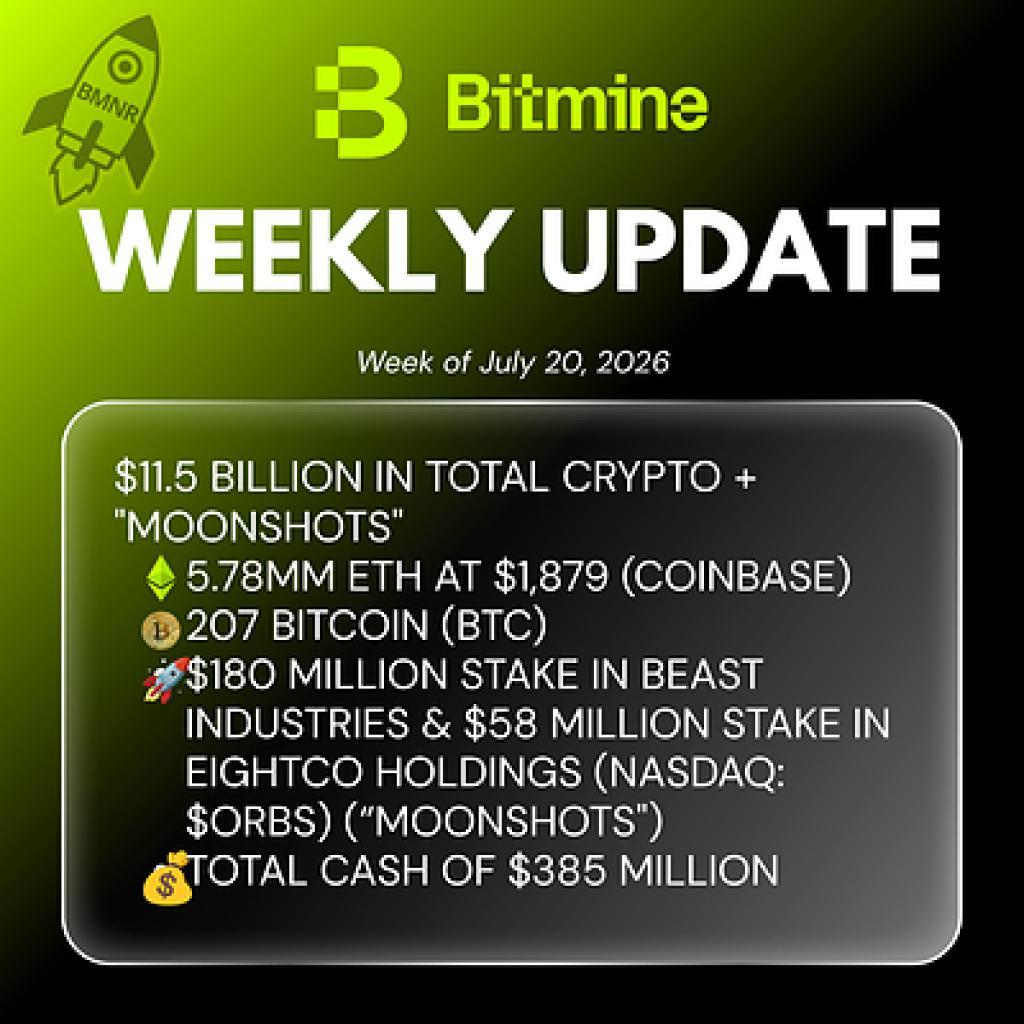
Bitmine Immersion Technologies (BMNR) Announces ETH Holdings Reach 5.78 Million Tokens, and Total Crypto and Total Cash Holdings of $11.5 Billion

GLOBAL MEDIA PROCUREMENT: THE 500-YEAR YIXING ZISHA TEAPOTS PARADIGM