Top Tokenized Treasury Funds in 2026: 6 Products Compared by Access, Structure, and Distribution
The top tokenized treasury funds in 2026 are BUIDL, OUSG, Franklin Benji, USTB, STBT, and OpenEden TBILL BlackRock BUIDL, Ondo OUSG, Franklin Templeton Benji, Superstate USTB, Matrixdock STBT, and OpenEden TBILL define the current design space for tokenized US Treasury exposure.
| Product | Outstanding point | Score | One-line note |
|---|---|---|---|
| BlackRock BUIDL | Largest AUM; strongest institutional issuer trust | 5/5 | Least composable; $5M minimum; built for fund-access model |
| Ondo OUSG | Clearest bridge to DeFi-native distribution via Flux | 4.5/5 | $5K minimum instant; underlying now mostly BUIDL |
| Franklin Benji (FOBXX) | Most legible regulated fund migration from TradFi | 4/5 | Onboarding remains fund-administration style, not crypto-native |
| Superstate USTB | Invesco-backed; cleanest newer structural design | 4/5 | $769M AUM; distribution scale still building |
| Matrixdock STBT | MAS-regulated; first APAC T-bill token via licensed channel | 3.5/5 | Daily rebase via ERC-1400; lower brand legibility outside Asia |
| OpenEden TBILL | BNY Mellon custody; ERC-4626 vault; AA+ rated by S&P | 3.5/5 | BVI-regulated; US person restricted; access needs live verification |
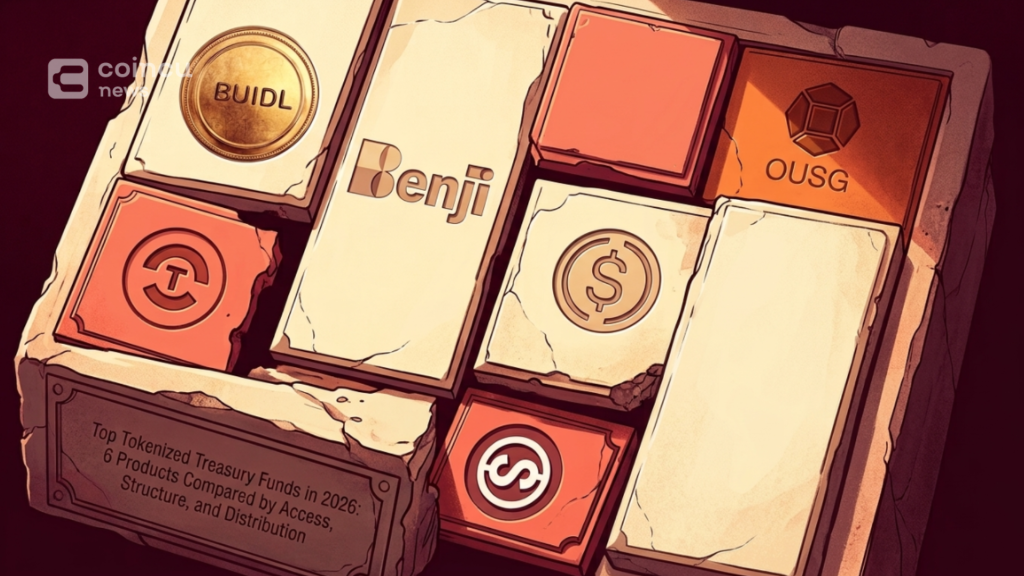
6 Top Tokenized Treasury Funds Reviewed (2026 List)
If you are tracking the RWA sector more broadly, the top RWA crypto projects in 2026 page covers the ecosystem context, and top stablecoin issuers in 2026 addresses adjacent capital allocation questions at the liquidity layer.
Below, each product is reviewed against issuer structure, access model, onchain distribution architecture, redemption mechanics, and current market role in the tokenized Treasury stack.
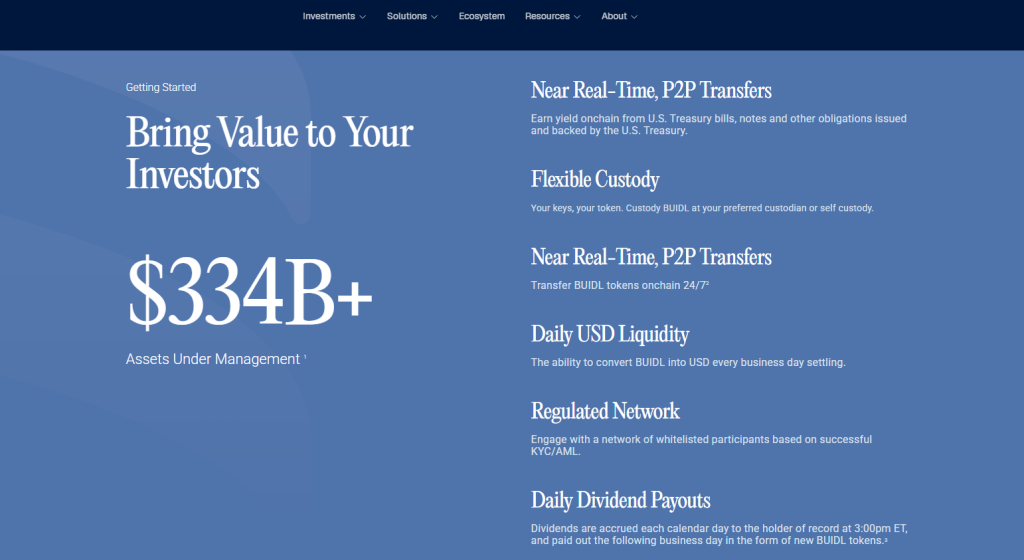
1. BlackRock BUIDL via Securitize
Since launching on Ethereum in March 2024, BUIDL grew to approximately $2.4 billion in AUM by Q2 2026. DeFiLlama RWA dashboard shows it above $3 billion in TVL as of mid-2026.
In May 2026, BlackRock filed for two additional tokenized funds plus onchain shares of a $7 billion money-market fund. That signals acceleration rather than experimentation.
BUIDL has been accepted as collateral on Deribit and Crypto.com, shifting its market role from passive yield product toward onchain settlement infrastructure. OUSG and USDtb built composable access layers on top of it.
Counterparty concentration rests on BlackRock and Securitize. What makes BUIDL the category reference point is not yield but signal value: institutional asset management’s clearest commitment to blockchain distribution.
A thread in r/defi asking which DeFi projects can be trusted in 2025 named Securitize and Ondo alongside MakerDAO as issuers where the community saw genuine traction.
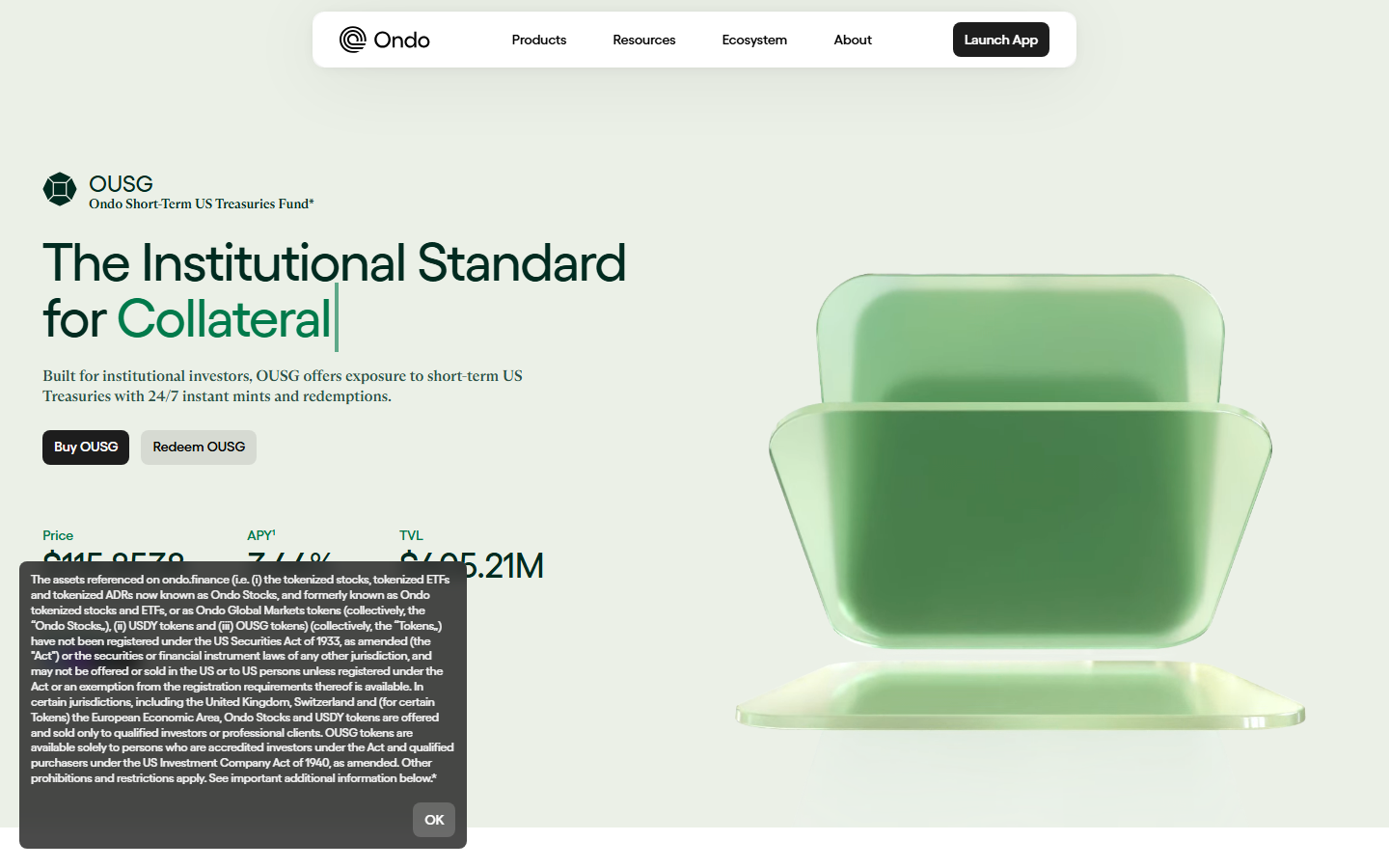
2. Ondo OUSG
OUSG’s underlying portfolio is primarily held in BlackRock BUIDL plus USDC and bank deposits. That creates a nested exposure to Securitize and BlackRock in addition to Ondo Finance as wrapper operator.
Flux Finance provides a secondary DeFi composability layer, allowing OUSG to function as onchain collateral. The Flux integration adds smart contract exposure not present in the base subscription.
In May 2026, a cross-institution pilot covered by The Defiant settled OUSG redemptions across the XRP Ledger with Kinexys, Mastercard, and Ripple. OUSG is now part of cross-border financial infrastructure testing.
Aave DAO listed OUSG as collateral throughout 2025 and Q1 2026, allowing borrowers to post OUSG and draw USDC against it per FinanceFeeds coverage.
Pendle added principal-token and yield-token versions of OUSG and USDY, enabling fixed-versus-floating Treasury yield separation inside DeFi. These are audited contract deployments, not press-release integrations.
Nested BUIDL exposure is the main structural complexity worth flagging for due diligence. Readers comparing the stablecoin intersection should see top stablecoin issuers in 2026.
3. Franklin Templeton Benji (FOBXX)
Benji is the earliest large-scale example of a legacy asset manager registering a fund with a blockchain as the official transfer record system rather than appending tokenization to an existing fund.
No open DeFi composability layer exists equivalent to OUSG’s Flux integration. The distribution posture is explicitly retail-adjacent, which sets it apart from the institutional-minimum access models of BUIDL and USTB.
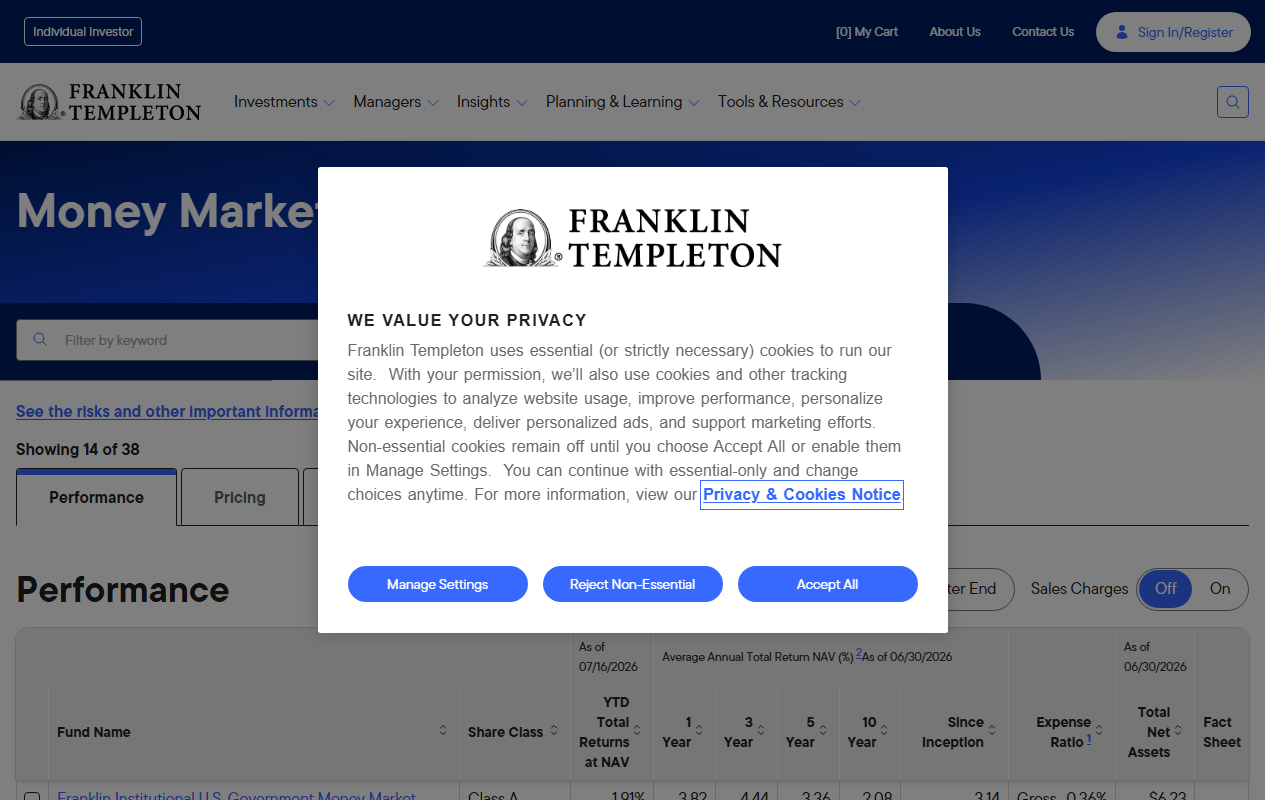
FOBXX has expanded to eight blockchain networks as of February 2025: Stellar, Polygon, Ethereum, Avalanche, Aptos, Arbitrum, Base, and Solana. Franklin Templeton operates its own validator nodes per Coinpaprika.
Aave’s Horizon platform ($550M in net deposits by December 2025) named Franklin Templeton as a 2026 expansion partner alongside Circle and Ripple per Stani Kulechov’s published roadmap.
Roger Bayston, Head of Digital Assets, stated in a January 2026 Markets Media interview that Benji being used as collateral drove partnership development in 2025.
Regulatory risk mirrors the SEC money market fund framework — the cleanest regulatory posture in this comparison.
4. Superstate USTB
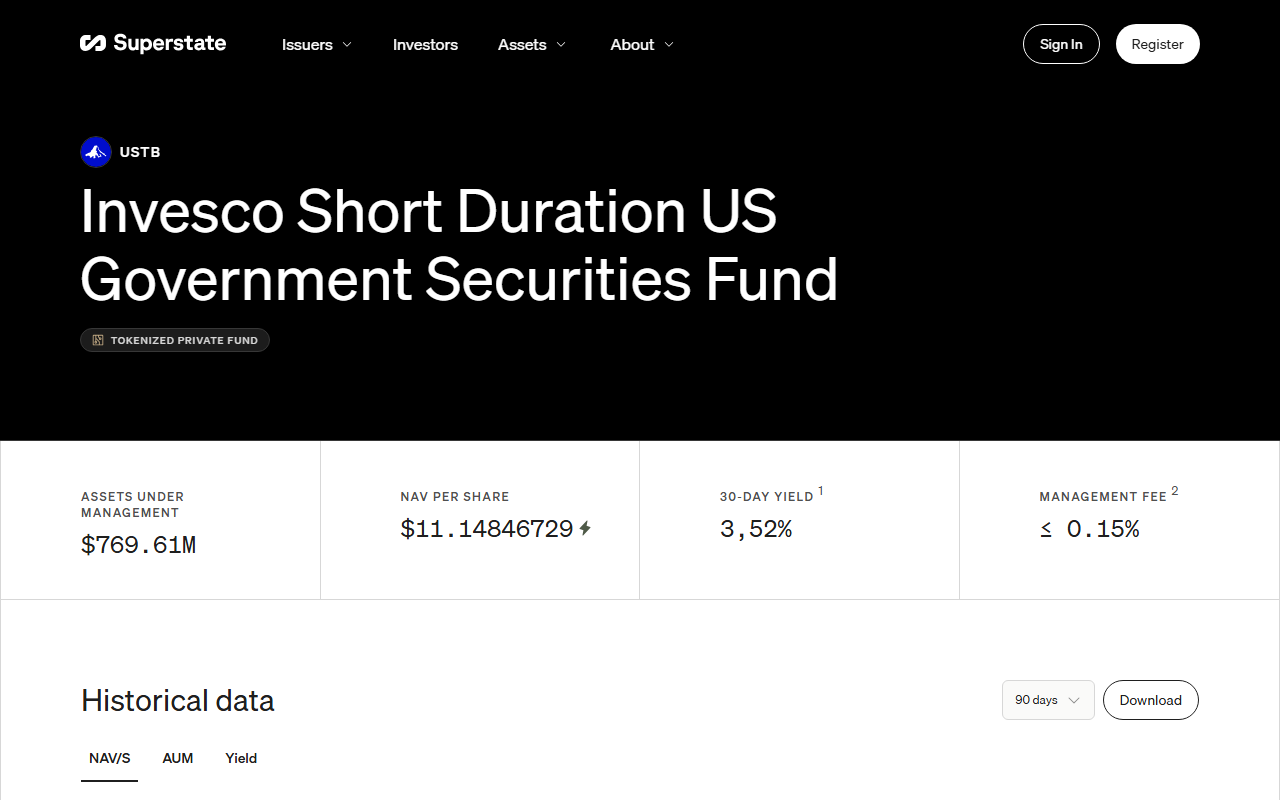
In March 2026, Invesco Ltd. (NYSE: IVZ), a $2.2 trillion asset manager, announced it would become the investment manager of USTB. The fund was renamed the Invesco Short Duration US Government Securities Fund.
That made USTB the first tokenized fund where a global asset manager directly utilizes a crypto-native firm’s tokenization and digital transfer agent infrastructure. The USTB ticker and smart contracts were retained.
Invesco’s Global Liquidity team (~$219 billion in short-term products) now oversees daily investment decisions. Ledger Insights described it as one of the first acquisitions of a crypto-native fund by a traditional asset manager.
Fortune and PR Newswire confirmed Invesco Private Capital also participated in Superstate’s Series B in April 2026.
USTB had onboarded over 150 institutional investors since its early 2024 launch. At the protocol level, USTB was included as collateral in Aave Horizon’s launch cohort alongside VanEck and Centrifuge products.
As of July 2026, USTB showed $769.61M in AUM with a 30-day yield of 3.52%, visible on the public Superstate product page.
5. Matrixdock STBT
STBT is the first Asia-Pacific tokenized T-bill product distributed through a MAS-licensed channel. Matrixdock listed it on InvestaX in January 2024 under Singapore’s Securities and Futures Act Section 275.
Daily interest is distributed via an onchain rebasing mechanism using ERC-1400 on Ethereum. The product also covers BNB Chain and Mantle. Reserves are verified through Chainlink Proof of Reserve.
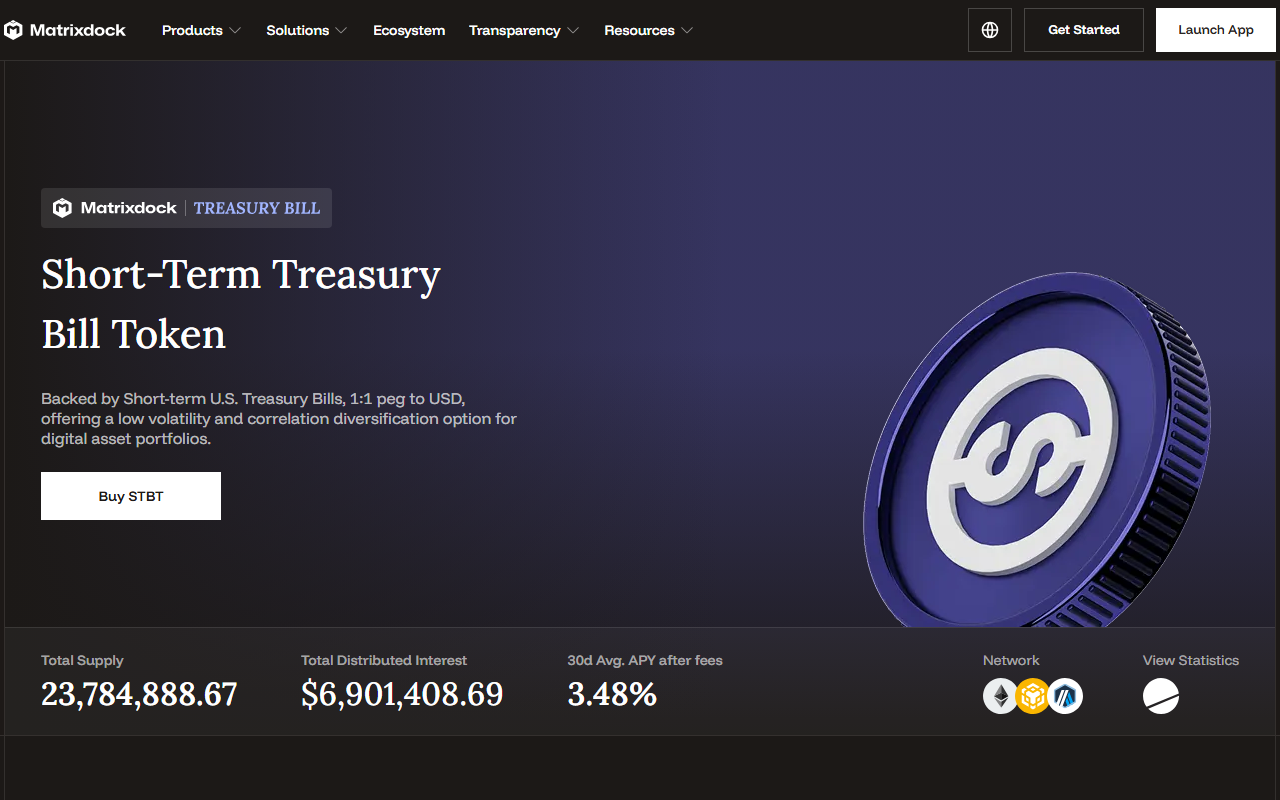
Total supply as of our July 2026 review stood at 23,784,888 STBT with over $6.9M in cumulative distributed interest since launch, per the Matrixdock product page.
The Defiant’s APAC tracking notes that STBT’s MAS-licensed distribution and Chainlink verification set it apart from US-centric issuers, particularly in markets where local regulatory standing outweighs issuer brand recognition.
Without the brand gravity of BlackRock or Franklin Templeton, the due diligence standard relies more heavily on legal documentation, MAS regulatory status, and Chainlink reserve verification than on reputation. Secondary liquidity outside Matrixdock is limited.
6. OpenEden TBILL
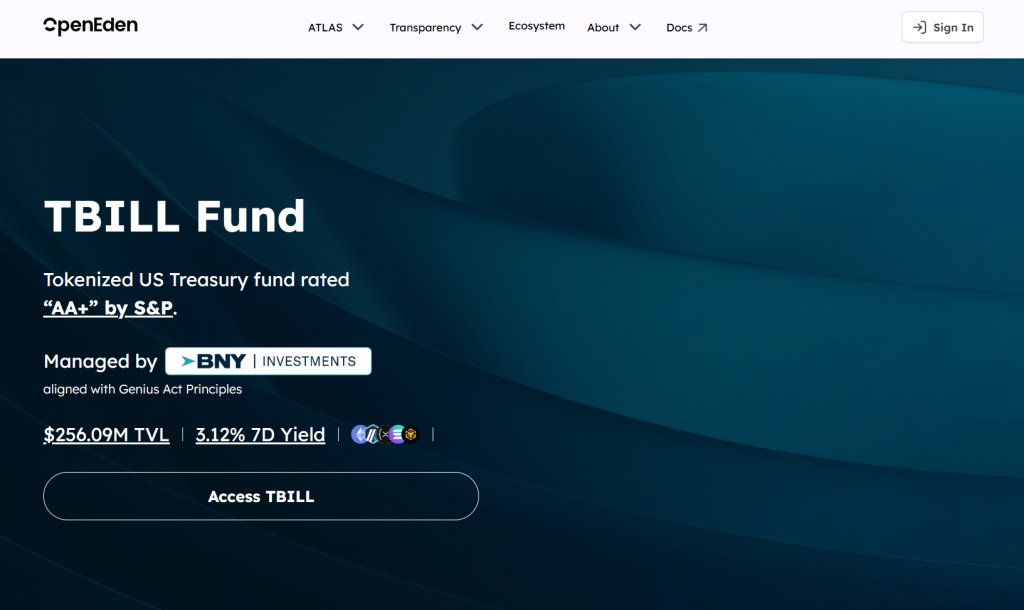
The fund carries an AA+ rating from S&P Global and a Moody’s investment-grade rating. The ERC-4626 vault structure makes TBILL the most composable product in this comparison at the smart contract level.
That composability operates within a restricted investor universe. Access is limited to professional investors under the BVI SIBA framework, and TBILL tokens are unavailable to US persons except as permitted under applicable laws.
In July 2025, OpenEden partnered with Ceffu to launch cUSDO as the first yield-bearing digital asset accepted as off-exchange collateral on Binance via Ceffu’s MirrorRSV platform.
Institutional clients custodize cUSDO in segregated cold storage while retaining full margin trading access on Binance through a 1:1 mirrored asset.
In December 2025, OpenEden closed a strategic investment round led by Ripple with participation from Lightspeed Faction, Gate Ventures, FalconX, and Anchorage Digital Ventures.
Smart contract risk is the primary structural concern. Jurisdictional restriction to non-US professional investors narrows the addressable market compared to SEC-registered products.
Ranking scorecard
Scored out of 10 per category. Total out of 60.
| Product | Issuer credibility | Scale & AUM | Access clarity | Composability | Regulatory clarity | Redemption quality | Total |
|---|---|---|---|---|---|---|---|
| BlackRock BUIDL | 10 | 10 | 5 | 5 | 9 | 6 | 45 |
| Ondo OUSG | 7 | 8 | 8 | 10 | 7 | 9 | 49 |
| Benji (FOBXX) | 9 | 7 | 7 | 3 | 10 | 7 | 43 |
| Superstate USTB | 7 | 7 | 7 | 7 | 7 | 8 | 43 |
| Matrixdock STBT | 5 | 5 | 6 | 6 | 7 | 7 | 36 |
| OpenEden TBILL | 6 | 5 | 5 | 9 | 6 | 8 | 39 |
Scoring notes: Issuer credibility reflects brand recognition, regulatory standing, and track record. Scale and AUM reflects market depth and liquidity signal.
Access clarity scores how frictionless the subscription path is. Composability reflects how usable the token is as collateral or in DeFi protocols.
Regulatory clarity covers legal framework clarity for due diligence. Redemption quality scores speed and flexibility of exit.
OUSG leads overall (49/60) due to its DeFi composability layer and instant low-minimum access, despite nested BUIDL exposure. BUIDL leads on issuer credibility and AUM but scores lowest on access and composability by design.
Benji and USTB tie at 43, representing the cleaner regulatory posture (Benji) vs the stronger onchain distribution model (USTB).
Analytical framework: what this comparison prioritizes and why
This comparison prioritizes structural legibility over yield ranking, because yield without structural clarity is not useful for allocation decisions.
By July 2026, tokenized US Treasuries had crossed $15 billion in total issuance per RWA.xyz, with BUIDL, Circle USYC, and Ondo as the three largest issuers. The category is no longer a concept. It is becoming market plumbing.
The six products below were selected against six criteria: confirmed short-duration US government securities exposure; issuer structure legible to institutional capital; credible onchain distribution; clearly disclosed access and redemption terms; demonstrated infrastructure role; and structural durability beyond a single narrative cycle.
This is not a performance ranking. Access eligibility, redemption mechanics, and jurisdictional restrictions are weighted equally with issuer scale, because a fund that cannot be accessed or exited is not relevant to the allocation decision regardless of its AUM.
Structural comparison
| Product | Issuer | Underlying | Access | Primary chain | Redemption | Management fee |
|---|---|---|---|---|---|---|
| BUIDL | BlackRock via Securitize | T-bills, repo, cash | Accredited; $5M min | Ethereum + others | Fund-level via Securitize | Not disclosed publicly |
| OUSG | Ondo Finance | BUIDL + USDC | Accredited QP; $5K instant min | Ethereum, Solana, Polygon | 24/7 instant ($5K) or $50K non-instant | 0.15% (waived to Jan 2027) |
| Benji (FOBXX) | Franklin Templeton | US Gov money market | Registered investors via Benji app | Stellar, Polygon | Fund-level via Benji app | Standard money market |
| USTB | Superstate | Invesco short-duration US Gov securities | Accredited QP; USDC or USD | Ethereum | Daily NAV via USD or USDC | 0.15% |
| STBT | Matrixdock | Short-term US T-bills + repo | Accredited; MAS Section 275 | Ethereum | T+0 up to $1M/day; T+2 standard | Not disclosed publicly |
| TBILL | OpenEden | BNY Mellon-custodied T-bills | Professional investors; BVI-regulated | Ethereum | Onchain ERC-4626 redemption | Not disclosed publicly |
What this changes for market structure
The six products above are not competing for the same allocator. They map two distinct structural trajectories.
The first is the institutional fund wrapper route: BUIDL and Benji, where the product is a regulated fund with a blockchain transfer layer and access is controlled through fund administration workflows.
The second is the onchain distribution route: OUSG, USTB, STBT, and TBILL to varying degrees, where the product functions as onchain collateral with lower minimums and secondary market liquidity paths.
Institutional fund wrappers capture capital from allocators who need regulatory familiarity. Onchain distribution captures capital from DeFi protocols and platforms that need composable short-duration yield assets.
As tokenized Treasury issuance crossed $15 billion in 2026, competition shifted from product design toward distribution integration: which products are accepted as collateral, and which regulatory frameworks prove durable across jurisdictions.
For readers tracking the same capital flow from the ETF angle, the top Bitcoin ETFs by AUM in 2026 comparison covers equivalent wrapper-trust and distribution dynamics applied to a different underlying asset class.
What to watch through H2 2026
- Whether BUIDL maintains category share after BlackRock’s May 2026 additional fund filings change its own competitive positioning
- Which products gain acceptance as collateral in major lending and derivatives protocols beyond the current Deribit and Crypto.com integrations
- How the OUSG nested-BUIDL structure performs under redemption stress relative to direct-subscription products
- Whether STBT and OpenEden TBILL expand distribution outside their current APAC and professional-investor primary audiences
- Whether the SEC’s treatment of tokenized fund shares as conventional securities remains stable or shifts to require new disclosure frameworks
What this review verified and what it did not
Product pages, issuer documentation, public fund directories, and live data visible on product surfaces were reviewed July 10 and July 17, 2026. AUM and yield figures reflect what was visible on the respective product pages during our captures and may have changed.
| Claim | Status |
|---|---|
| Securitize BUIDL product page captured (securitize-buidl-product-page-2026-07-17.png) | Verified |
| Ondo OUSG product page captured (ondo-ousg-product-page-2026-07-17.png) | Verified |
| Franklin Templeton FOBXX fund page on franklintempleton.com loaded and captured | Verified |
| Superstate USTB product page with live AUM ($769.61M) and yield (3.52%) captured | Verified |
| Matrixdock STBT product page with live supply (23.78M) and APY (3.48%) captured | Verified |
| OpenEden TBILL product page with Important Information modal captured | Verified |
| Franklin Templeton Benji consumer app (app.benji.investments) loaded | Not verified (DNS error during capture) |
| Live subscription or onboarding workflow completed for any product | Not verified |
| Redemption mechanics tested end-to-end | Not verified |
| Smart contract audits reviewed for OUSG, USTB, STBT, or TBILL | Not verified |
| Accredited/QP investor eligibility confirmed per jurisdiction | Not verified |
Why you can trust this guide
This comparison is based on live public product surfaces, issuer documentation, and market data captured in July 2026. Every structural claim cites the specific source it draws from.
All six product pages were captured and verified between July 10 and July 17, 2026. AUM and yield figures reflect what was publicly visible on those dates and may have changed.
What was not verified: live subscription or onboarding workflows, end-to-end redemption mechanics, smart contract audit reviews, and jurisdiction-specific investor eligibility. These require independent due diligence before any allocation decision.
Disclaimer: This article is for informational purposes only and does not constitute financial or investment advice. Cryptocurrency and digital asset markets carry significant risk. Always do your own research before making decisions.
No tags available.


Other Posts






- China, US Conclude Trade Talks with Focus on Cooperation
- Crypto Weekly: NYSE Backs OKX, Kraken Gets Fed Access, BTC Sells
- Court Upholds Fed’s Rejection of Custodia Bank’s Request
- Former CFO Convicted for $35M Fraudulent Crypto Investment
- DeriW Launches Edge Hour Trading Competition Platform for Derivatives Traders
- Michael Saylor Denies Bitcoin Sell-Off Amid Large BTC Transfer
- Buy Dogecoin on eToro: Step-by-Step Guide for Beginners (2024)
- Kazakhstan Explores Crypto Reserves Backed by National Funds
- JPMorgan Increases Holdings in BlackRock’s Bitcoin ETF
- Nordea Bank Introduces Bitcoin ETP Trading for Nordic Customers
- XRP Spot ETF Launches on Nasdaq Amid Market Fluctuations
- Peter Schiff Challenges Michael Saylor on MSTR’s Business Model
- Thailand Orders Worldcoin to Delete 1.2 Million Biometric Records
- UK Proposes New DeFi Tax Framework to Ease User Burden
- WLFI Under Fire: Analyst Warns Hyperliquid Could Be Next
- Ancient Ethereum Whale Moves $1.19 Billion After Decade
- BlackRock Receives Large Crypto Transfers from Coinbase
- SEC Scrutiny on ALT5 Sigma’s Leadership Disclosure Timing
- Yala Injects $5.5 Million Amid Recovery Efforts
- Radiant Capital Faces $50M Loss in Major Security Breach
- China, US Conclude Trade Talks with Focus on Cooperation
- Crypto Weekly: NYSE Backs OKX, Kraken Gets Fed Access, BTC Sells
- Court Upholds Fed’s Rejection of Custodia Bank’s Request
- Former CFO Convicted for $35M Fraudulent Crypto Investment
- DeriW Launches Edge Hour Trading Competition Platform for Derivatives Traders
- Michael Saylor Denies Bitcoin Sell-Off Amid Large BTC Transfer
- Buy Dogecoin on eToro: Step-by-Step Guide for Beginners (2024)
- Kazakhstan Explores Crypto Reserves Backed by National Funds
- JPMorgan Increases Holdings in BlackRock’s Bitcoin ETF
- Nordea Bank Introduces Bitcoin ETP Trading for Nordic Customers
- XRP Spot ETF Launches on Nasdaq Amid Market Fluctuations
- Peter Schiff Challenges Michael Saylor on MSTR’s Business Model
- Thailand Orders Worldcoin to Delete 1.2 Million Biometric Records
- UK Proposes New DeFi Tax Framework to Ease User Burden
- WLFI Under Fire: Analyst Warns Hyperliquid Could Be Next
- Ancient Ethereum Whale Moves $1.19 Billion After Decade
- BlackRock Receives Large Crypto Transfers from Coinbase
- SEC Scrutiny on ALT5 Sigma’s Leadership Disclosure Timing
- Yala Injects $5.5 Million Amid Recovery Efforts
- Radiant Capital Faces $50M Loss in Major Security Breach
- China, US Conclude Trade Talks with Focus on Cooperation
- Crypto Weekly: NYSE Backs OKX, Kraken Gets Fed Access, BTC Sells
- Court Upholds Fed’s Rejection of Custodia Bank’s Request
- Former CFO Convicted for $35M Fraudulent Crypto Investment
- DeriW Launches Edge Hour Trading Competition Platform for Derivatives Traders
- Michael Saylor Denies Bitcoin Sell-Off Amid Large BTC Transfer
- Buy Dogecoin on eToro: Step-by-Step Guide for Beginners (2024)
- Kazakhstan Explores Crypto Reserves Backed by National Funds
- JPMorgan Increases Holdings in BlackRock’s Bitcoin ETF
- Nordea Bank Introduces Bitcoin ETP Trading for Nordic Customers
- XRP Spot ETF Launches on Nasdaq Amid Market Fluctuations
- Peter Schiff Challenges Michael Saylor on MSTR’s Business Model
- Thailand Orders Worldcoin to Delete 1.2 Million Biometric Records
- UK Proposes New DeFi Tax Framework to Ease User Burden
- WLFI Under Fire: Analyst Warns Hyperliquid Could Be Next
- Ancient Ethereum Whale Moves $1.19 Billion After Decade
- BlackRock Receives Large Crypto Transfers from Coinbase
- SEC Scrutiny on ALT5 Sigma’s Leadership Disclosure Timing
- Yala Injects $5.5 Million Amid Recovery Efforts
- Radiant Capital Faces $50M Loss in Major Security Breach

FATF Says DeFi With Identifiable Controllers Should Be Regulated as VASPs


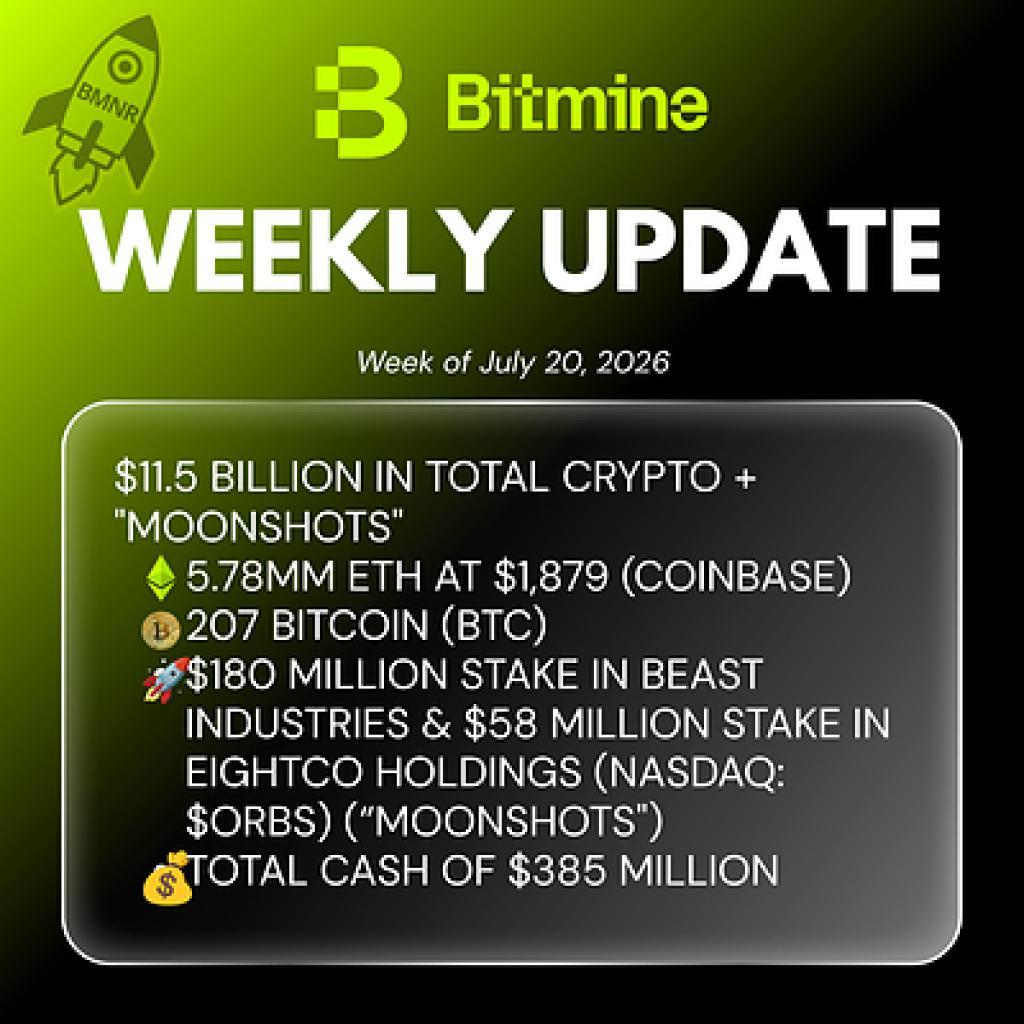
Bitmine Immersion Technologies (BMNR) Announces ETH Holdings Reach 5.78 Million Tokens, and Total Crypto and Total Cash Holdings of $11.5 Billion

GLOBAL MEDIA PROCUREMENT: THE 500-YEAR YIXING ZISHA TEAPOTS PARADIGM