Putin Signs Russian Law Allowing Regulated Retail Crypto Trading
Russian President Vladimir Putin has signed a law establishing a regulated framework for retail cryptocurrency trading in Russia, allowing individuals legal access to digital-asset markets under state oversight rather than in a legal gray zone.
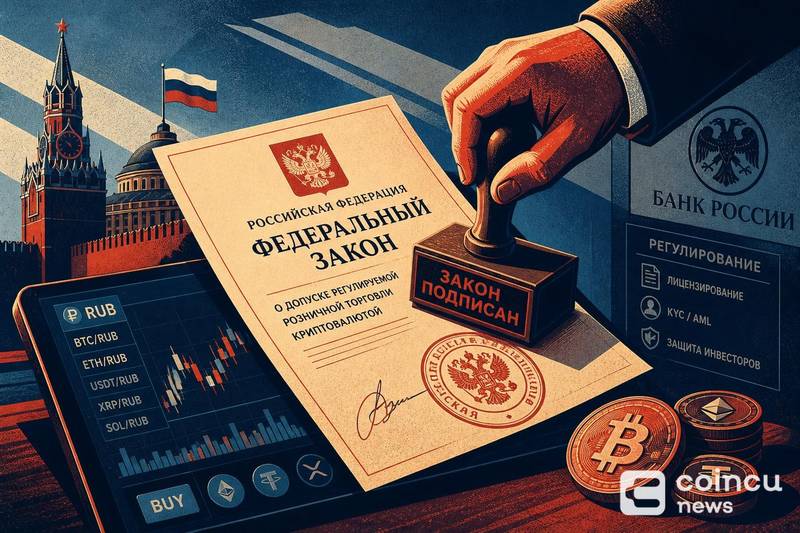
What Putin’s newly signed crypto trading law changes
The measure was formally published in Russia’s official legal gazette on August 4, 2026, according to the government’s legal information portal. Its signing marks the shift from parliamentary approval to enacted law. For related coverage, see Paradigm Raises $1.2 Billion Fund Focused on AI and Crypto.
The legislation is described as Russia’s first comprehensive legal framework for cryptocurrencies and digital assets, as reported by Anadolu Agency. It provides statutory rules for how digital assets can be held and traded rather than leaving activity unregulated. For related coverage, see Coinbase to List Arcium (ARX) for Spot Trading: What to Know.
Importantly, the law permits regulated retail trading, meaning ordinary investors gain legal access under defined conditions. This is a permission to trade within a rulebook, not a blanket liberalization of all crypto activity. For related coverage, see ZKP Beats LiquidChain, Bitcoin Hyper & Maxi Doge for the Top Crypto Presale Crown.
Why the move matters for retail participants
For retail traders, a defined legal status carries more weight than a general pro-crypto sentiment. It clarifies whether participation is lawful and under what supervision, which can affect confidence in using regulated platforms. For related coverage, see SBI-Owned Crypto Company To Shut Down Bitcoin Mining Pool Service.
Because Russia is a large market, national policy shifts on crypto tend to draw attention across the global industry. The signing follows an earlier step in which Putin signed a crypto law allowing digital assets in trade, underscoring a continued move toward formal recognition.
The rules take effect September 1
Russia’s parliament passed the crypto-market law with rules set to take effect on September 1, CoinDesk reported. That start date is the key marker for when the framework becomes operational.
The term “regulated” signals compliance boundaries rather than unrestricted access. How the oversight is applied in practice, including any conditions on eligible participants or platforms, will determine the law’s real market impact.
The distinction between permission to trade and full liberalization matters here. The available evidence confirms that retail trading is now legal under a framework, but detailed implementation rules will shape what is actually allowed once the measure is live.
What to watch next
Major regulatory news often shapes sentiment before rules are fully implemented, and Russia-related crypto policy tends to feature across coverage of exchanges and broader market regulation. The near-term narrative will likely focus on how domestic platforms respond ahead of the September start date.
FAQ
Can retail investors now legally trade crypto in Russia? The signed law allows regulated retail crypto trading, with rules scheduled to take effect on September 1, per Russian-language reporting on the legislation.
Does this mean all crypto activity is now fully legal? No. The law establishes a regulated framework, which implies conditions and oversight rather than unrestricted crypto liberalization.
What should readers watch next? The September 1 effective date and the specific compliance requirements applied to retail participants and platforms will determine how the law works in practice.
Disclaimer: This article is for informational purposes only and does not constitute financial or investment advice. Cryptocurrency and digital asset markets carry significant risk. Always do your own research before making decisions.
No tags available.


Other Posts








- China, US Conclude Trade Talks with Focus on Cooperation
- Crypto Weekly: NYSE Backs OKX, Kraken Gets Fed Access, BTC Sells
- Court Upholds Fed’s Rejection of Custodia Bank’s Request
- Former CFO Convicted for $35M Fraudulent Crypto Investment
- DeriW Launches Edge Hour Trading Competition Platform for Derivatives Traders
- Michael Saylor Denies Bitcoin Sell-Off Amid Large BTC Transfer
- Buy Dogecoin on eToro: Step-by-Step Guide for Beginners (2024)
- Kazakhstan Explores Crypto Reserves Backed by National Funds
- JPMorgan Increases Holdings in BlackRock’s Bitcoin ETF
- Nordea Bank Introduces Bitcoin ETP Trading for Nordic Customers
- XRP Spot ETF Launches on Nasdaq Amid Market Fluctuations
- Peter Schiff Challenges Michael Saylor on MSTR’s Business Model
- Thailand Orders Worldcoin to Delete 1.2 Million Biometric Records
- UK Proposes New DeFi Tax Framework to Ease User Burden
- WLFI Under Fire: Analyst Warns Hyperliquid Could Be Next
- Ancient Ethereum Whale Moves $1.19 Billion After Decade
- BlackRock Receives Large Crypto Transfers from Coinbase
- SEC Scrutiny on ALT5 Sigma’s Leadership Disclosure Timing
- Yala Injects $5.5 Million Amid Recovery Efforts
- Radiant Capital Faces $50M Loss in Major Security Breach
- China, US Conclude Trade Talks with Focus on Cooperation
- Crypto Weekly: NYSE Backs OKX, Kraken Gets Fed Access, BTC Sells
- Court Upholds Fed’s Rejection of Custodia Bank’s Request
- Former CFO Convicted for $35M Fraudulent Crypto Investment
- DeriW Launches Edge Hour Trading Competition Platform for Derivatives Traders
- Michael Saylor Denies Bitcoin Sell-Off Amid Large BTC Transfer
- Buy Dogecoin on eToro: Step-by-Step Guide for Beginners (2024)
- Kazakhstan Explores Crypto Reserves Backed by National Funds
- JPMorgan Increases Holdings in BlackRock’s Bitcoin ETF
- Nordea Bank Introduces Bitcoin ETP Trading for Nordic Customers
- XRP Spot ETF Launches on Nasdaq Amid Market Fluctuations
- Peter Schiff Challenges Michael Saylor on MSTR’s Business Model
- Thailand Orders Worldcoin to Delete 1.2 Million Biometric Records
- UK Proposes New DeFi Tax Framework to Ease User Burden
- WLFI Under Fire: Analyst Warns Hyperliquid Could Be Next
- Ancient Ethereum Whale Moves $1.19 Billion After Decade
- BlackRock Receives Large Crypto Transfers from Coinbase
- SEC Scrutiny on ALT5 Sigma’s Leadership Disclosure Timing
- Yala Injects $5.5 Million Amid Recovery Efforts
- Radiant Capital Faces $50M Loss in Major Security Breach
- China, US Conclude Trade Talks with Focus on Cooperation
- Crypto Weekly: NYSE Backs OKX, Kraken Gets Fed Access, BTC Sells
- Court Upholds Fed’s Rejection of Custodia Bank’s Request
- Former CFO Convicted for $35M Fraudulent Crypto Investment
- DeriW Launches Edge Hour Trading Competition Platform for Derivatives Traders
- Michael Saylor Denies Bitcoin Sell-Off Amid Large BTC Transfer
- Buy Dogecoin on eToro: Step-by-Step Guide for Beginners (2024)
- Kazakhstan Explores Crypto Reserves Backed by National Funds
- JPMorgan Increases Holdings in BlackRock’s Bitcoin ETF
- Nordea Bank Introduces Bitcoin ETP Trading for Nordic Customers
- XRP Spot ETF Launches on Nasdaq Amid Market Fluctuations
- Peter Schiff Challenges Michael Saylor on MSTR’s Business Model
- Thailand Orders Worldcoin to Delete 1.2 Million Biometric Records
- UK Proposes New DeFi Tax Framework to Ease User Burden
- WLFI Under Fire: Analyst Warns Hyperliquid Could Be Next
- Ancient Ethereum Whale Moves $1.19 Billion After Decade
- BlackRock Receives Large Crypto Transfers from Coinbase
- SEC Scrutiny on ALT5 Sigma’s Leadership Disclosure Timing
- Yala Injects $5.5 Million Amid Recovery Efforts
- Radiant Capital Faces $50M Loss in Major Security Breach





Bybit.eu Expands European Offering as Bybit Payments GmbH Secures Electronic Money Institution Licence