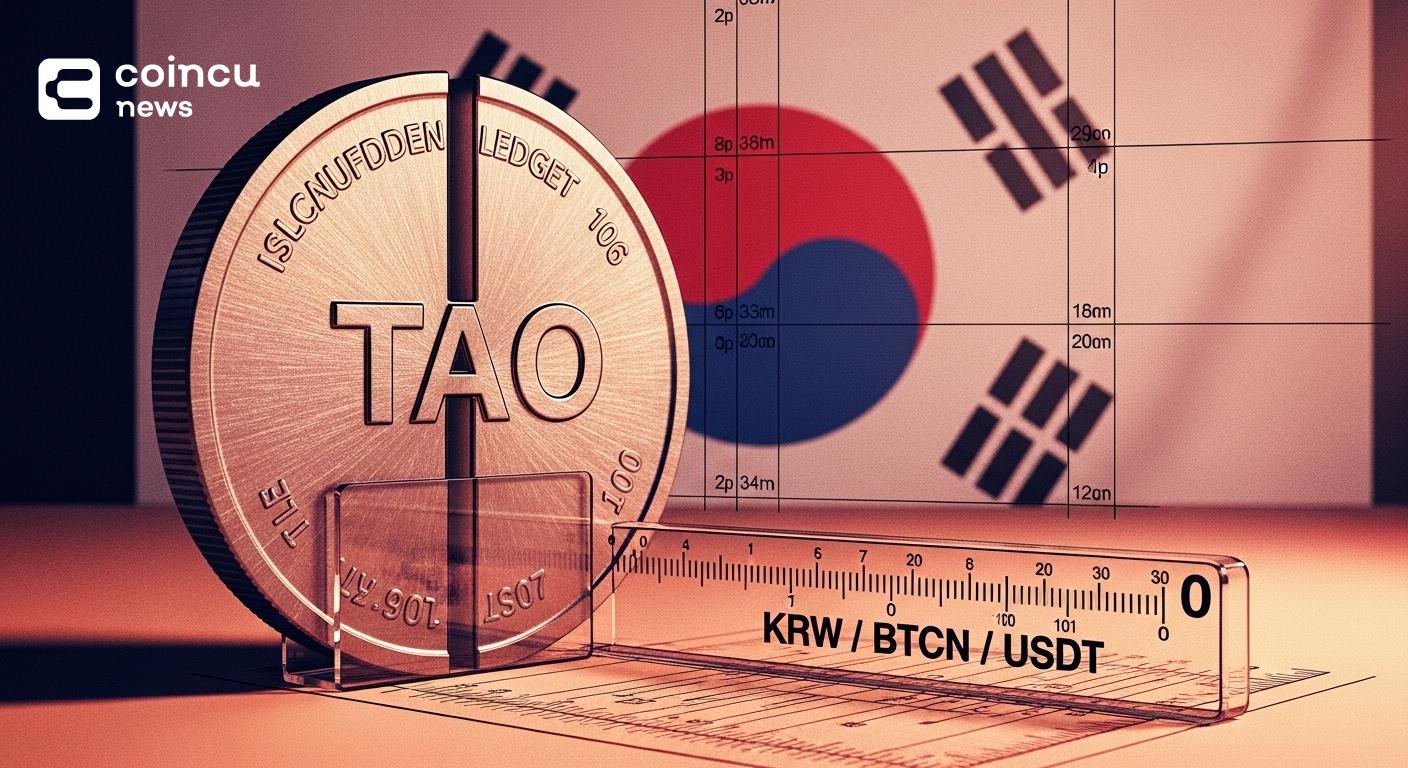
Upbit lists Bittensor (TAO) with KRW, BTC, USDT trading support
Upbit, south korea’s largest cryptocurrency exchange, listed Bittensor (TAO) on February 16, 2026 with KRW, BTC, and USDT spot pairs, according to CryptoRank. The move introduces TAO directly to Korea’s fiat market via KRW while expanding liquidity across BTC and USDT crosses.
The listing formalizes access for domestic traders within a regulated on-ramp and is likely to broaden market participation. It also positions TAO within a venue known for concentrated retail volumes during high-visibility listings.
Why it matters: KRW access, Korean liquidity, and arbitrage flows
KRW pairing provides direct fiat access for Korean market participants and can catalyze cross-venue arbitrage between KRW books and USD- or USDT-denominated markets. CoinMarketCap noted a nearly 8% reaction alongside arbitrage activity after the announcement, underscoring how Korean liquidity can compress or widen spreads across venues.
Community commentary has framed the dynamic as a fast repricing impulse when Korean order flow engages. “The ‘Upbit Effect’ is officially in play for Bittensor (TAO),” said Binance Square in a post.
Immediate impact: ~8% spike, $207 high, pullback below $190
Following the listing, TAO rallied intraday toward roughly $207 before quickly slipping below $190, as reported by CoinPedia. The outlet characterized the pattern as a short-term liquidity sweep rather than evidence of a sustained breakout.
These swings illustrate elevated event-driven volatility common around new exchange listings. Price discovery can be abrupt and two-sided as market makers and arbitrageurs recalibrate inventories across KRW and non-KRW venues.
Trading mechanics and risk signals after the Upbit listing
Deposits and withdrawals: native Bittensor only; no EVM support
Upbit supports TAO deposits and withdrawals only on the native Bittensor network; EVM networks are not supported, according to Wu Blockchain. Using unsupported networks can result in failed credits or irreversible loss, a common operational risk when assets exist across multiple infrastructures.
Volatility, KRW arbitrage, and key levels: $180–185, $200–210
KRW-book participation can widen or compress basis versus USD markets, encouraging arbitrage that often accelerates mean reversion after sharp moves. Based on the $207 intraday high and sub-$190 retracement, traders are watching $200–210 as near-term resistance and $180–185 as initial support. These are interpretive reference zones, not assurances of future behavior.
FAQ about Upbit listing
Does Upbit support TAO deposits and withdrawals only on the native Bittensor network or are EVM networks supported?
Upbit currently supports deposits and withdrawals only on the native Bittensor network; EVM-network TAO transfers are not supported.
How did the Upbit listing affect TAO’s price and volatility (e.g., ~8% jump, $207 intraday high, drop below $190)?
TAO jumped intraday toward $207 after the announcement, then fell below $190, reflecting elevated, listing-driven volatility and short-term arbitrage.
| DISCLAIMER: The information on this website is provided as general market commentary and does not constitute investment advice. We encourage you to do your own research before investing. |


Other Posts









- Amplify 2024: Ohio’s Premier Blockchain Summit
- Polymarket Announces U.S. Beta Relaunch Amid Market Buzz
- China, US Conclude Trade Talks with Focus on Cooperation
- Crypto Weekly: NYSE Backs OKX, Kraken Gets Fed Access, BTC Sells
- CELO holds as Celo reviews Opera 160M token claim
- Michael Saylor Denies Bitcoin Sell-Off Amid Large BTC Transfer
- Court Upholds Fed’s Rejection of Custodia Bank’s Request
- EU Opens Antitrust Probe Into Deutsche Boerse and Nasdaq Derivatives Dealings
- Kazakhstan Explores Crypto Reserves Backed by National Funds
- JPMorgan Increases Holdings in BlackRock’s Bitcoin ETF
- Nordea Bank Introduces Bitcoin ETP Trading for Nordic Customers
- XRP Spot ETF Launches on Nasdaq Amid Market Fluctuations
- JPMorgan Chase Launches 24/7 Digital Deposit Token for Clients
- Crypto Leaders Address Macro Volatility Amid Market Shifts
- Former CFO Convicted for $35M Fraudulent Crypto Investment
- Peter Schiff Challenges Michael Saylor on MSTR’s Business Model
- Thailand Orders Worldcoin to Delete 1.2 Million Biometric Records
- UK Proposes New DeFi Tax Framework to Ease User Burden
- U.S. Treasury Proposes New Tax Relief Regulations
- Uniswap’s UNIfication Proposal Gains Massive Preliminary Support
- Amplify 2024: Ohio’s Premier Blockchain Summit
- Polymarket Announces U.S. Beta Relaunch Amid Market Buzz
- China, US Conclude Trade Talks with Focus on Cooperation
- Crypto Weekly: NYSE Backs OKX, Kraken Gets Fed Access, BTC Sells
- CELO holds as Celo reviews Opera 160M token claim
- Michael Saylor Denies Bitcoin Sell-Off Amid Large BTC Transfer
- Court Upholds Fed’s Rejection of Custodia Bank’s Request
- EU Opens Antitrust Probe Into Deutsche Boerse and Nasdaq Derivatives Dealings
- Kazakhstan Explores Crypto Reserves Backed by National Funds
- JPMorgan Increases Holdings in BlackRock’s Bitcoin ETF
- Nordea Bank Introduces Bitcoin ETP Trading for Nordic Customers
- XRP Spot ETF Launches on Nasdaq Amid Market Fluctuations
- JPMorgan Chase Launches 24/7 Digital Deposit Token for Clients
- Crypto Leaders Address Macro Volatility Amid Market Shifts
- Former CFO Convicted for $35M Fraudulent Crypto Investment
- Peter Schiff Challenges Michael Saylor on MSTR’s Business Model
- Thailand Orders Worldcoin to Delete 1.2 Million Biometric Records
- UK Proposes New DeFi Tax Framework to Ease User Burden
- U.S. Treasury Proposes New Tax Relief Regulations
- Uniswap’s UNIfication Proposal Gains Massive Preliminary Support
- Amplify 2024: Ohio’s Premier Blockchain Summit
- Polymarket Announces U.S. Beta Relaunch Amid Market Buzz
- China, US Conclude Trade Talks with Focus on Cooperation
- Crypto Weekly: NYSE Backs OKX, Kraken Gets Fed Access, BTC Sells
- CELO holds as Celo reviews Opera 160M token claim
- Michael Saylor Denies Bitcoin Sell-Off Amid Large BTC Transfer
- Court Upholds Fed’s Rejection of Custodia Bank’s Request
- EU Opens Antitrust Probe Into Deutsche Boerse and Nasdaq Derivatives Dealings
- Kazakhstan Explores Crypto Reserves Backed by National Funds
- JPMorgan Increases Holdings in BlackRock’s Bitcoin ETF
- Nordea Bank Introduces Bitcoin ETP Trading for Nordic Customers
- XRP Spot ETF Launches on Nasdaq Amid Market Fluctuations
- JPMorgan Chase Launches 24/7 Digital Deposit Token for Clients
- Crypto Leaders Address Macro Volatility Amid Market Shifts
- Former CFO Convicted for $35M Fraudulent Crypto Investment
- Peter Schiff Challenges Michael Saylor on MSTR’s Business Model
- Thailand Orders Worldcoin to Delete 1.2 Million Biometric Records
- UK Proposes New DeFi Tax Framework to Ease User Burden
- U.S. Treasury Proposes New Tax Relief Regulations
- Uniswap’s UNIfication Proposal Gains Massive Preliminary Support
Latest

US Non-Farm Payrolls March 2026: What Crypto Traders Need to Know This Week

Gold Falls 1% as Crude Oil Climbs Over 1% — Global Asset Performance Diverges









Press Release

TxFlow L1 Mainnet Launch Marks a New Phase for Multi-Application On-Chain Finance
Novava Launches a Game-Changing Futures-First Crypto Exchange for Serious Traders