China’s Hainan Bureau Bans RWA Tokenization, Warns of Fake Exchange Volume Fraud
China’s Hainan Provincial Local Financial Management Bureau issued a public risk alert on March 24, 2026, warning citizens against fraudulent entities operating fake exchanges under names like “Hainan International Data Asset Exchange” and reiterating that all RWA tokenization business remains prohibited within mainland China.
The bureau identified three specific unauthorized entities using the province’s name to lend credibility to illegal operations: “Hainan International Data Asset Exchange,” “Hainan Digital Exchange,” and “Hainan Sea Exchange.” None of these entities have received regulatory approval.
“Currently, no such exchange has been approved within our provincial jurisdiction,” the bureau stated, confirming that these operations are entirely fraudulent. The alert referenced the eight-department regulatory framework for “domestic prohibition, overseas strict management” (境内严禁、境外严管) as its legal basis, according to a report from ChainCatcher.
Regulatory Context
September 2021
China’s blanket ban on all cryptocurrency transactions took effect, declared jointly by the People’s Bank of China and nine other central government bodies, forming the legal foundation Hainan regulators are now invoking against RWA tokenization schemes.
Source: People’s Bank of China joint circular, Sept. 2021
The fake entities falsely claimed they could legitimately conduct RWA (Real World Assets) and RDA (Real Data Assets) business. The bureau emphasized that unauthorized organizations are prohibited from using terms like “exchange” or “trading center” in their registered names without proper government approval.
How Fake Exchanges Exploit Provincial Branding
The fraudulent exchanges identified by the Hainan bureau operate by co-opting the province’s reputation as a free trade zone to appear legitimate. Hainan’s special economic status makes it an attractive brand for scammers targeting investors who assume the province has more permissive financial regulations.
These operations typically fabricate trading volumes, order book depth, and price data to create the illusion of a functioning marketplace. Investors deposit funds believing they are participating in a regulated exchange, only to discover withdrawals are blocked or their assets have disappeared.
For retail investors, key warning signs include: exchanges that cannot produce verifiable government approval documentation, platforms not listed on any recognized regulatory registry, and trading venues that use geographic branding (province or city names) without official authorization. Similar scam operations using RWA-themed branding have been reported across multiple Chinese provinces, including Zhejiang, Shanxi, and Dalian, since mid-2025.
The bureau kept its warning general regarding enforcement actions, not disclosing whether arrests or asset seizures have been made against the three named entities. The alert focused on public awareness rather than announcing specific prosecutions. The story was among today’s top crypto headlines as China’s regulatory enforcement continues to draw international attention.
China’s Multi-Step RWA Crackdown: From Industry Warnings to Full Prohibition
RWA tokenization refers to the process of representing ownership of real-world assets, such as real estate, commodities, bonds, or financial instruments, as digital tokens on a blockchain. Globally, the sector has been one of crypto’s fastest-growing narratives, with projections of 185% growth in 2026 before the impact of China’s ban was factored in.
The Hainan bureau’s alert is not a new policy. It is a local enforcement of a national prohibition that has escalated through three distinct stages over the past four months.
In December 2025, seven major Chinese financial associations, including the China Banking Association and the Securities Association of China, jointly declared RWA tokenization illegal and ordered member institutions not to participate. This industry-level warning laid the groundwork for regulatory action.
On February 6, 2026, eight government departments led by the People’s Bank of China (PBOC) and the China Securities Regulatory Commission (CSRC) issued a formal joint notice establishing “domestic prohibition, overseas strict management” (境内严禁、境外严管). The domestic ban is absolute: all forms of RWA issuance, trading, and related services are prohibited within China’s borders.
The prohibition covers a wide scope of activities. No financial institution in China may provide services for unauthorized RWA activities. Internet companies are barred from providing platforms, advertising, or traffic for RWA-related businesses. Local trading venues are explicitly forbidden from conducting any form of RWA token issuance or trading.
Providing intermediary services or technical support for RWA tokenization constitutes illegal financial activity, including unauthorized token issuance, securities violations, and illegal fundraising. The framework represents one of the most comprehensive regulatory approaches to emerging digital asset technology seen globally.
The Hainan bureau’s March 24 alert represents the third stage: local-level enforcement. It references the eight-department regulatory framework and applies it to specific fraudulent operations within its jurisdiction, demonstrating that provincial regulators are actively policing violations, not merely deferring to central government policy.
What This Means for RWA Projects Operating Near China
The distinction between mainland China and Hong Kong is critical for RWA projects and exchanges. Hong Kong operates under a separate regulatory framework that permits certain tokenization activities through its licensed regime. The Hainan bureau’s prohibition, and the broader national ban, applies exclusively to mainland China.
However, this separation is not a loophole. The February 2026 eight-department notice established “overseas strict management” alongside the domestic ban. Offshore RWA activities involving Chinese-based assets or entities require prior regulatory approval. Projects registered in Hong Kong or other jurisdictions cannot freely market RWA products to mainland Chinese nationals.
Louis Wan, CEO of Unified Labs, described the regulatory framework as “a clear separation between virtual currencies and RWA,” noting that while virtual currencies remain outlawed, RWA is being included in the regulatory system. He called it a milestone for China’s approach to digital assets.
Alex Zuo, Senior Vice President at Cobo, offered a more nuanced reading: “This means China is allowing the issuance of offshore tokens based on onshore assets,” suggesting a controlled pathway for compliant cross-border tokenization under strict oversight.
Winston Ma, Adjunct Professor at NYU School of Law, framed it differently: “China’s central bank is essentially highlighting that only its own digital yuan is legitimate.” This interpretation positions the RWA ban as part of China’s broader strategy to consolidate digital currency authority under the state-controlled CBDC.
Christian Ruz, Business Strategy Director at Hype, noted that Chinese investors “already know how to survive these restrictions” and does not anticipate significant market impact, given that most stablecoin and RWA firms operate at a global scale.
For businesses, the practical risk summary is straightforward: any entity providing RWA tokenization services, intermediary support, or technical infrastructure to mainland Chinese users is operating in violation of Chinese law. The penalties include prosecution for illegal fundraising, pyramid schemes, and unauthorized securities offerings.
FAQ: China’s RWA Ban and Fake Exchange Warnings
Is RWA tokenization legal anywhere in mainland China, including free trade zones like Hainan?
No. The February 2026 eight-department notice establishes a blanket domestic prohibition. No free trade zone, special economic zone, or provincial jurisdiction has been granted an exemption. The Hainan bureau explicitly confirmed zero approved RWA exchanges within its jurisdiction.
What is a “fake number exchange” and how can I identify one?
A fake number exchange (假号交易所) is an unauthorized platform that fabricates trading volumes and order book data to appear legitimate. Check whether the platform holds verifiable government approval, is listed on recognized regulatory registries, and has transparent ownership. If an exchange uses a geographic name like a province or city without documented authorization, treat it as a red flag.
Does this prohibition affect stablecoins backed by real-world assets?
The eight-department framework prohibits all forms of RWA-related issuance and trading within China. Stablecoins backed by real-world assets would fall under this prohibition if issued, traded, or serviced within mainland China. The global crypto industry continues to develop these products outside Chinese jurisdiction.
Is Hong Kong affected by this ruling?
Hong Kong operates under a separate regulatory regime and is not subject to the mainland prohibition. However, the “overseas strict management” component means that Hong Kong-based projects involving mainland Chinese assets or targeting mainland investors must obtain prior regulatory approval from Chinese authorities.
What enforcement risks exist for foreign RWA platforms with Chinese users?
Foreign platforms providing RWA services to mainland Chinese nationals risk violating the prohibition. The regulatory framework explicitly bars internet companies from providing platforms, advertising, or traffic for RWA businesses, extending enforcement reach beyond China’s physical borders to digital services accessible by Chinese citizens.
Disclaimer: This article is for informational purposes only and does not constitute financial or investment advice. Cryptocurrency and digital asset markets carry significant risk. Always do your own research before making decisions.

No tags available.


Other Posts







- Amplify 2024: Ohio’s Premier Blockchain Summit
- Polymarket Announces U.S. Beta Relaunch Amid Market Buzz
- China, US Conclude Trade Talks with Focus on Cooperation
- Crypto Weekly: NYSE Backs OKX, Kraken Gets Fed Access, BTC Sells
- CELO holds as Celo reviews Opera 160M token claim
- DeriW Launches Edge Hour Trading Competition Platform for Derivatives Traders
- Michael Saylor Denies Bitcoin Sell-Off Amid Large BTC Transfer
- Court Upholds Fed’s Rejection of Custodia Bank’s Request
- EU Opens Antitrust Probe Into Deutsche Boerse and Nasdaq Derivatives Dealings
- Kazakhstan Explores Crypto Reserves Backed by National Funds
- JPMorgan Increases Holdings in BlackRock’s Bitcoin ETF
- Nordea Bank Introduces Bitcoin ETP Trading for Nordic Customers
- XRP Spot ETF Launches on Nasdaq Amid Market Fluctuations
- JPMorgan Chase Launches 24/7 Digital Deposit Token for Clients
- Crypto Leaders Address Macro Volatility Amid Market Shifts
- Former CFO Convicted for $35M Fraudulent Crypto Investment
- Peter Schiff Challenges Michael Saylor on MSTR’s Business Model
- Thailand Orders Worldcoin to Delete 1.2 Million Biometric Records
- UK Proposes New DeFi Tax Framework to Ease User Burden
- U.S. Treasury Proposes New Tax Relief Regulations
- Amplify 2024: Ohio’s Premier Blockchain Summit
- Polymarket Announces U.S. Beta Relaunch Amid Market Buzz
- China, US Conclude Trade Talks with Focus on Cooperation
- Crypto Weekly: NYSE Backs OKX, Kraken Gets Fed Access, BTC Sells
- CELO holds as Celo reviews Opera 160M token claim
- DeriW Launches Edge Hour Trading Competition Platform for Derivatives Traders
- Michael Saylor Denies Bitcoin Sell-Off Amid Large BTC Transfer
- Court Upholds Fed’s Rejection of Custodia Bank’s Request
- EU Opens Antitrust Probe Into Deutsche Boerse and Nasdaq Derivatives Dealings
- Kazakhstan Explores Crypto Reserves Backed by National Funds
- JPMorgan Increases Holdings in BlackRock’s Bitcoin ETF
- Nordea Bank Introduces Bitcoin ETP Trading for Nordic Customers
- XRP Spot ETF Launches on Nasdaq Amid Market Fluctuations
- JPMorgan Chase Launches 24/7 Digital Deposit Token for Clients
- Crypto Leaders Address Macro Volatility Amid Market Shifts
- Former CFO Convicted for $35M Fraudulent Crypto Investment
- Peter Schiff Challenges Michael Saylor on MSTR’s Business Model
- Thailand Orders Worldcoin to Delete 1.2 Million Biometric Records
- UK Proposes New DeFi Tax Framework to Ease User Burden
- U.S. Treasury Proposes New Tax Relief Regulations
- Amplify 2024: Ohio’s Premier Blockchain Summit
- Polymarket Announces U.S. Beta Relaunch Amid Market Buzz
- China, US Conclude Trade Talks with Focus on Cooperation
- Crypto Weekly: NYSE Backs OKX, Kraken Gets Fed Access, BTC Sells
- CELO holds as Celo reviews Opera 160M token claim
- DeriW Launches Edge Hour Trading Competition Platform for Derivatives Traders
- Michael Saylor Denies Bitcoin Sell-Off Amid Large BTC Transfer
- Court Upholds Fed’s Rejection of Custodia Bank’s Request
- EU Opens Antitrust Probe Into Deutsche Boerse and Nasdaq Derivatives Dealings
- Kazakhstan Explores Crypto Reserves Backed by National Funds
- JPMorgan Increases Holdings in BlackRock’s Bitcoin ETF
- Nordea Bank Introduces Bitcoin ETP Trading for Nordic Customers
- XRP Spot ETF Launches on Nasdaq Amid Market Fluctuations
- JPMorgan Chase Launches 24/7 Digital Deposit Token for Clients
- Crypto Leaders Address Macro Volatility Amid Market Shifts
- Former CFO Convicted for $35M Fraudulent Crypto Investment
- Peter Schiff Challenges Michael Saylor on MSTR’s Business Model
- Thailand Orders Worldcoin to Delete 1.2 Million Biometric Records
- UK Proposes New DeFi Tax Framework to Ease User Burden
- U.S. Treasury Proposes New Tax Relief Regulations
Latest

Bitcoin Slides to $71,000 as Hormuz Tensions Hit Risk Appetite


Binance Alpha GENIUS Airdrop Delay: What Binance Wallet Confirmed
Press Release
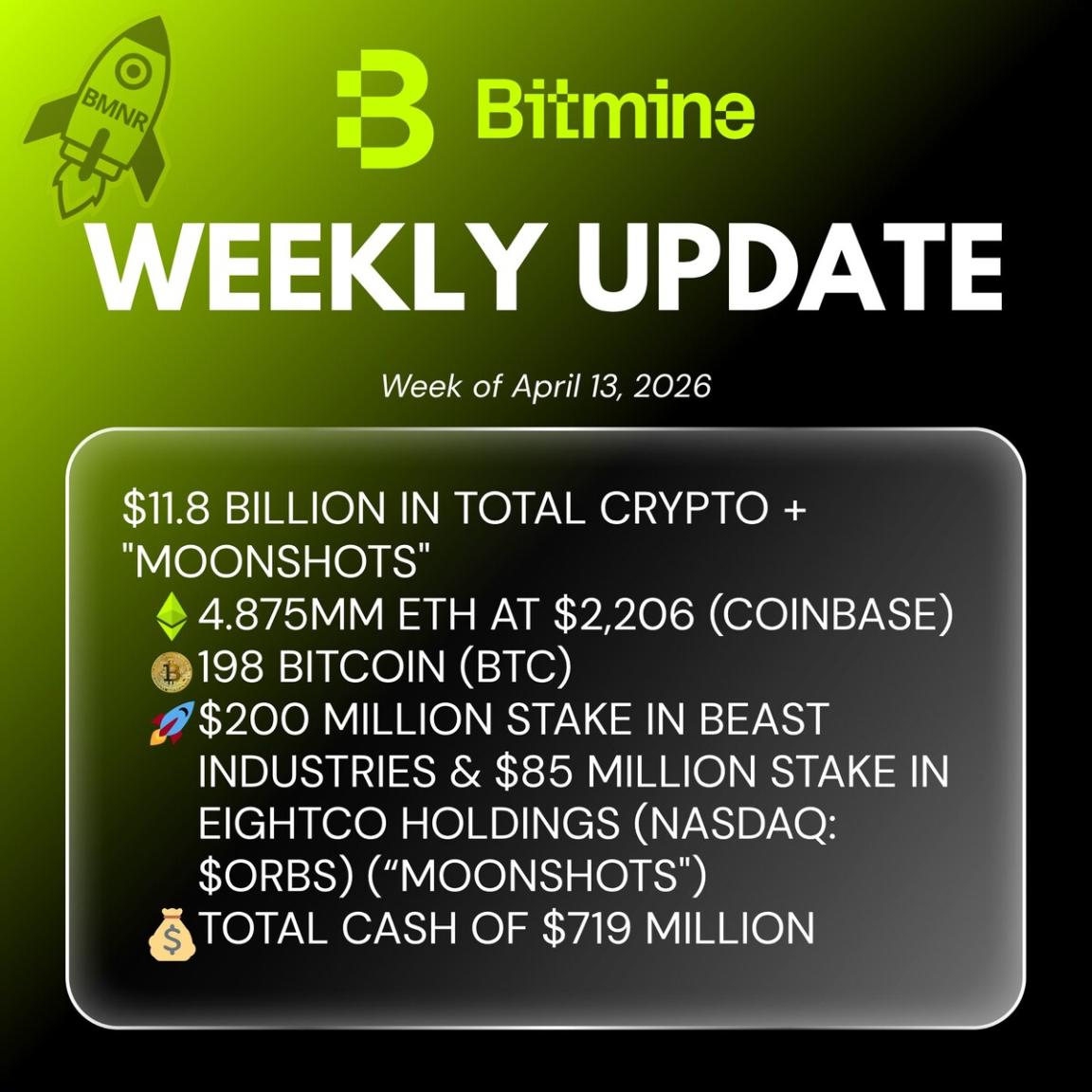
Bitmine Immersion Technologies (BMNR) Announces ETH Holdings Reach 4.875 Million Tokens, and Total Crypto and Total Cash Holdings of $11.8 Billion

Cango’s HPC and AI Inference Subsidiary, EcoHash, Begins Commercial Operations