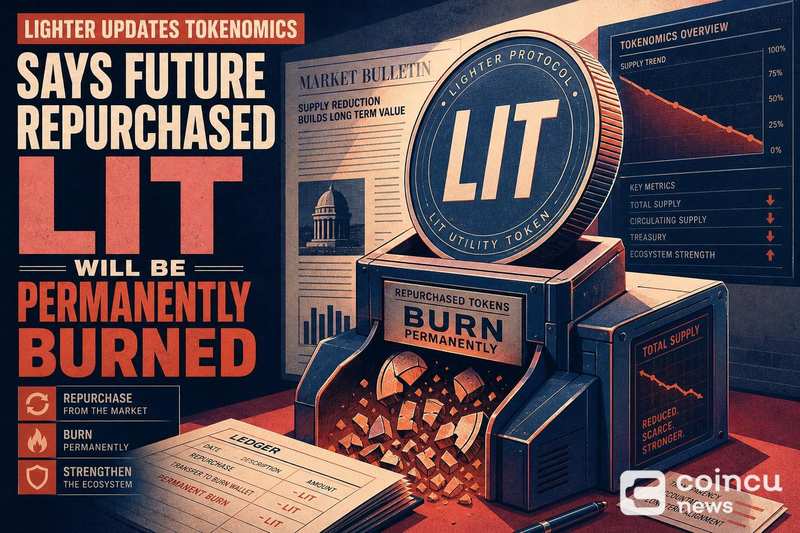

Lighter has announced a tokenomics update stating that all future repurchased LIT tokens will be permanently burned, shifting from a model where bought-back tokens could potentially re-enter circulation to one where they are removed from supply indefinitely.
The announcement, shared by the project on its official X account, frames the change as a deliberate policy commitment rather than a one-time event. Going forward, any LIT acquired through repurchase mechanisms will be sent to a burn address, making the tokens irretrievable.
What Changes Under the New Burn Policy
The core distinction is between repurchasing tokens and repurchasing plus burning them. When a project buys back its own token without burning, those tokens typically sit in a treasury wallet. They remain part of the total supply and could theoretically be redeployed, sold, or redistributed.

Under Lighter’s updated policy, that optionality is eliminated. Repurchased LIT will be permanently destroyed, meaning the tokens cannot be restaked, resold, or used for future incentive programs. The project’s documentation on LIT utility outlines the token’s role within the Lighter ecosystem.
The practical impact on circulating supply depends entirely on the volume and frequency of future repurchases. A burn policy without significant buyback activity would have minimal effect on token economics, so holders will need to monitor actual execution over time.
Strategic Intent Behind the Move
Token burn policies are a common mechanism in crypto projects seeking to introduce deflationary pressure on their native asset. By committing to permanent removal rather than treasury retention, Lighter signals a stronger stance on supply discipline than passive buyback-and-hold strategies.
The move could serve multiple purposes: reinforcing a scarcity narrative, aligning team incentives with long-term holders, and reducing concerns about future token dumps from project-controlled wallets. However, it is important to distinguish between the policy announcement and measurable results, as the update itself does not indicate any immediate change in network activity or revenue generation.
This type of tokenomics adjustment has become increasingly common across DeFi protocols as projects look for ways to differentiate their token models. In the broader crypto space, regulatory actions continue to shape how projects structure their token economics, as seen in cases where Dutch prosecutors have sought to declare crypto platforms bankrupt over compliance failures.
What LIT Holders Should Watch
For current LIT holders, the announcement changes supply expectations but not immediate circulating supply. No tokens have been burned under the new policy yet, and the update applies specifically to future repurchases, not to any previously acquired tokens that may already sit in project wallets.
Short-term sentiment may respond positively to the deflationary framing, but long-term impact hinges on execution. Key variables include how frequently Lighter conducts repurchases, the dollar volume of those buybacks, and whether the project provides transparent on-chain verification of burn transactions.
Transparency will be critical. Projects that announce burn mechanisms but fail to provide verifiable proof of execution tend to lose credibility over time. Holders should look for burn transaction hashes on the relevant block explorer to confirm that repurchased tokens are actually being sent to a provably unrecoverable address.
As crypto markets continue to evolve, investors are paying closer attention to tokenomics fundamentals. Regulatory developments, including the SEC’s ongoing review of ETF rules for crypto funds, underscore the growing scrutiny applied to digital asset structures.
FAQ About Lighter’s LIT Burn Update
Does this policy apply to previously repurchased LIT?
The announcement specifies that all future repurchased LIT will be burned. It does not indicate retroactive application to tokens already held in project wallets.
What does “permanently burned” mean in practice?
Permanently burning a token means sending it to a wallet address from which it can never be retrieved. This removes the token from both circulating and total effective supply.
Will this immediately reduce circulating supply?
No. The policy establishes a framework for future burns. Actual supply reduction will only occur as repurchases are executed and the acquired tokens are sent to burn addresses.
How can holders verify that burns are happening?
Holders should monitor the project’s official communications for burn transaction hashes, which can be verified on the appropriate blockchain explorer to confirm tokens were sent to an irrecoverable address.
Additional source references: source document 1.
Disclaimer: This article is for informational purposes only and does not constitute financial or investment advice. Cryptocurrency and digital asset markets carry significant risk. Always do your own research before making decisions.