Spot Ethereum ETF vs Ethereum Futures ETF in 2026: Key Differences That Matter
Spot Ethereum ETF vs Ethereum Futures ETF in 2026: Key Differences That Matter
Updated July 8, 2026
Quick Answer
The biggest difference between a spot Ethereum ETF and an Ethereum futures ETF is simple:
- a spot Ethereum ETF holds or tracks actual ether exposure through a spot trust structure
- an Ethereum futures ETF gains exposure through CME-listed ether futures contracts rather than holding spot ETH directly
In practice, that means spot Ethereum ETFs are usually the cleaner choice for investors who want price exposure that more closely follows ether itself. Ethereum futures ETFs can still be useful, but they add futures-specific issues such as contract roll cost, collateral management, and performance slippage over time.
Why This Comparison Matters More in 2026
This topic changed once U.S. spot Ethereum ETFs became real products rather than a pending narrative.
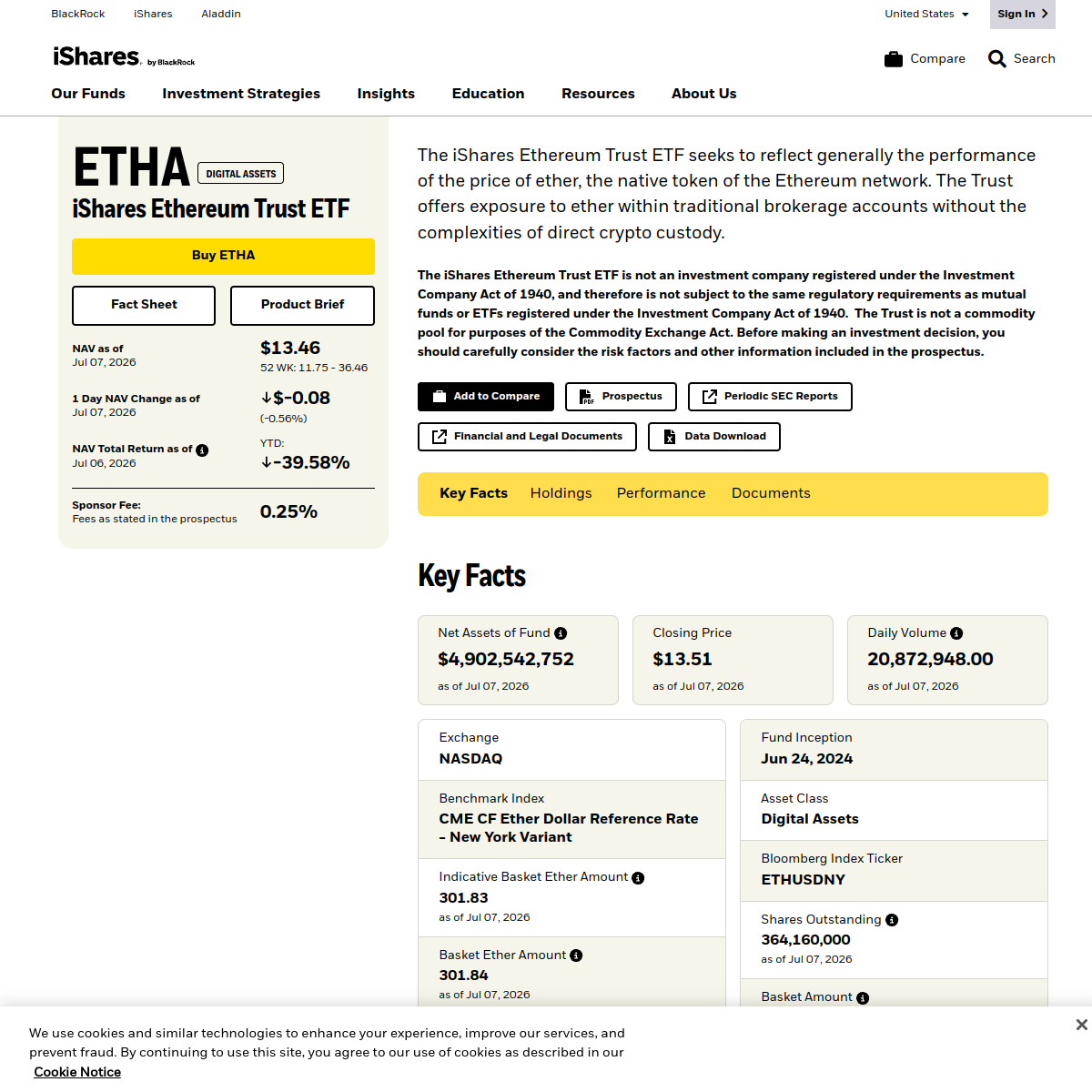
By July 2026, investors can compare live spot products such as the iShares Ethereum Trust ETF (ETHA) with futures-based products such as the ProShares Ether ETF (EETH). That changes the question from “Will a spot ETF be approved?” to “Which structure actually fits my goal?”
The answer depends less on headlines and more on fund mechanics.
The Core Difference in One Table
| Feature | Spot Ethereum ETF | Ethereum Futures ETF |
|---|---|---|
| Exposure method | Tracks spot ETH through a trust holding ether | Uses CME ether futures contracts |
| Direct ETH custody | Yes, through fund/custodian structure | No direct ether held in the fund portfolio as primary exposure |
| Main tracking issue | Premium/discount and sponsor fee | Roll cost, term structure, collateral drag |
| Regulatory structure | Often trust-based digital-asset vehicle | Usually 1940 Act fund structure |
| Best fit | Investors seeking cleaner ETH price exposure | Investors who prefer futures-based structure or want to avoid direct spot custody exposure in the fund |
| Main trade-off | Spot-asset risk remains | Performance can diverge from spot ETH over time |
How Spot Ethereum ETFs Work
A spot Ethereum ETF is designed to reflect the price of ether more directly.
BlackRock’s iShares Ethereum Trust ETF says the fund seeks to reflect generally the performance of the price of ether and offers exposure within a traditional brokerage account without requiring the investor to handle direct crypto custody themselves. VanEck’s Ethereum ETF uses similar language, describing itself as a passive vehicle that tracks the price of ETH.
That structure matters because the fund is built around ether exposure itself, not around derivatives layered on top of it.
What spot ETFs usually do better
- price exposure tends to be cleaner over longer holding periods
- investors do not need to manage wallets or private keys themselves
- the structure is easier to explain to readers who simply want ETH exposure in a brokerage account
What spot ETFs still do not solve
- they do not remove ETH market risk
- the investor still pays fund fees
- the product may behave differently from self-custodied ETH in areas such as staking participation, onchain utility, or wallet-level control
How Ethereum Futures ETFs Work
An Ethereum futures ETF gets exposure through CME ether futures rather than by holding spot ETH directly.
CME says its ether futures are cash-settled contracts based on the CME CF Ether-Dollar Reference Rate. ProShares says its EETH fund invests in futures and does not directly invest in ether. The fund also markets a structural distinction: it operates inside a 1940 Act ETF framework and avoids direct ether custody risk inside the fund itself.
That creates a different risk-and-cost profile from spot ETFs.
What futures ETFs may do better
- some investors prefer the more familiar derivatives-fund structure
- the fund avoids holding spot ether directly
- futures-based products may appeal to allocators already comfortable with commodity-linked ETFs
What futures ETFs usually get criticized for
- contract roll can create drag when futures trade above spot
- performance can diverge from spot ETH over longer holding periods
- the product is more complex than it first appears
Tracking Difference: Where the Gap Usually Shows Up
For many investors, this is the real decision point.
A spot Ethereum ETF is usually easier to hold as a simple ETH-price exposure tool because the structure is closer to the underlying asset. A futures ETF can still track ETH directionally, but it does so through contracts that expire and must be rolled.
That means spot ETFs often make more sense for investors asking:
- “I want ETH exposure in my brokerage account”
- “I care about long-term tracking more than derivatives structure”
Futures ETFs may be more relevant for investors asking:
- “I am comfortable with futures-linked products”
- “I want ETH exposure but do not want the fund itself holding spot ether”
Regulatory Structure Is Not the Same
One of the most misunderstood parts of this comparison is that the two products do not sit in exactly the same wrapper.
The iShares Ethereum Trust ETF says it is not an investment company registered under the Investment Company Act of 1940. By contrast, ProShares highlights the Investment Company Act protections of its futures-based Ether ETF.
That does not automatically make one product “safe” and the other “unsafe.” It means the wrapper, rules, and investor expectations are different.
Readers comparing these products should treat the legal structure as part of the product design, not as a side note.
Costs Matter, But Not Only the Headline Fee
It is easy to compare the visible fee and stop there. That is incomplete.
For spot Ethereum ETFs, the visible cost is usually the sponsor fee plus any premium/discount behavior. For futures ETFs, the visible expense ratio is only part of the story because the fund may also face roll-related costs or other structural drag depending on the futures curve and portfolio management.
That is why a futures ETF can look straightforward at first glance but still underperform spot ETH over time even when it broadly follows the same direction.
Which Type of Ethereum ETF Fits Different Investors?
If you only want a practical chooser:
- choose a spot Ethereum ETF if you want cleaner ETH price exposure inside a brokerage account
- consider a futures ETF if you specifically prefer a futures-based fund structure and understand that it may not track spot ETH as tightly over time
More specifically:
- a long-term “just give me ETH exposure” investor will usually find spot ETFs easier to justify
- a structure-sensitive investor who already uses futures-linked commodity ETFs may be more comfortable with a futures ETF
What These Products Still Do Not Give You
Neither structure is the same as using Ethereum onchain.
Even a spot ETH ETF does not give you:
- direct self-custody
- native staking participation unless the specific product structure includes it
- wallet-level utility for DeFi, NFTs, or smart-contract interaction
That matters because some readers compare ETFs against self-custodied ETH, while others compare ETFs only against each other. Those are different decisions.
FAQ
Is a spot Ethereum ETF better than an Ethereum futures ETF?
For many long-term investors seeking simple ETH price exposure, yes. Spot Ethereum ETFs usually provide cleaner exposure to ether itself. Futures ETFs can still be useful, but they introduce contract-roll and tracking issues that spot products generally reduce.
Why can a futures ETF underperform spot ETH?
Because the fund may need to roll futures contracts over time, and that process can create drag depending on market structure. The visible expense ratio is not the only cost investors should consider.
Does a spot Ethereum ETF hold actual ETH?
In practical product terms, yes, spot Ethereum ETFs are built around spot ether exposure through trust and custodian arrangements rather than through futures contracts. Investors still do not directly control the underlying ETH themselves.
Does an Ethereum futures ETF hold ether?
Not as its main exposure mechanism. A futures ETF primarily uses CME ether futures contracts, plus cash and collateral management, rather than holding spot ETH directly.
Final Takeaway
The cleanest way to think about this comparison in 2026 is:
- spot Ethereum ETFs are usually the simpler tool for investors who want ETH exposure
- Ethereum futures ETFs are more structure-dependent products that can still work, but they require a better understanding of futures mechanics
That does not make futures ETFs useless. It means they should not be treated as interchangeable with spot ETH exposure just because both products have “Ethereum ETF” in the name.
References
- iShares Ethereum Trust ETF (
ETHA): https://www.ishares.com/us/products/337614/ishares-ethereum-trust-etf - VanEck Ethereum ETF (
ETHV): https://www.vaneck.com/us/en/investments/ethereum-etf-ethv/overview/ - ProShares Ether ETF (
EETH): https://prod.proshares.com/our-etfs/strategic/eeth - CME Ether futures product overview: https://www.cmegroup.com/education/courses/introduction-to-ether/ether-futures-product-overview
- CME ether futures trading page: https://www.cmegroup.com/trading/ether-futures.html
Internal Link Opportunities
- Bitcoin spot ETF vs futures ETF explainer: https://coincu.com/bitcoin-spot-etf-vs-futures-etf/
- What is crypto custody: https://coincu.com/what-is-crypto-custody/
- Ethereum explainer or ETF explainer page if available: add nearest live Coincu ETH guide
Media Plan
Featured image:
- split visual showing spot ETH exposure on one side and futures-contract exposure on the other
- avoid price-chart hero styling
Suggested inline media:
- ETHA product page capture
- CME ether futures specification capture
- EETH fund overview capture
Caption direction:
- reinforce structure difference rather than market prediction
Disclosure
This article is for informational purposes only and does not constitute investment advice. Fund fees, structures, distributions, and legal documents can change, so readers should review the latest prospectus and official product pages before making any allocation decision.




- China, US Conclude Trade Talks with Focus on Cooperation
- Crypto Weekly: NYSE Backs OKX, Kraken Gets Fed Access, BTC Sells
- Court Upholds Fed’s Rejection of Custodia Bank’s Request
- Former CFO Convicted for $35M Fraudulent Crypto Investment
- DeriW Launches Edge Hour Trading Competition Platform for Derivatives Traders
- Michael Saylor Denies Bitcoin Sell-Off Amid Large BTC Transfer
- Buy Dogecoin on eToro: Step-by-Step Guide for Beginners (2024)
- Kazakhstan Explores Crypto Reserves Backed by National Funds
- JPMorgan Increases Holdings in BlackRock’s Bitcoin ETF
- Nordea Bank Introduces Bitcoin ETP Trading for Nordic Customers
- XRP Spot ETF Launches on Nasdaq Amid Market Fluctuations
- Peter Schiff Challenges Michael Saylor on MSTR’s Business Model
- Thailand Orders Worldcoin to Delete 1.2 Million Biometric Records
- UK Proposes New DeFi Tax Framework to Ease User Burden
- WLFI Under Fire: Analyst Warns Hyperliquid Could Be Next
- Ancient Ethereum Whale Moves $1.19 Billion After Decade
- BlackRock Receives Large Crypto Transfers from Coinbase
- SEC Scrutiny on ALT5 Sigma’s Leadership Disclosure Timing
- Yala Injects $5.5 Million Amid Recovery Efforts
- Radiant Capital Faces $50M Loss in Major Security Breach
- China, US Conclude Trade Talks with Focus on Cooperation
- Crypto Weekly: NYSE Backs OKX, Kraken Gets Fed Access, BTC Sells
- Court Upholds Fed’s Rejection of Custodia Bank’s Request
- Former CFO Convicted for $35M Fraudulent Crypto Investment
- DeriW Launches Edge Hour Trading Competition Platform for Derivatives Traders
- Michael Saylor Denies Bitcoin Sell-Off Amid Large BTC Transfer
- Buy Dogecoin on eToro: Step-by-Step Guide for Beginners (2024)
- Kazakhstan Explores Crypto Reserves Backed by National Funds
- JPMorgan Increases Holdings in BlackRock’s Bitcoin ETF
- Nordea Bank Introduces Bitcoin ETP Trading for Nordic Customers
- XRP Spot ETF Launches on Nasdaq Amid Market Fluctuations
- Peter Schiff Challenges Michael Saylor on MSTR’s Business Model
- Thailand Orders Worldcoin to Delete 1.2 Million Biometric Records
- UK Proposes New DeFi Tax Framework to Ease User Burden
- WLFI Under Fire: Analyst Warns Hyperliquid Could Be Next
- Ancient Ethereum Whale Moves $1.19 Billion After Decade
- BlackRock Receives Large Crypto Transfers from Coinbase
- SEC Scrutiny on ALT5 Sigma’s Leadership Disclosure Timing
- Yala Injects $5.5 Million Amid Recovery Efforts
- Radiant Capital Faces $50M Loss in Major Security Breach
- China, US Conclude Trade Talks with Focus on Cooperation
- Crypto Weekly: NYSE Backs OKX, Kraken Gets Fed Access, BTC Sells
- Court Upholds Fed’s Rejection of Custodia Bank’s Request
- Former CFO Convicted for $35M Fraudulent Crypto Investment
- DeriW Launches Edge Hour Trading Competition Platform for Derivatives Traders
- Michael Saylor Denies Bitcoin Sell-Off Amid Large BTC Transfer
- Buy Dogecoin on eToro: Step-by-Step Guide for Beginners (2024)
- Kazakhstan Explores Crypto Reserves Backed by National Funds
- JPMorgan Increases Holdings in BlackRock’s Bitcoin ETF
- Nordea Bank Introduces Bitcoin ETP Trading for Nordic Customers
- XRP Spot ETF Launches on Nasdaq Amid Market Fluctuations
- Peter Schiff Challenges Michael Saylor on MSTR’s Business Model
- Thailand Orders Worldcoin to Delete 1.2 Million Biometric Records
- UK Proposes New DeFi Tax Framework to Ease User Burden
- WLFI Under Fire: Analyst Warns Hyperliquid Could Be Next
- Ancient Ethereum Whale Moves $1.19 Billion After Decade
- BlackRock Receives Large Crypto Transfers from Coinbase
- SEC Scrutiny on ALT5 Sigma’s Leadership Disclosure Timing
- Yala Injects $5.5 Million Amid Recovery Efforts
- Radiant Capital Faces $50M Loss in Major Security Breach


Bonzo Finance Oracle Attack Triggers Approximate $9 Million Loss

AFX Surpasses $1.1 Billion in Total Trading Volume, Highlighting Capital Efficiency in On-Chain Derivatives