Assembly of Experts must act as soon as possible under Article 111
Iran’s constitution requires the clerical Assembly of Experts to appoint a new Supreme Leader “as soon as possible” once the position becomes vacant, as reported by the Associated Press. The mandate is procedural, not predictive: it compels rapid action but does not fix a public deadline.
Until that vote, Article 111 provides for an interim leadership council to discharge the Leader’s powers, according to the Assembly of Experts entry on Wikipedia. That council operates only until the Assembly completes its selection and formalizes the succession.
Why this matters now: continuity via interim leadership council
Continuity mechanisms help stabilize command and governance while deliberations proceed, especially amid conflict. The interim council is designed to keep state functions and security oversight intact until a successor is confirmed.
The process could deviate from a neat legal script under wartime pressure, said Suzanne Maloney of the Brookings Institution, as reported by the Washington Post. She cautioned that sequencing and tempo may be more improvised than textbook.
Immediate signals: timeline, announcement channel, official statements
Officials have begun signaling a compressed timeline for the Assembly’s decision. “Maybe in one or two days, they will elect a new leader,” said Abbas Araghchi, Iran’s foreign minister, in remarks aired by Al Jazeera and reported by Yahoo news.
Separately, Assembly cleric Ahmad Khatami said candidates have been determined and selection would come soon, as reported by China Daily Hong Kong. That framing aligns the constitutional “as soon as possible” requirement with an expedited, but not guaranteed, window.
On the announcement channel, Assembly member Mahmoud Rajabi stated that the final result “will be announced through the Secretariat of the Assembly of Experts,” according to News.am. This indicates a centralized, formal release rather than fragmented briefings.
Some officials have also emphasized that ongoing hostilities complicate logistics and deliberations, even as they invoke the duty to act quickly. In practice, public signaling of speed may coexist with procedural caution.
At the time of this writing, Bitcoin (BTC) traded near $71,289 with medium day-to-day volatility and a neutral 14‑day RSI, reflecting guarded risk sentiment in crypto markets.
Candidate landscape and what each choice could signal
Mojtaba Khamenei mentioned; official denies appointment reports
Mojtaba Khamenei has been repeatedly profiled as a potential contender in scholarly and media analyses, as noted by The Conversation. Mentions of his candidacy reflect name recognition, not confirmation of selection.
An Iranian official in India publicly said no successor had yet been chosen, as reported by the Economic Times. That denial underscores why appointment claims should be treated cautiously until the Assembly’s Secretariat issues a formal notice.
Wartime context may shape the succession process
Choices will be interpreted as policy signals. Selecting a strongly anti‑Western figure could indicate limited scope for accommodation with Washington, according to the Guardian.
Wartime constraints may still shape sequencing, venues, and how consensus is managed inside the Assembly, as reported by Le Monde. Even with urgency, institutional bargaining and security conditions can extend deliberations.
FAQ about Assembly of Experts
Who runs the country in the interim, and what exactly does the interim leadership council do?
A three‑person interim leadership council temporarily executes the Supreme Leader’s duties until the Assembly of Experts elects a successor under Article 111.
How long could the Assembly of Experts take to elect the next Supreme Leader, and are officials signaling a one-to-two-day timeline?
Some officials floated a one‑to‑two‑day window, but wartime conditions introduce uncertainty and the timeline could extend beyond early signaling.
| DISCLAIMER: The information on this website is provided as general market commentary and does not constitute investment advice. We encourage you to do your own research before investing. |


Other Posts








- China, US Conclude Trade Talks with Focus on Cooperation
- Crypto Weekly: NYSE Backs OKX, Kraken Gets Fed Access, BTC Sells
- Court Upholds Fed’s Rejection of Custodia Bank’s Request
- Former CFO Convicted for $35M Fraudulent Crypto Investment
- DeriW Launches Edge Hour Trading Competition Platform for Derivatives Traders
- Michael Saylor Denies Bitcoin Sell-Off Amid Large BTC Transfer
- Buy Dogecoin on eToro: Step-by-Step Guide for Beginners (2024)
- Kazakhstan Explores Crypto Reserves Backed by National Funds
- JPMorgan Increases Holdings in BlackRock’s Bitcoin ETF
- Nordea Bank Introduces Bitcoin ETP Trading for Nordic Customers
- XRP Spot ETF Launches on Nasdaq Amid Market Fluctuations
- Peter Schiff Challenges Michael Saylor on MSTR’s Business Model
- Thailand Orders Worldcoin to Delete 1.2 Million Biometric Records
- UK Proposes New DeFi Tax Framework to Ease User Burden
- WLFI Under Fire: Analyst Warns Hyperliquid Could Be Next
- Ancient Ethereum Whale Moves $1.19 Billion After Decade
- BlackRock Receives Large Crypto Transfers from Coinbase
- SEC Scrutiny on ALT5 Sigma’s Leadership Disclosure Timing
- Yala Injects $5.5 Million Amid Recovery Efforts
- Radiant Capital Faces $50M Loss in Major Security Breach
- China, US Conclude Trade Talks with Focus on Cooperation
- Crypto Weekly: NYSE Backs OKX, Kraken Gets Fed Access, BTC Sells
- Court Upholds Fed’s Rejection of Custodia Bank’s Request
- Former CFO Convicted for $35M Fraudulent Crypto Investment
- DeriW Launches Edge Hour Trading Competition Platform for Derivatives Traders
- Michael Saylor Denies Bitcoin Sell-Off Amid Large BTC Transfer
- Buy Dogecoin on eToro: Step-by-Step Guide for Beginners (2024)
- Kazakhstan Explores Crypto Reserves Backed by National Funds
- JPMorgan Increases Holdings in BlackRock’s Bitcoin ETF
- Nordea Bank Introduces Bitcoin ETP Trading for Nordic Customers
- XRP Spot ETF Launches on Nasdaq Amid Market Fluctuations
- Peter Schiff Challenges Michael Saylor on MSTR’s Business Model
- Thailand Orders Worldcoin to Delete 1.2 Million Biometric Records
- UK Proposes New DeFi Tax Framework to Ease User Burden
- WLFI Under Fire: Analyst Warns Hyperliquid Could Be Next
- Ancient Ethereum Whale Moves $1.19 Billion After Decade
- BlackRock Receives Large Crypto Transfers from Coinbase
- SEC Scrutiny on ALT5 Sigma’s Leadership Disclosure Timing
- Yala Injects $5.5 Million Amid Recovery Efforts
- Radiant Capital Faces $50M Loss in Major Security Breach
- China, US Conclude Trade Talks with Focus on Cooperation
- Crypto Weekly: NYSE Backs OKX, Kraken Gets Fed Access, BTC Sells
- Court Upholds Fed’s Rejection of Custodia Bank’s Request
- Former CFO Convicted for $35M Fraudulent Crypto Investment
- DeriW Launches Edge Hour Trading Competition Platform for Derivatives Traders
- Michael Saylor Denies Bitcoin Sell-Off Amid Large BTC Transfer
- Buy Dogecoin on eToro: Step-by-Step Guide for Beginners (2024)
- Kazakhstan Explores Crypto Reserves Backed by National Funds
- JPMorgan Increases Holdings in BlackRock’s Bitcoin ETF
- Nordea Bank Introduces Bitcoin ETP Trading for Nordic Customers
- XRP Spot ETF Launches on Nasdaq Amid Market Fluctuations
- Peter Schiff Challenges Michael Saylor on MSTR’s Business Model
- Thailand Orders Worldcoin to Delete 1.2 Million Biometric Records
- UK Proposes New DeFi Tax Framework to Ease User Burden
- WLFI Under Fire: Analyst Warns Hyperliquid Could Be Next
- Ancient Ethereum Whale Moves $1.19 Billion After Decade
- BlackRock Receives Large Crypto Transfers from Coinbase
- SEC Scrutiny on ALT5 Sigma’s Leadership Disclosure Timing
- Yala Injects $5.5 Million Amid Recovery Efforts
- Radiant Capital Faces $50M Loss in Major Security Breach

Lightning Labs Launches Wavelength Ark-Style Bitcoin Payment Platform


U.S. Congress Debates Crypto Ethics as DeFi Provisions Stay Under Negotiation
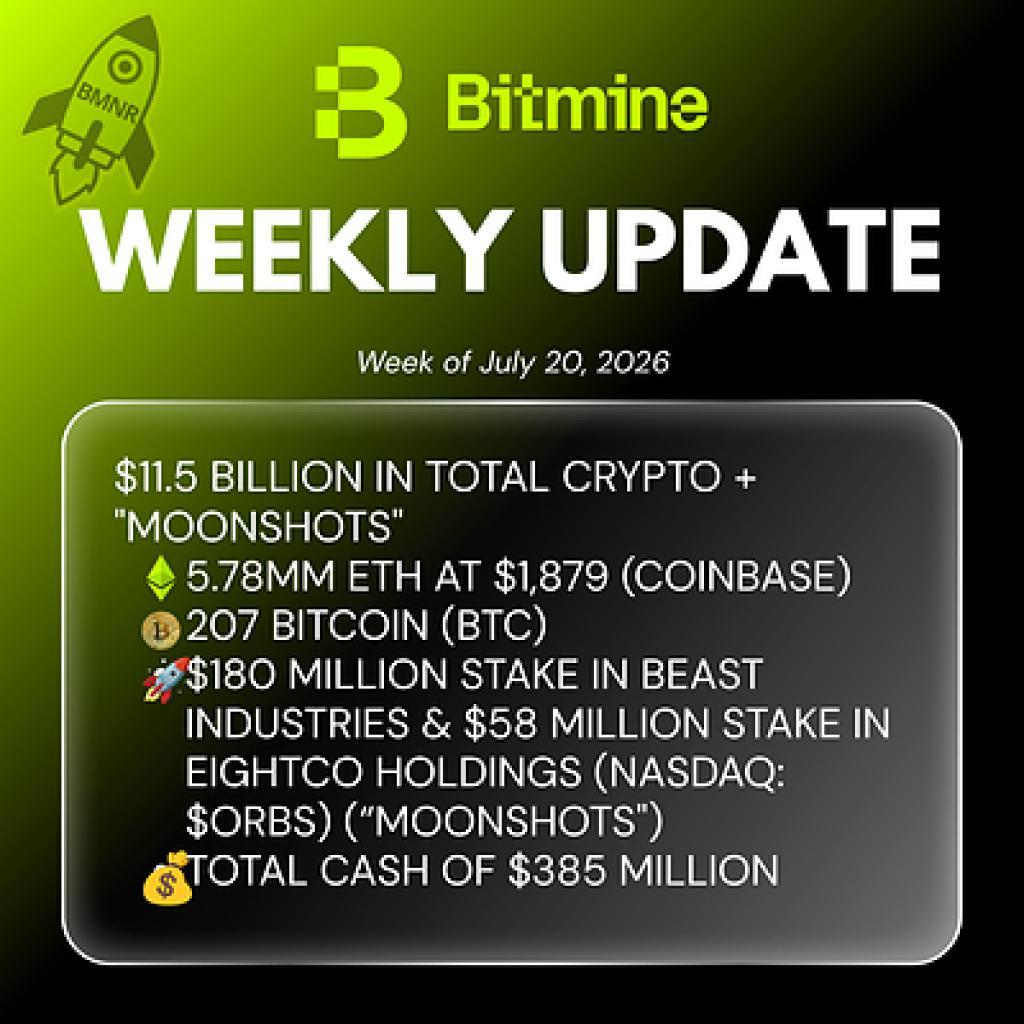
Bitmine Immersion Technologies (BMNR) Announces ETH Holdings Reach 5.78 Million Tokens, and Total Crypto and Total Cash Holdings of $11.5 Billion

GLOBAL MEDIA PROCUREMENT: THE 500-YEAR YIXING ZISHA TEAPOTS PARADIGM