What Is USD.AI (CHIP)? How the AI-Credit Protocol Works
What makes USD.AI interesting is that it sits at the intersection of synthetic dollars, real-yield products, and private-credit style AI infrastructure finance. It is also what makes the project harder to evaluate than a simpler DeFi protocol, because the thesis depends not only on token demand but on underwriting, legal enforceability, borrower quality, and whether AI hardware finance becomes a durable crypto narrative.
Table of Contents
Key Takeaways
- USD.AI is not just an AI token. It is a synthetic-dollar and yield protocol tied to AI
infrastructure credit. - CHIP is the governance and utility token, which means buyers are pricing exposure to the protocol
narrative, not just a standalone asset. - The project stands out because it combines synthetic dollars, yield products, and GPU-backed
credit into one structure.
What USD.AI Is
The clean way to read USD.AI is to separate the protocol from the token.
The asset trading on CoinMarketCap is CHIP, but CHIP is not the synthetic dollar itself. It sits above a broader system designed to connect depositors, a savings layer, and AI-infrastructure borrowers.
At a high level, the structure looks like this:
| Piece | What it does | Why it matters |
|---|---|---|
| USDai | Synthetic dollar layer | This is the base asset users hold and move through the system |
| sUSDai | Yield-bearing version of USDai | This is where the protocol expresses the savings side of the product |
| CHIP | Governance and utility token | This is the asset the market buys when it wants exposure to protocol upside rather than just dollar stability |
That distinction matters because many readers instinctively compare CHIP to a stablecoin or to a generic DeFi launch token. Neither comparison is quite right. CHIP functions more like the speculative and governance layer sitting on top of the protocol’s monetary and credit engine.
The deeper thesis is that USD.AI wants to connect three demands that usually live in separate conversations:
| Demand layer | What users or markets want |
|---|---|
| Onchain dollar demand | A transferable dollar-like asset |
| Onchain yield demand | A savings product that can offer attractive return |
| AI compute financing demand | Credit for hardware fleets and infrastructure tied to the AI economy |
The project is therefore not just saying “hold a dollar and earn yield.” It is saying that the yield side can be connected to a specific real-economy financing market, namely AI compute infrastructure.
How the machine is supposed to work
Depositors enter the USD.AI system through the dollar side, those dollars connect to a credit engine, that credit engine is aimed at financing AI infrastructure borrowers, and the yield from that system then supports the savings layer. CHIP sits above that structure as the token that governs and captures protocol-level upside if the whole mechanism grows.
In other words, the protocol is trying to connect:
- onchain dollar demand
- onchain yield demand
- offchain-or-hybrid AI infrastructure credit demand
into one stack.
That is precisely what makes the protocol more interesting than a normal launch and, at the same time, harder to evaluate. A simple stablecoin can mostly be judged on backing and redemption, whereas USD.AI has to be judged on backing, redemption, credit quality, legal enforceability, and borrower demand all at once.
Why the market can take this seriously
A lot of launch tokens tell a big story and show almost no operating surface underneath. USD.AI is different enough that the market can at least point to something real.

Public operating metrics are already visible:
| Source | Metric |
|---|---|
| USD.AI website | $344M total deposits |
| USD.AI website | 73,766 users |
| USD.AI website | 7.11% current APR |
| DefiLlama | $282.98M TVL |
| DefiLlama | $10.37M annualized revenue |
| DefiLlama | $60.61M active loans |
Those numbers do not prove the token is cheap. They do prove that the story is not empty. That alone is enough to separate CHIP from the average AI-narrative launch.
Where USD.AI fits in the current market map
One reason this section needs more context is that crypto narratives in 2026 are not all competing in the same lane. Recent market attention has tended to cluster around a few recognizable categories:
| Category | Why it matters here |
|---|---|
| Perp and trading infrastructure, led by projects like Hyperliquid | Shows how quickly the market rewards simple fee-and-flow loops |
| Synthetic dollar systems, led by projects like Ethena | Provides the closest comparison for USD.AI’s dollar plus savings layer |
| Yield abstraction and yield trading, led by projects like Pendle | Shows that yield itself can become a narrative product |
| Onchain private credit and RWA lending, led by projects like Maple | Gives USD.AI its closest credit-market peer group |
USD.AI matters because it does not fit cleanly into only one of those boxes. It looks partly like Ethena because it has a synthetic dollar plus a savings wrapper, partly like the Pendle era because it sells a yield narrative rather than just a token narrative, and partly like Maple and other credit or RWA protocols because it is trying to monetize a real financing activity. At the same time, it differs from the perp category in a crucial way: it is not winning through pure trading velocity or fee reflexivity.
That last distinction is important because perp protocols are easy for the market to understand: more traders bring more fees, more attention, and a stronger token narrative. USD.AI runs on a slower, more institutional loop in which more credible borrowing demand should lead to more financed infrastructure, more sustainable yield, more trust in the dollar layer, and only then more value attributed to the governance token.
So why could it become more important from here?
USD.AI will probably not become a top-tier market story by trying to look like a perp exchange or a meme coin. It can only become important if the market decides that AI infrastructure finance deserves its own premium narrative.
That is not a crazy idea.
The reason is that AI infrastructure is increasingly being financed like a capital market, not just like a tech product category. Clifford Chance’s 2026 note on data centres and AI compute infrastructure explicitly points to the rise of GPU lease finance and large-scale GPU-collateralised credit structures. USD.AI is trying to build an onchain version of exposure to that world.
If the market keeps rotating toward:
- onchain real yield
- tokenized private credit
- AI infrastructure rails
- and systems with real economic throughput behind the token
then USD.AI becomes easier to understand and easier to re-rate higher.
And why might it fail to become a true trend?
The bearish case is not hard to see. USD.AI may simply be too complex for broad retail attention.
Perp exchanges are easy to explain. Users trade. Fees are generated. The token narrative is immediate. Synthetic-dollar systems are also relatively easy to explain once the user understands the hedge. Yield trading protocols at least have a simple user promise: lock fixed yield or speculate on future yield.
USD.AI asks the market to understand a more complicated chain:
A synthetic dollar, a yield-bearing wrapper, GPU-backed borrowing, legal tokenization of hard assets, queue-based redemptions, and a governance token sitting above all of it. That can absolutely work with sophisticated capital.
But it may struggle to become a broad retail trend unless one of two things happens:
Either the protocol starts showing unmistakably strong growth in deposits, loans, and revenue, or the market starts treating AI compute financing as one of the major investable narratives of the cycle. That is the key tradeoff.
USD.AI is not simple enough to go viral on structure alone. It has to earn attention either through real traction or through a bigger macro narrative around AI infrastructure finance.
Why It Is Different
The easiest way to misunderstand USD.AI is to treat it like just another synthetic-dollar protocol. That is too shallow. USD.AI is really trying to combine three layers that are usually discussed separately:
| Layer | What most projects do | What USD.AI is trying to do |
|---|---|---|
| Stablecoin layer | Issue a dollar-backed or synthetic dollar | Use USDai and sUSDai as the monetary layer |
| Yield layer | Offer DeFi lending or treasury-style yield | Route yield through AI-infrastructure credit |
| Collateral layer | Rely on crypto collateral or standard RWAs | Underwrite loans against GPU and AI hardware exposure |
That is the core distinction. This is not only a tokenized-dollar story. It is a compute-financing story wrapped inside a synthetic-dollar system.
What is genuinely different here
From the public docs, USD.AI stands out in four ways:
| Differentiator | Why it is unusual |
|---|---|
| GPU-backed credit focus | Most DeFi lending systems are not built around financing AI hardware fleets |
| CALIBER legal wrapper | The docs explicitly try to map tokenized hardware claims into a real-world legal enforcement structure |
| QEV redemption design | The protocol is openly built around liquidity bottlenecks instead of pretending GPU credit is instantly liquid |
| AI yield framing | The project is selling access to the “interest rate of AI,” not just another generic stablecoin APR |
None of that guarantees success, but it does show that the protocol is trying to solve a harder and more differentiated problem than a normal yield-bearing stablecoin.
What The Website And Docs Actually Show
One useful filter for projects like USD.AI is simple:
- if the website only sells a story, the token usually trades like a story.
- USD.AI’s public site and docs show a fuller operating surface than that.
What a user can actually see from the public product stack
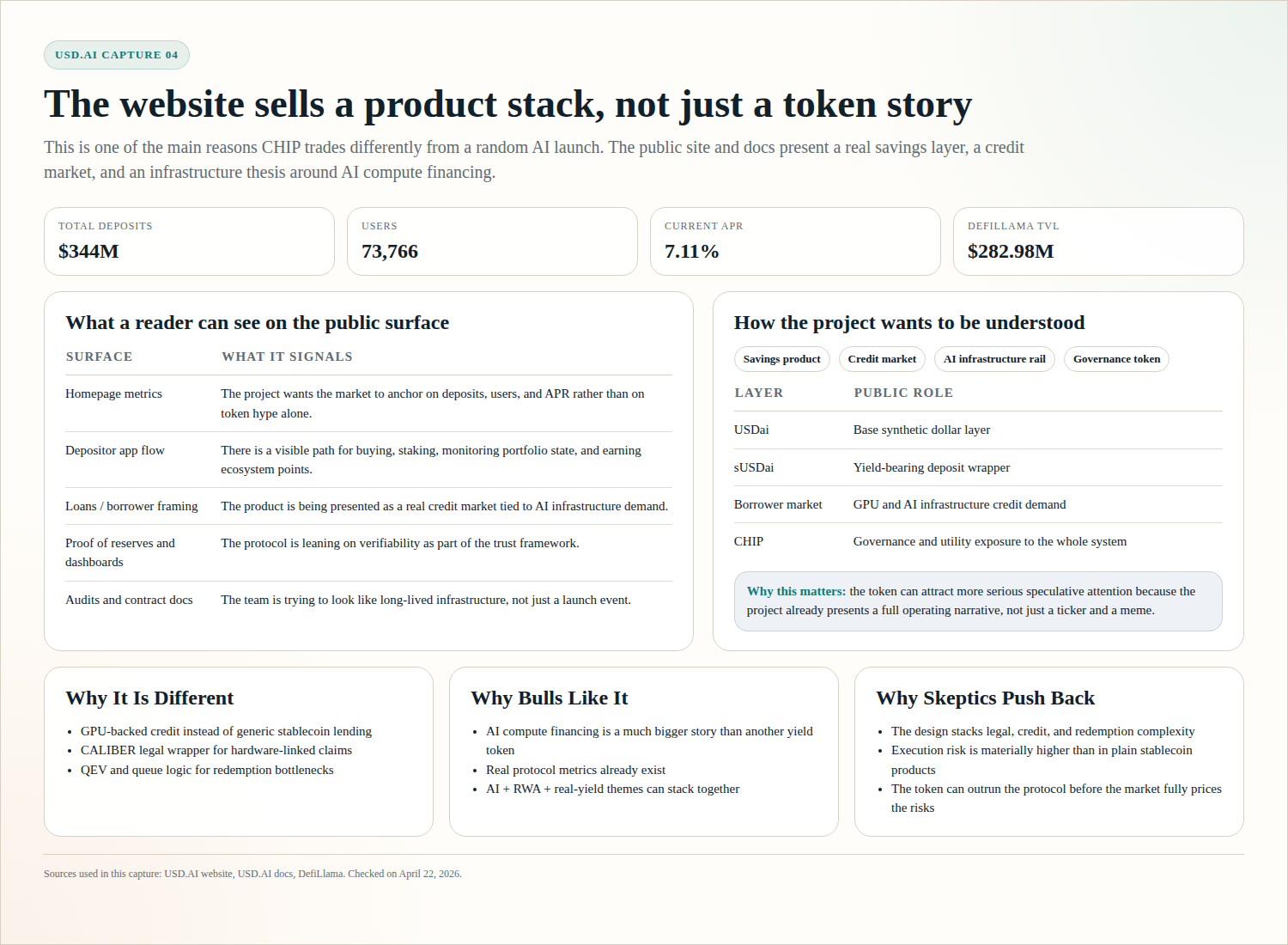
From the website and docs, the protocol is already presenting multiple live surfaces:
| Surface | What it tells users |
|---|---|
| Website headline metrics | The team wants the market to anchor on deposits, users, and APR, not just token price |
| Depositor app flow | There is a visible path for buying, staking, earning points, and monitoring portfolio state |
| Loans and borrower framing | The system is clearly presenting itself as a real credit market, not just a stablecoin wrapper |
| Proof of reserves / dashboards | The protocol is leaning into transparency and verifiability as part of the pitch |
| Audits and contract-address docs | It is trying to present itself as infrastructure, not as a launch-only token |

Raw homepage screenshot from USD.AI checked on April 22, 2026, showing the live product framing around deposits, users, APR, and the protocol’s AI-credit positioning.
What that means in practice
The public product experience suggests USD.AI wants to be understood in three roles at once:
| Role | Public-facing expression |
|---|---|
| Savings product | Deposit USDai, stake into sUSDai, earn yield |
| Credit market | Finance GPU operators and AI infrastructure borrowers |
| Coordination layer | Use CHIP for governance, utility, and protocol-level upside |
Altogether, that is a more serious surface area than what you usually see in a short-lived listing pump. It still does not prove the economics are durable, but it does explain why traders can justify giving this launch more attention than they would give to a narrative-only token.
Is This Already A Trend, Or Just Trend-Adjacent?
The best answer is:
USD.AI is not the main retail trend by itself yet, but it sits directly inside two trends that are very real in 2026.
Trend 1: Real-world asset and private-credit tokenization
This is a live trend, not a hypothetical one.
The broad RWA market has continued to scale in 2026, and private credit is one of the strongest segments inside it. Framed that way, USD.AI becomes easier to understand as an RWA or private-credit project first, a stablecoin and yield product second, and only then an AI narrative token.
Trend 2: AI infrastructure financing is becoming a real capital market
This is the more important trend for the long-term thesis.
Clifford Chance’s 2026 data-centre financing note says the market is increasingly financing data centres as compute-first infrastructure rather than simple real estate, and explicitly highlights the rise of GPU lease finance and multibillion-dollar GPU-collateralised credit programmes.
That supports a broader inference that AI hardware financing is increasingly being treated as its own capital market rather than as a side note to software growth, which is exactly the lane USD.AI is trying to occupy on-chain.
So is USD.AI “in trend” right now?
Yes, but in a specific way.
| Question | Answer |
|---|---|
| Is it in the broad AI trend? | Yes, because the collateral story is AI compute and GPU infrastructure |
| Is it in the RWA / real-yield trend? | Yes, very clearly |
| Is it a mainstream retail trend like a meme coin or AI agent token? | No, not yet |
| Could it become a bigger trend if the market rotates toward AI infrastructure and real yield? | Yes, that is the real upside case |
Right now, USD.AI is best described not as a mass-retail mega-trend, but as a high-quality trend-adjacent narrative with a real chance to become stronger if AI infrastructure finance keeps institutionalizing. If the market stays focused on fast meme rotation, it may remain only a niche but credible story; if the market instead starts rewarding AI infrastructure rails, tokenized private credit, real yield, and asset-backed financing, the narrative can strengthen from here rather than fade.
Tokenomics And Supply Structure
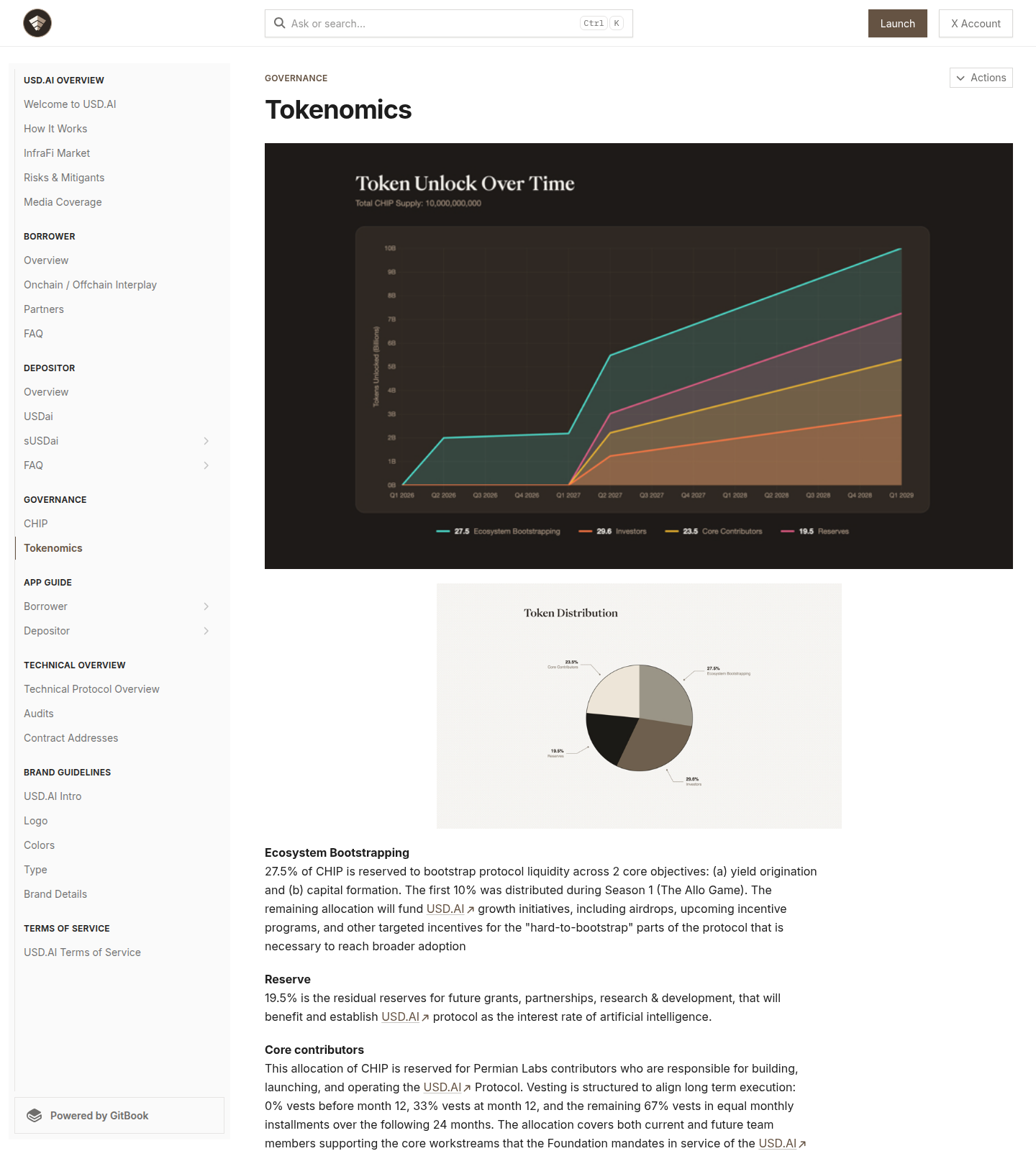
The tokenomics matter here because CHIP is not moving inside a fully open float.
It is moving inside a managed float.
What is confirmed publicly
From CoinMarketCap, CoinList, and USD.AI docs:
| Tokenomics item | Publicly visible figure |
|---|---|
| Max supply | 10B CHIP |
| Circulating supply | 2B CHIP |
| Circulating share | 20% |
| CoinList sale amount | 700M CHIP |
| CoinList sale price | $0.03 |
| CoinList reference FDV | $300M |
| Ecosystem bootstrapping allocation | 27.5% |
| Reserve allocation | 19.5% |
| Core contributors unlocked before month 12 | 0% |
| Investors unlocked before month 12 | 0% |
Why this structure matters more than the headline supply
There are three tokenomics tensions sitting on top of each other:
| Tension | Why it matters |
|---|---|
| Only 20% is circulating | The price can move violently on a much smaller real float than the 10B headline suggests |
| Sale participants are already deep in profit | At roughly $0.10, the market is already far above the $0.03 public sale anchor |
| A very large supply still appears contract-controlled | Most of the supply is still not behaving like free-float spot inventory |
As a result, CHIP can look legitimate on a protocol basis, bullish on a narrative basis, and still dangerous on a market-structure basis.
What this means for price behavior
In a normal token, a bigger float can stabilize price.
In CHIP, the current tokenomics do the opposite by creating room for launch squeezes, keeping traders focused on the visible float instead of full supply, and making every new listing or venue expansion more important.
This is also why future unlock perception matters even before actual unlocks arrive.
If the market believes most near-term supply is still boxed away, it will price CHIP like a scarce launch asset. If the market starts believing more sale or treasury-linked inventory is reaching exchanges, the same structure can reverse fast.

Why the Market Is Watching
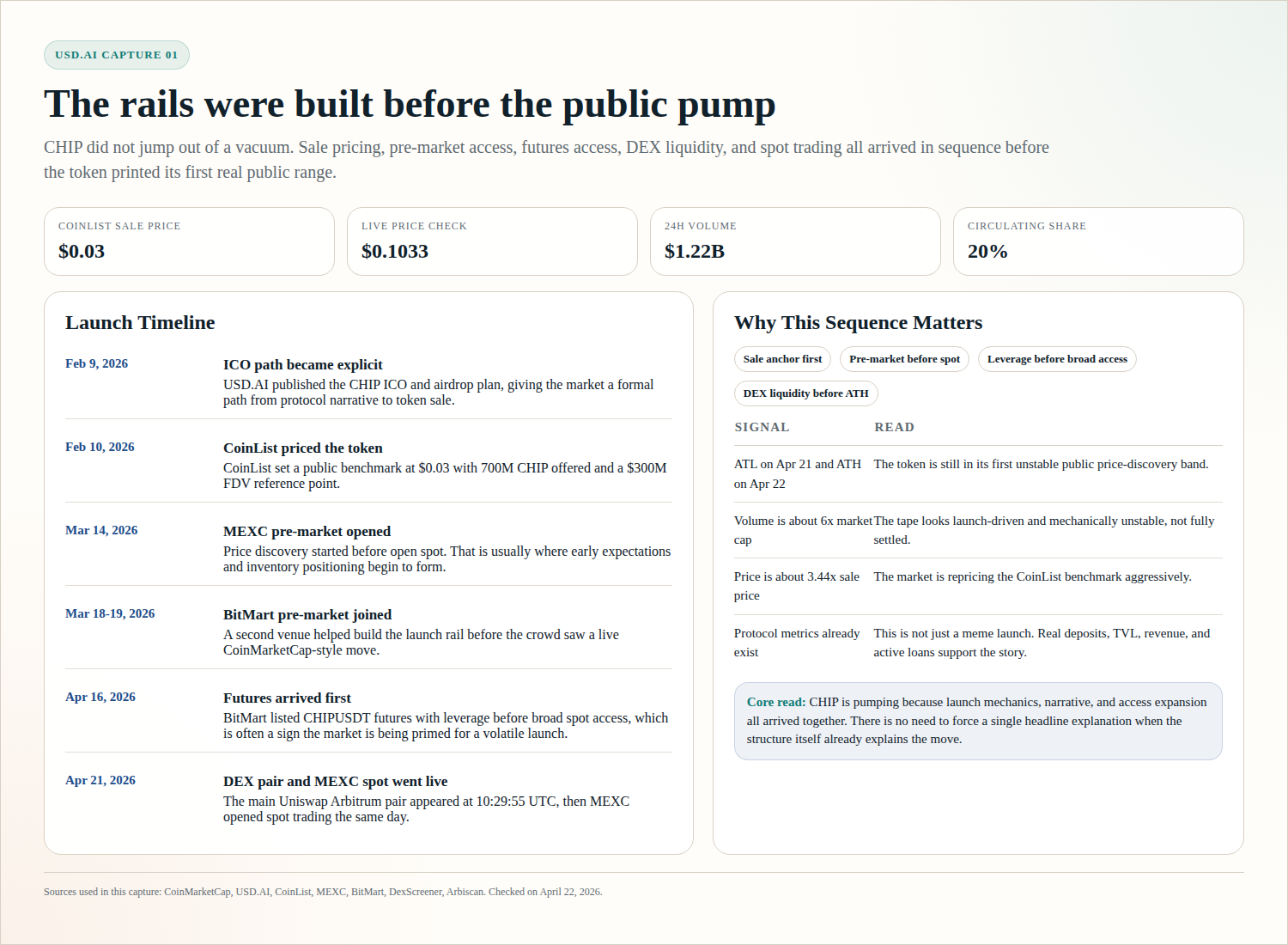
The cleanest explanation for the pump is not one news item. It is the sequence.
| Date | Event | Why it matters |
|---|---|---|
| February 9, 2026 | USD.AI officially announced the CHIP ICO and airdrop path | Public sale framework became explicit |
| February 10, 2026 | CoinList published sale terms: $0.03 token price, $300M FDV, 700M CHIP allocated, 100% unlock at TGE expected March 2026 | The market got a public reference price |
| March 14, 2026 | MEXC pre-market opened | Price discovery started before full spot |
| March 18-19, 2026 | BitMart launched pre-market trading for CHIP points | Another venue started building the launch rail |
| April 16, 2026 | BitMart futures launched CHIPUSDT with up to 5x leverage | Leverage arrived before broad spot access |
| April 17, 2026 | Arbiscan shows the current CHIP implementation became active via proxy upgrade | Onchain launch prep continued just days before the move |
| April 21, 2026 10:29:55 UTC | Main Uniswap Arbitrum pair was created | DEX liquidity came live before exchange spot |
| April 21, 2026 12:20 / 12:40 UTC | MEXC opened CHIP/USDT and CHIP/USDC spot trading | Full public spot access opened |
| April 21-22, 2026 | CoinMarketCap recorded ATL on April 21 and ATH on April 22 | True live range discovery began immediately |
This is the strongest parallel with RAVE.
In both cases, the market move did not appear from nowhere. The rails existed before the public explosion.
Final Read
USD.AI matters because it is trying to occupy a lane that crypto still has not fully priced: onchain exposure to AI-infrastructure finance through a synthetic-dollar and savings framework.
That does not make the project safe by default. It remains complex, execution-heavy, and dependent on both credit quality and market trust. But it does make the protocol more substantial than a typical AI-themed token launch. The website, docs, and tokenomics all point to a system that is attempting to build a real financing stack rather than a simple speculative wrapper.
The clean conclusion is that USD.AI is best understood as a specialized yield-and-credit protocol whose main bet is that AI compute becomes an investable financing market onchain. If that broader market matures, the project becomes easier to value and easier to explain. If it does not, CHIP may remain interesting but niche.
| Methodology |
|---|
| This review is based on public materials available as of April 23, 2026, including the USD.AI website, official docs, token sale materials, CoinMarketCap, DefiLlama, exchange announcements, and public onchain data from Arbitrum explorers and liquidity trackers. Market data and protocol metrics can change quickly, so figures in this article should be read as point-in-time observations rather than fixed values. |
| Disclaimer |
|---|
| This article is for research and informational purposes only and should not be treated as financial advice. Crypto assets are highly volatile, and early-stage token narratives can change quickly as liquidity, listings, and supply conditions evolve. |
Sources
CoinMarketCap, USD.AI market page: https://coinmarketcap.com/currencies/usd-ai/
USD.AI website: https://usd.ai/
USD.AI docs, CHIP tokenomics: https://docs.usd.ai/faq/usdchip/tokenomics
USD.AI docs, technical overview: https://docs.usd.ai/technical-overview/technical-protocol-overview
USD.AI docs, contract addresses: https://docs.usd.ai/technical-overview/contract-addresses
USD.AI article, CHIP ICO and airdrop: https://usd.ai/insights/chip-ico-airdrop
USD.AI article, Foundation and CHIP: https://usd.ai/insights/usdai-foundation-chip
CoinList blog, USD.AI token sale: https://blog.coinlist.co/announcing-the-usd-ai-token-sale-on-coinlist/
CoinList sale page: https://coinlist.co/usdai
MEXC pre-market announcement: https://www.mexc.com/announcements/article/mexc-pre-market-trading-17827791534233
MEXC spot listing announcement: https://www.mexc.com/announcements/article/first-in-market-17827791534985
BitMart pre-market announcement: https://www.bitmart.com/ar/support/articles/7923014477723/360001026214/47952482033947
BitMart futures announcement: https://www.bitmart.com/fa-IR/support/articles/28421981478683/28422943207579/49209414724123
DefiLlama USD AI page: https://defillama.com/protocol/usd-ai
Clifford Chance, Data Centres & AI Compute Infrastructure Insights 2026: https://www.cliffordchance.com/content/dam/cliffordchance/briefings/2026/03/data-centres-and-ai-compute-infrastructure-insights-2026.pdf
No tags available.


Other Posts






- China, US Conclude Trade Talks with Focus on Cooperation
- Crypto Weekly: NYSE Backs OKX, Kraken Gets Fed Access, BTC Sells
- Court Upholds Fed’s Rejection of Custodia Bank’s Request
- DeriW Launches Edge Hour Trading Competition Platform for Derivatives Traders
- Former CFO Convicted for $35M Fraudulent Crypto Investment
- Michael Saylor Denies Bitcoin Sell-Off Amid Large BTC Transfer
- Buy Dogecoin on eToro: Step-by-Step Guide for Beginners (2024)
- Kazakhstan Explores Crypto Reserves Backed by National Funds
- JPMorgan Increases Holdings in BlackRock’s Bitcoin ETF
- Nordea Bank Introduces Bitcoin ETP Trading for Nordic Customers
- XRP Spot ETF Launches on Nasdaq Amid Market Fluctuations
- Peter Schiff Challenges Michael Saylor on MSTR’s Business Model
- Thailand Orders Worldcoin to Delete 1.2 Million Biometric Records
- UK Proposes New DeFi Tax Framework to Ease User Burden
- WLFI Under Fire: Analyst Warns Hyperliquid Could Be Next
- Ancient Ethereum Whale Moves $1.19 Billion After Decade
- BlackRock Receives Large Crypto Transfers from Coinbase
- SEC Scrutiny on ALT5 Sigma’s Leadership Disclosure Timing
- Yala Injects $5.5 Million Amid Recovery Efforts
- Radiant Capital Faces $50M Loss in Major Security Breach
- China, US Conclude Trade Talks with Focus on Cooperation
- Crypto Weekly: NYSE Backs OKX, Kraken Gets Fed Access, BTC Sells
- Court Upholds Fed’s Rejection of Custodia Bank’s Request
- DeriW Launches Edge Hour Trading Competition Platform for Derivatives Traders
- Former CFO Convicted for $35M Fraudulent Crypto Investment
- Michael Saylor Denies Bitcoin Sell-Off Amid Large BTC Transfer
- Buy Dogecoin on eToro: Step-by-Step Guide for Beginners (2024)
- Kazakhstan Explores Crypto Reserves Backed by National Funds
- JPMorgan Increases Holdings in BlackRock’s Bitcoin ETF
- Nordea Bank Introduces Bitcoin ETP Trading for Nordic Customers
- XRP Spot ETF Launches on Nasdaq Amid Market Fluctuations
- Peter Schiff Challenges Michael Saylor on MSTR’s Business Model
- Thailand Orders Worldcoin to Delete 1.2 Million Biometric Records
- UK Proposes New DeFi Tax Framework to Ease User Burden
- WLFI Under Fire: Analyst Warns Hyperliquid Could Be Next
- Ancient Ethereum Whale Moves $1.19 Billion After Decade
- BlackRock Receives Large Crypto Transfers from Coinbase
- SEC Scrutiny on ALT5 Sigma’s Leadership Disclosure Timing
- Yala Injects $5.5 Million Amid Recovery Efforts
- Radiant Capital Faces $50M Loss in Major Security Breach
- China, US Conclude Trade Talks with Focus on Cooperation
- Crypto Weekly: NYSE Backs OKX, Kraken Gets Fed Access, BTC Sells
- Court Upholds Fed’s Rejection of Custodia Bank’s Request
- DeriW Launches Edge Hour Trading Competition Platform for Derivatives Traders
- Former CFO Convicted for $35M Fraudulent Crypto Investment
- Michael Saylor Denies Bitcoin Sell-Off Amid Large BTC Transfer
- Buy Dogecoin on eToro: Step-by-Step Guide for Beginners (2024)
- Kazakhstan Explores Crypto Reserves Backed by National Funds
- JPMorgan Increases Holdings in BlackRock’s Bitcoin ETF
- Nordea Bank Introduces Bitcoin ETP Trading for Nordic Customers
- XRP Spot ETF Launches on Nasdaq Amid Market Fluctuations
- Peter Schiff Challenges Michael Saylor on MSTR’s Business Model
- Thailand Orders Worldcoin to Delete 1.2 Million Biometric Records
- UK Proposes New DeFi Tax Framework to Ease User Burden
- WLFI Under Fire: Analyst Warns Hyperliquid Could Be Next
- Ancient Ethereum Whale Moves $1.19 Billion After Decade
- BlackRock Receives Large Crypto Transfers from Coinbase
- SEC Scrutiny on ALT5 Sigma’s Leadership Disclosure Timing
- Yala Injects $5.5 Million Amid Recovery Efforts
- Radiant Capital Faces $50M Loss in Major Security Breach

BSTR Deal Collapses After $1.5B Financing Fails; American Bitcoin Adds 500 BTC


Prediction Market World Announces Migration From Solana to Robinhood Chain

Bitcoin Suisse Advances Middle East Expansion, Receives Financial Services Permission in Abu Dhabi
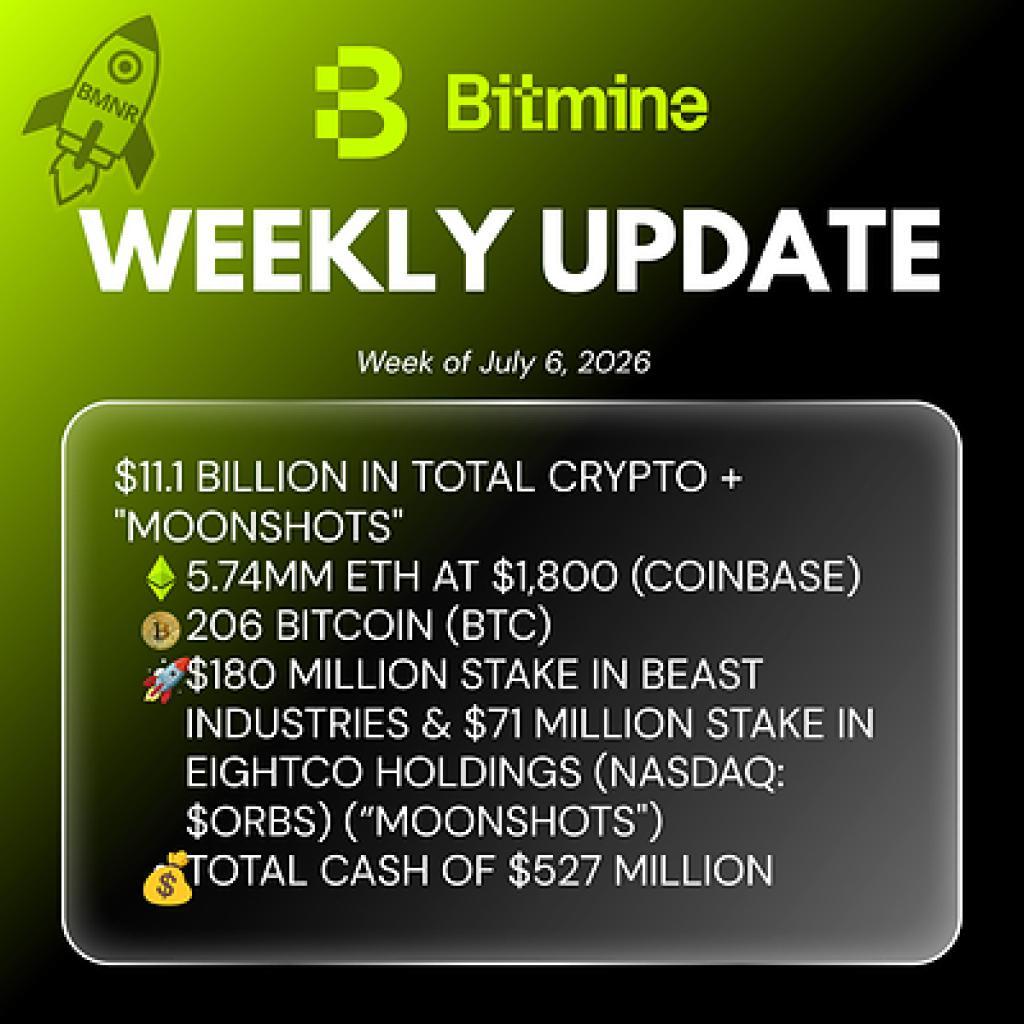
Bitmine Immersion Technologies (BMNR) Announces Total Crypto and Cash Holdings Top $11.1 Billion Now