Why Is USD.AI (CHIP) Pumping? 3 Bullish Clues Hidden in the On-Chain Data
USD.AI (CHIP) is moving higher because the token has only just entered true public price discovery, the tradable float still appears tight relative to demand, and the market is repricing it far above its $0.03 CoinList sale anchor.
The broader risk backdrop has also improved, with Bitcoin recovering into the high-$78,000 area on April 23, 2026, but the stronger evidence still points to token-specific drivers. What makes this move different from a generic market rebound is the structure underneath it: listings were layered in before broad attention arrived, the main DEX pool held only about 4.02 million CHIP with roughly $1.51 million in liquidity at the time of review, and the first on-chain trading window looked more like active routing and pool churn than obvious fresh-mint distribution.
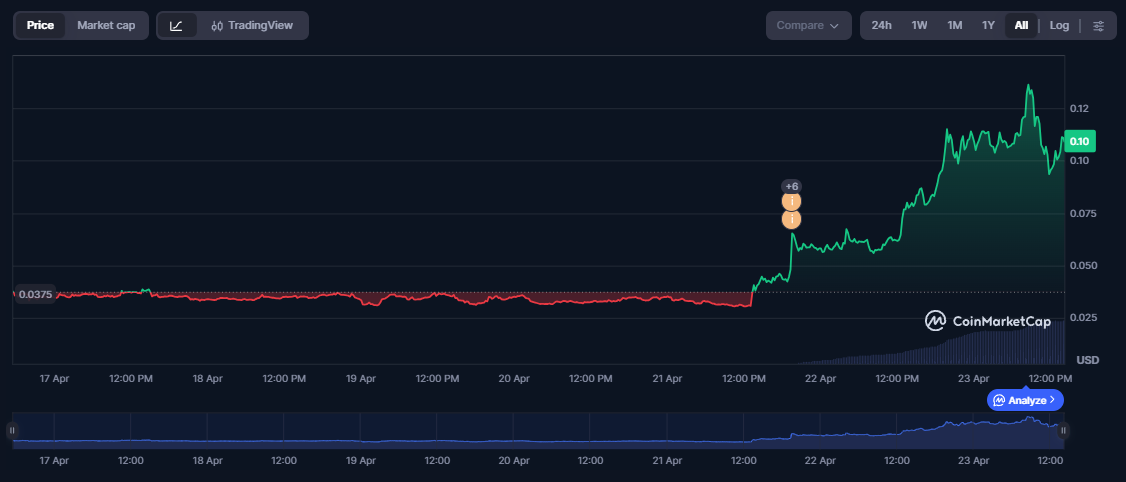
The move is also being amplified by five forces acting at the same time:
| Driver | Why it matters |
|---|---|
| Fresh launch window | Public spot access only opened on April 21, 2026, so the market is still discovering the first real range |
| Strong narrative | AI infrastructure, GPU-backed credit, DeFi yield, and RWA lending are all live narratives traders already understand |
| Real protocol underneath | USD.AI is not a blank token shell; the protocol already shows deposits, TVL, revenue, and active loans |
| Tight visible float | CoinMarketCap shows only 20% of max supply circulating, while DEX liquidity is still thin relative to valuation |
| Multi-venue access expansion | CoinList sale, MEXC pre-market, BitMart pre-market/futures, and then live spot all stacked into the same launch arc |
The short answer on whether it can pump further is:
- Yes, another leg higher is possible
- But the base case is not a clean straight-line continuation
- The higher-probability near-term outcome is volatile consolidation first, then a possible second squeeze if access expands again and float stays tight
The disciplined answer on whether CHIP can keep pumping is yes, but not because the market has already proven a durable second leg. Right now the structure still looks more like the first explosive repricing wave of a launch than a fully matured squeeze machine.
This is similar to RAVE in the sense that the rails were built before the public move. But it is not yet the same structure as RAVE.
Quick Project Snapshot
USD.AI is a broader protocol, while CHIP is the governance and utility token attached to that system. The project is trying to connect a synthetic dollar stack, a yield layer, and AI-infrastructure credit into one structure. That distinction matters because traders are not buying a stablecoin here; they are buying optionality on the protocol narrative wrapped around that dollar system.
For the pump analysis, the important point is simple: this is not just a meme launch. The protocol already presents deposits, users, yield, and loan activity publicly, which gives the listing move more credibility than a pure narrative-only token would normally have.
Table of Contents
Key Takeaways
- USD.AI (CHIP) is pumping because live public trading only opened on April 21, 2026, while the
tradable float still appears tight relative to demand. - CoinMarketCap showed only 2 billion CHIP circulating out of a 10 billion max supply, while the
main DEX pool held only about 4.02 million CHIP at the time of review. - Launch-window on-chain activity looked dominated by routing, pair activity, and transit wallets
rather than obvious fresh-mint dumping.
Why CHIP Is Pumping
1. The market is repricing from sale price into live trading price
CoinList set a public sale price of $0.03. At roughly $0.1033, CHIP is already trading at about 3.44x that sale price.
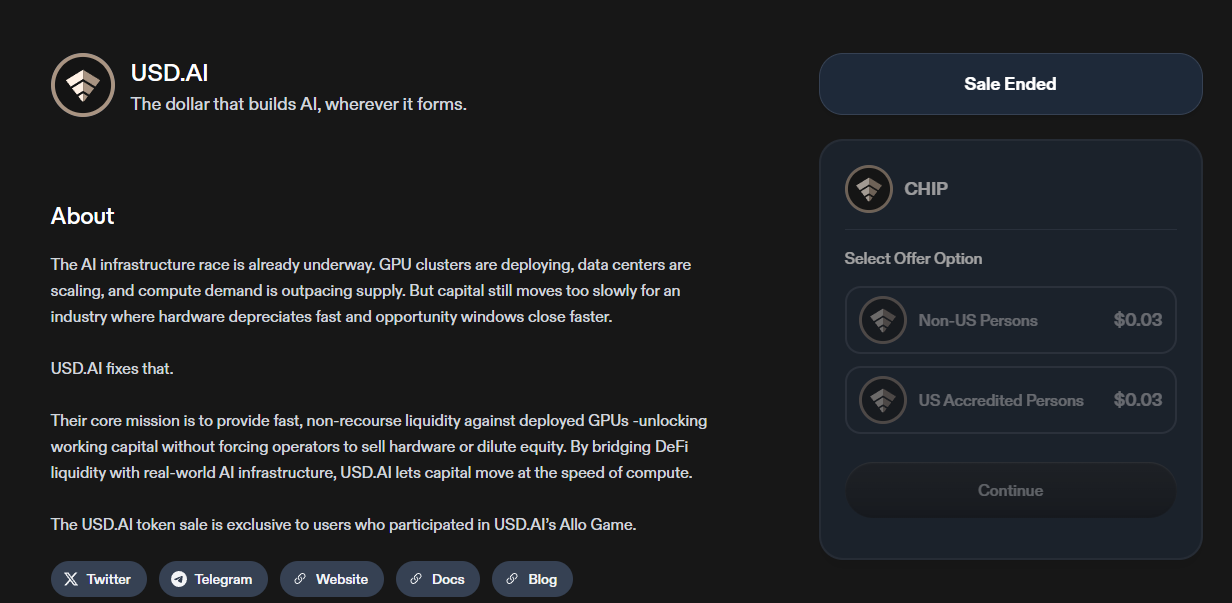
The sale price matters because it becomes an anchor around which traders organize expectations, with buyers treating it as proof that the token deserves a higher range, early participants using it as a profit-taking reference, and new traders framing upside and downside around it.
This is one reason launch-day moves in these setups get violent. Everyone has the same visible benchmark.
2. The visible float is much smaller than the headline valuation
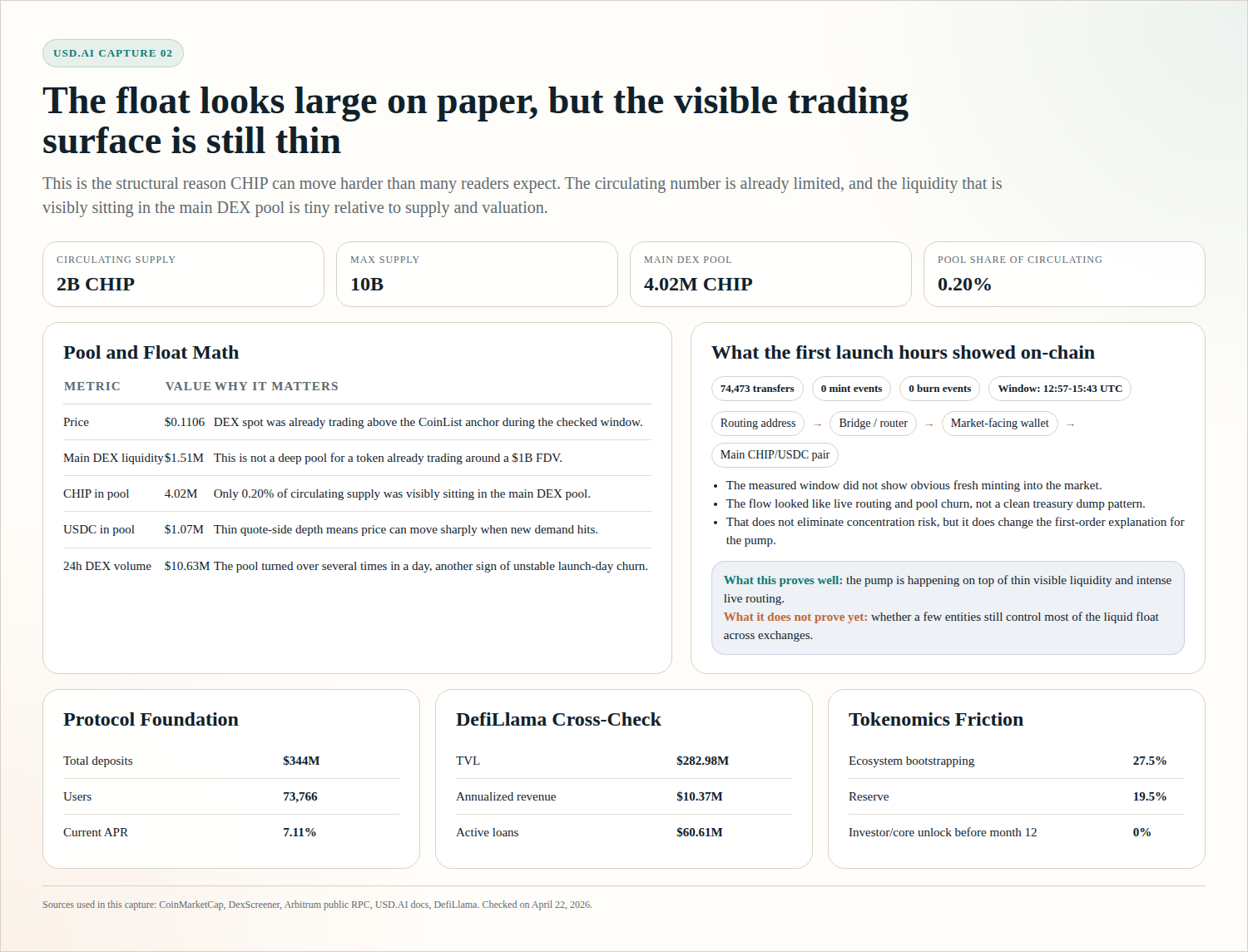
CoinMarketCap shows 2B CHIP circulating against a 10B max supply, which means only 20% of the total framework is in circulation. That already makes the token structurally more explosive than FDV suggests, and the DEX layer tightens the visible float even further.
DexScreener showed the main Arbitrum Uniswap pool at the time of research with:
| Metric | Value |
|---|---|
| Price | $0.1106 |
| Liquidity | $1.51M |
| CHIP in pool | 4.02M |
| USDC in pool | 1.07M |
| 24h DEX volume | $10.63M |
| 24h price change | +89.18% |
| Pair created | April 21, 2026 10:29:55 UTC |
The key float insight is that the main DEX pool held only about 4.02M CHIP, which is roughly 0.20% of circulating supply and only about 0.04% of max supply. So even though the token looks big on paper, the amount visibly sitting in a major public pool is tiny. That is a recipe for hard moves when new demand arrives.
3. On-chain flow says launch churn, not obvious fresh mint dumping
Using the public Arbitrum RPC together with the Arbiscan CHIP token page, the contract reads with 18 decimals and a total supply of 10B CHIP.
From roughly April 21, 2026, 12:57 UTC to 15:43 UTC, the contract showed 74,473 transfer events with zero mint events and zero burn events. That does not prove the token is clean, but it does weaken the simple bearish claim that the move was driven by treasury minting straight into the market.
The first hours looked much more like heavy routing through the main CHIP/USDC pair on DexScreener, intense activity across a small set of route addresses, and launch-day churn across pool and routing infrastructure.
4. The listing rails were built before broad attention arrived
The main Uniswap pair then went live on April 21, MEXC spot opened later that same day, and the access stack broadened further as Upbit officially announced CHIP trading support in KRW, BTC, and USDT markets on April 21. Published market coverage citing Binance’s exchange notice also reported a same-day Binance spot listing with CHIP/USDT, CHIP/USDC, and CHIP/TRY pairs and a Seed Tag applied.
That setup does not guarantee continuation, but it does explain why the first repricing wave was so forceful. Demand arrived into a market that had already been partially wired together.
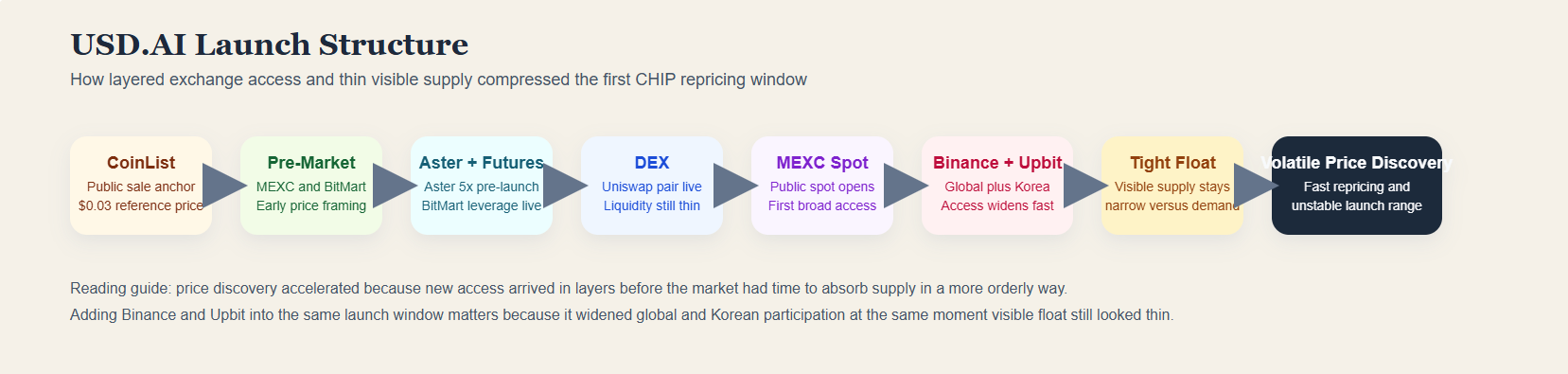
This same-day global-plus-Korea access pattern is not unique to CHIP. Similar launch windows were reported for LayerZero (ZRO) on June 20, 2024, Movement (MOVE) on December 9, 2024, and Magic Eden (ME) on December 10, 2024, when Binance and Upbit were both part of the initial exchange wave.
The point is not that all of these tokens should trade the same way. The point is that simultaneous access across Binance and Upbit can compress price discovery into a much shorter and more volatile window than a staggered listing schedule usually would.
5. The protocol has a real fundamental story under the launch
This is where CHIP differs from many listing pumps.
The protocol already has:
- meaningful deposits
- meaningful TVL
- revenue
- active loans
- a reasonably coherent product story
That does not mean current price is fair. It means traders are not forced to rely only on memes and momentum. There is enough real protocol substance for the market to assign a premium narrative.
6. Tokenomics reduce some immediate insider-overhang fear, but not public-sale overhang
USD.AI docs say that 27.5% of supply is reserved for ecosystem bootstrapping, 19.5% is reserve, core contributor allocation has zero vesting before month 12, and investor allocation has zero unlock before month 12. Taken together, those signals suggest the near-term float is not being immediately flooded by contributor or investor supply.
There is still a real overhang, though, because CoinList sold 700M CHIP at a sale price of $0.03 with unlock expected at TGE. Current price strength can therefore continue while a large amount of paper profit already exists in the public-sale cohort.
What On-chain Evidence Supports
The first version of this note established that launch-hour flow looked like live routing, not obvious fresh mint dumping.
The deeper on-chain read adds three more important points.
1. The post-launch token graph expanded very quickly
Using public Arbitrum RPC data from April 21, 2026, 13:00 UTC onward, together with the Arbiscan token page, the CHIP contract showed:
| Metric | Value |
|---|---|
| Transfer logs after live trading opened | 235,424 |
| Unique addresses touched in that window | 9,049 |
That scale shows the launch was not a tiny one-pool event. Even if much of the activity was routing and churn, the token still spread across a reasonably broad early-address graph very quickly.
2. The early flow was dominated by market infrastructure, not obvious accumulation wallets
In the first major launch window, roughly 13:00 to 15:43 UTC on April 21, 2026, several addresses dominated flow:
| Address or role | Launch-window flow read | Ending balance at check | Link |
|---|---|---|---|
| Main CHIP/USDC pair | 11,514 in / 9,385 out | 3.56M CHIP | DexScreener pair |
| Address commonly identified as LI.FI Diamond | 4,015 in / 4,105 out | 0 CHIP | Arbiscan address |
| Address commonly identified as Uniswap v4 PoolManager | 4,688 in / 6,514 out | 2.51M CHIP | Arbiscan address |
| Route wallet 0x5600…a306 | 3,697 in / 3,755 out | 434.2K CHIP | Arbiscan address |
| Route wallet 0x6aba…1b90 | 3,559 in / 3,559 out | 0 CHIP | Arbiscan address |
| Route wallet 0x5df4…1cdd | 3,320 in / 2,785 out | 0 CHIP | Arbiscan address |
| Route wallet 0x8f10…f996 | 3,017 in / 3,042 out | 0 CHIP | Arbiscan address |
The pattern is fairly clear: the main pair was the central inventory sink, major routing contracts were extremely active, and several high-frequency route wallets finished with zero balance. That is exactly what you would expect from a launch driven by routing, pool recycling, and venue connectivity, not from a market in which one or two wallets were simply accumulating and sitting still.
3. Most supply still appears to sit outside active public float
This is the most important structural point in the whole on-chain section.
The GeckoTerminal CHIP pool page states that the contract address 0xe23796fbda930646e903c2c94a6ed1312409ca05 on Arbiscan holds the largest amount of CHIP, currently about 9B CHIP.
Public Arbitrum RPC cross-checking also shows that this address is a contract, not an externally owned wallet.
The point becomes more interesting when you line it up against the broader supply picture: total supply is 10B CHIP, CoinMarketCap shows only 2B CHIP circulating, and GeckoTerminal reports a 9B CHIP top-holder contract.
The disciplined read is not “one whale can dump 90% tomorrow.”
The better read is:
- most supply still appears to be sitting in managed contract-controlled buckets
- active public float is much smaller than the total supply number
- price discovery is therefore happening on a relatively narrow tradable surface
That is one of the clearest on-chain reasons CHIP can overshoot in both directions.
What the deeper on-chain changes
| On-chain conclusion | Why it matters |
|---|---|
| Launch activity scaled fast across thousands of addresses | The move was not just a dead pool with no real engagement |
| Early flow was dominated by pair and router infrastructure | The first move looked mechanical and routing-heavy |
| Large route addresses often ended with little or no CHIP | Much of the flow was transit, not final accumulation |
| A contract address appears to hold 9B CHIP | Most of the supply still sits outside active public float |
That is a materially stronger explanation for the pump than “AI narrative” alone.
What On-chain Actually Proves Right Now
The on-chain evidence is useful, but it does not prove everything.
What it does prove well
| On-chain finding | Confidence | Why it matters |
|---|---|---|
| CHIP is a live Arbitrum proxy token with a 10B supply framework | High | Confirms the token architecture and current implementation path |
| The current implementation became active on April 17, 2026 | High | Shows launch prep was still happening just days before the move |
| Main DEX pair went live on April 21, 2026 10:29:55 UTC | High | DEX liquidity arrived before broad spot attention |
| Early launch flow showed intense routing and pair activity | High | Confirms real live price-discovery churn |
| First observed launch hours showed zero mint/burn in the measured window | High | Weakens the idea of obvious fresh mint-driven dumping during that window |
| DEX liquidity was thin relative to valuation | High | Supports the “tight visible float” thesis |
What it does not prove yet
| Open question | Why it still matters |
|---|---|
| Whether a few entities still control a very large share of liquid float | That would change manipulation risk materially |
| How much CHIP from the sale cohort is already on exchanges | This determines how much profit-taking supply is overhead |
| Whether large CEX market makers are supporting the tape aggressively | This can keep price elevated longer than fundamentals alone would suggest |
| Whether venue expansion continues from here | A second leg often needs new access, not just the same traders recycling |
So the on-chain case is useful, but still incomplete.
Does CHIP Look Like RAVE?
Yes, but only in part.
Similarities
| Similarity | RAVE | CHIP |
|---|---|---|
| Rails built before the public move | Yes | Yes |
| Exchange access mattered a lot | Yes | Yes |
| Float and access mismatch amplified price | Yes | Yes |
| Narrative did heavy lifting | Yes | Yes |
| Early public move looked mechanically unstable | Yes | Yes |
Differences
| Difference | RAVE | CHIP |
|---|---|---|
| Timing of explosion | Delayed, with a later squeeze phase | Immediate, launch-day repricing |
| Fundamental base | More reflexive and structure-driven | Backed by a real protocol with TVL, fees, and loans |
| Evidence style | Wallet routing and squeeze behavior became central | Current evidence is more launch-churn and thin-liquidity behavior |
| Key risk | Delayed squeeze, concentration, leverage cascade | Listing-day speculation plus public-sale overhang |
| Second-pump profile | Needed time to build into a squeeze machine | Still too early to call a true second-pump structure |
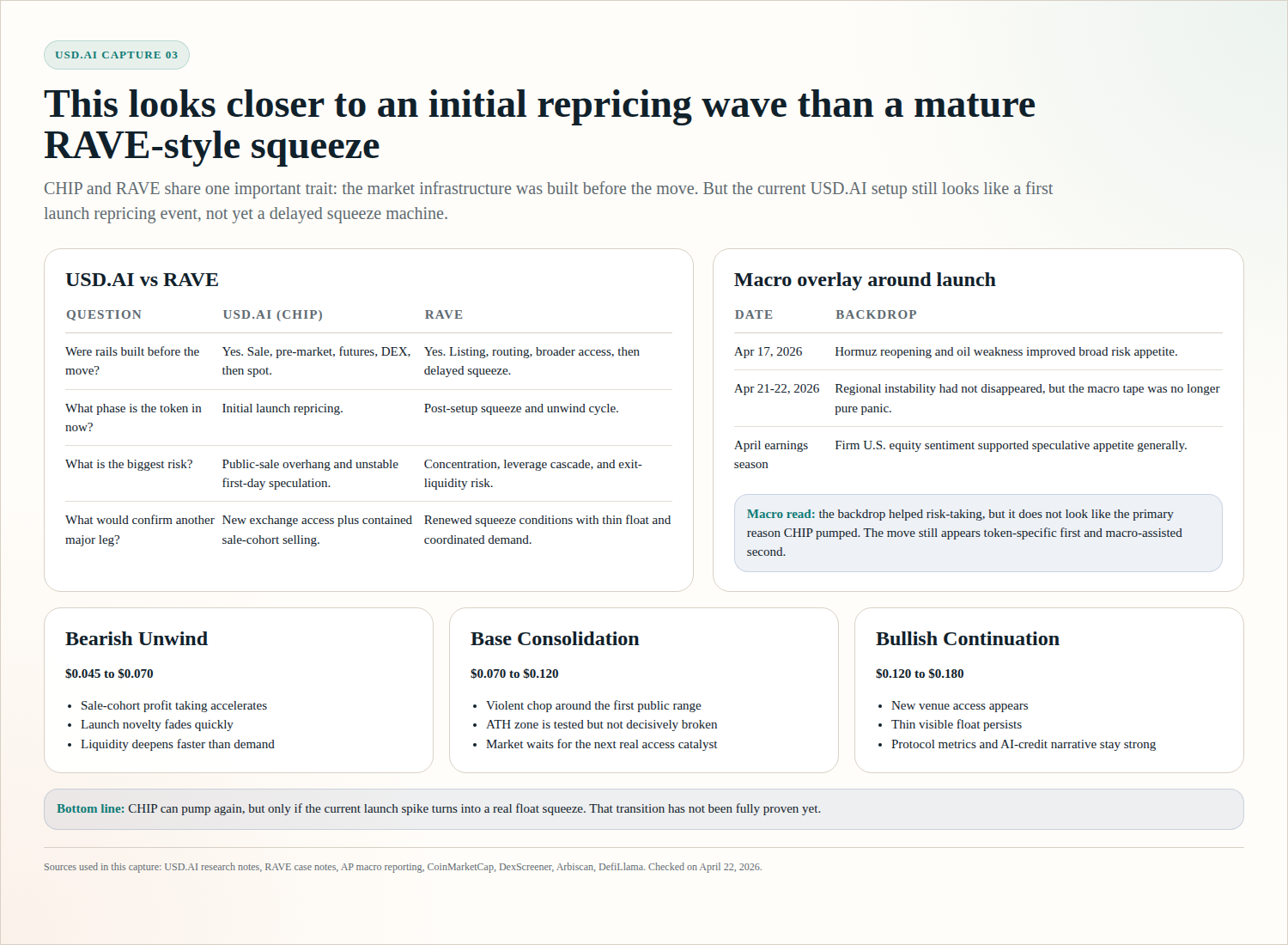
CHIP currently looks more like the first explosive leg of a launch than a mature RAVE-style second squeeze. That does not mean it cannot have another pump. It means calling a RAVE-like repeat already would be premature.
Did The Launch Coincide With The “Strait of Hormuz” Event?
Yes, but not in a simple one-headline way.
The timing overlaps with an improving macro backdrop around Strait of Hormuz headlines, yet the token-specific ignition still lines up more clearly with listing and liquidity events than with geopolitics.
| Date | Macro event | CHIP event / state | Price state |
|---|---|---|---|
| April 17, 2026 | AP reported that France and the U.K. welcomed the Strait of Hormuz reopening and pushed for permanent freedom of navigation. See AP. AP also reported oil fell sharply and Wall Street rallied as Iran said the strait was open again. See AP. | There was no live CoinMarketCap spot range yet. CHIP was still in the pre-spot stage, with leverage rails already building. The closest token-side milestone was the BitMart futures launch on April 16, 2026. See BitMart futures announcement. | No public CMC spot print yet. The token had not entered true open-market price discovery. |
| April 21, 2026 | The improved post-ceasefire tone was still part of the backdrop, even though it was no longer fresh news. | This is when the real CHIP market opened. The main Arbitrum pair was created at 10:29:55 UTC on DexScreener: CHIP/USDC pair. MEXC spot then opened at 12:20 / 12:40 UTC: MEXC listing. | CoinMarketCap later marked this day as the ATL date at $0.03027. See CoinMarketCap. |
| April 22, 2026 | AP reported renewed shipping attacks in the Strait of Hormuz even while the U.S. maintained the ceasefire line and blockade pressure. See AP. | There was no matching fresh CHIP announcement of the same scale. The token was mainly trading on the rails that had already been built. | CoinMarketCap marked this day as the ATH date at $0.1171. See CoinMarketCap. |
- April 17 improved the macro tape before CHIP entered true public spot trading
- April 21 was the actual token-specific ignition point
- April 22 shows the rally continued even after macro headlines became noisier again
So if the question is “did USD.AI pump because of a U.S.-Iran headline?”
The disciplined answer is:
No, not primarily.
Put more simply, macro made risk-taking easier, but CHIP only really ignited once the token got open-market rails, and the rally continuing into April 22, 2026 despite worse shipping headlines argues that the move was still mainly token-structure-led.
Will CHIP Go Higher?
The answer is possibly yes, but the path matters.
Base case
The highest-probability near-term outcome is still a volatile consolidation range rather than a straight vertical continuation. The token is already far above the public sale price, launch-day volume is extreme, and the market has had only one real day of open public trading. It still needs to discover where meaningful supply appears.
Why:
- current price is already far above the public sale price
- launch-day volume is extreme
- the market has had only one real day of public trading
- traders still need to discover where real supply appears
What would support another leg higher
| Bullish condition | Why it matters |
|---|---|
| New major exchange access | Fresh access often creates a second wave of demand |
| DEX liquidity stays thin | Thin visible liquidity can force price higher on marginal demand |
| Sale-cohort selling stays contained | Less near-term overhead means squeezes travel further |
| Protocol metrics keep improving | Real TVL and revenue give the market something fundamental to point to |
| AI infrastructure narrative stays hot | Narrative persistence extends the life of launch momentum |
What would likely stop or reverse the move
| Bearish condition | Why it matters |
|---|---|
| Sale-cohort exits accelerate | A lot of holders are already deep in profit versus the $0.03 sale price |
| Spot listing demand fades after day one | Launch pumps often fail once novelty disappears |
| Liquidity deepens faster than demand | More supply availability reduces squeeze intensity |
| Market attention rotates away | New launch stories die fast when the feed moves on |
| Macro risk returns | A sharper geopolitical or macro reversal would punish unstable launch assets first |
Scenario Bands
These ranges are editorial inference rather than forecasts. They are anchored to the CoinList sale price, the first public ATL and ATH on CoinMarketCap, and the thin-liquidity structure visible across the initial launch window.
| Scenario | Range | Read | Why |
|---|---|---|---|
| Pullback and stabilization | $0.045 to $0.070 | Lower-support case | Public-sale profit taking overwhelms listing demand and the token retraces toward a calmer post-launch base |
| Consolidation above the sale anchor | $0.070 to $0.120 | Base case | The first repricing wave cools into volatile consolidation while the market tests where real supply emerges |
| Extension on fresh access and tight float | $0.120 to $0.180 | Higher-upside case | New access, thin liquidity, and sustained narrative strength support another expansion leg |
A move back into the $0.06 to $0.08 area would still leave CHIP well above the CoinList anchor. Holding around $0.10 to $0.12 would suggest launch demand is still absorbing profit-taking. A clean break through the $0.1171 high would improve the case for another fast expansion, although that would still need to be confirmed by liquidity and flow rather than assumed in advance.
Final Read
CHIP is rising in the kind of environment where crypto prices can move sharply: a credible story, a fresh public launch, thin visible liquidity, multiple venues opening in sequence, and enough protocol substance underneath the token for traders to take the listing seriously.
Compared with RAVE, the main distinction is timing. RAVE looked more like a delayed secondary expansion after a longer setup, while CHIP still looks like an initial launch repricing with real fundamentals underneath but a highly unstable market structure on top.
The disciplined conclusion is that the move is real and understandable, but still early. Evidence supports the idea that launch structure and float conditions drove the initial advance. It does not yet support treating current price as settled fair value or assuming the next leg is automatic.
| Methodology |
|---|
| This review is based on public materials checked on April 22, 2026, including CoinMarketCap, DexScreener, GeckoTerminal, Arbiscan, exchange announcements, the USD.AI website, official docs, and public Arbitrum on-chain data. Market prices, liquidity, holder counts, and protocol metrics can change quickly, so all figures in this article should be read as point-in-time observations rather than fixed values. |
| Disclaimer |
|---|
| This article is for research and informational purposes only and should not be treated as financial advice. Crypto assets are highly volatile, and launch-stage tokens can move sharply as liquidity, listings, and supply conditions change. |
Sources
CoinMarketCap, USD.AI market page: https://coinmarketcap.com/currencies/usd-ai/
USD.AI website: https://usd.ai/
USD.AI docs, CHIP tokenomics: https://docs.usd.ai/faq/usdchip/tokenomics
USD.AI docs, technical overview: https://docs.usd.ai/technical-overview/technical-protocol-overview
USD.AI docs, contract addresses: https://docs.usd.ai/technical-overview/contract-addresses
USD.AI article, CHIP ICO and airdrop: https://usd.ai/insights/chip-ico-airdrop
USD.AI article, Foundation and CHIP: https://usd.ai/insights/usdai-foundation-chip
CoinList blog, USD.AI token sale: https://blog.coinlist.co/announcing-the-usd-ai-token-sale-on-coinlist/
CoinList sale page: https://coinlist.co/usdai
MEXC pre-market announcement: https://www.mexc.com/announcements/article/mexc-pre-market-trading-17827791534233
MEXC spot listing announcement: https://www.mexc.com/announcements/article/first-in-market-17827791534985
BitMart pre-market announcement: https://www.bitmart.com/ar/support/articles/7923014477723/360001026214/47952482033947
BitMart futures announcement: https://www.bitmart.com/fa-IR/support/articles/28421981478683/28422943207579/49209414724123
Arbiscan CHIP token page: https://arbiscan.io/token/0x0c1c1c109fe34733fca54b82d7b46b75cfb71f6e
DexScreener CHIP pair: https://dexscreener.com/arbitrum/0x49340dbb8fb5ece2f9b594e77ab774e65725e9d8
DefiLlama USD AI page: https://defillama.com/protocol/usd-ai
AP News, Hormuz reopening and diplomatic response: https://apnews.com/article/hormuz-strait-iran-blockade-britain-france-10518e69aecbb986c9118ff42ab0ca02
AP News, oil drop and Wall Street rally after reopening: https://apnews.com/article/stock-markets-trump-oil-iran-war-50e10bf2aa9b0b658c51e17db3eb3b13
AP News, renewed shipping attacks despite ceasefire backdrop: https://apnews.com/article/us-iran-war-hormuz-israel-pakistan-ceasefire-april-22-2026-267230f7f32b436822484479313840f7
GeckoTerminal CHIP pool page: https://www.geckoterminal.com/arbitrum/pools/0x49340dbb8fb5ece2f9b594e77ab774e65725e9d8
Clifford Chance, Data Centres & AI Compute Infrastructure Insights 2026: https://www.cliffordchance.com/content/dam/cliffordchance/briefings/2026/03/data-centres-and-ai-compute-infrastructure-insights-2026.pdf
Hyperliquid docs: https://hyperliquid.gitbook.io/hyperliquid-docs
Ethena docs: https://docs.ethena.fi/
Pendle docs, Introduction: https://docs.pendle.finance/pendle-v2/Introduction
Maple docs: https://docs.maple.finance/
Upbit official notice 6158, CHIP listing: https://www.upbit.com/service_center/notice?id=6158
No tags available.


Other Posts






- China, US Conclude Trade Talks with Focus on Cooperation
- Crypto Weekly: NYSE Backs OKX, Kraken Gets Fed Access, BTC Sells
- DeriW Launches Edge Hour Trading Competition Platform for Derivatives Traders
- Court Upholds Fed’s Rejection of Custodia Bank’s Request
- Former CFO Convicted for $35M Fraudulent Crypto Investment
- Michael Saylor Denies Bitcoin Sell-Off Amid Large BTC Transfer
- Kazakhstan Explores Crypto Reserves Backed by National Funds
- JPMorgan Increases Holdings in BlackRock’s Bitcoin ETF
- Nordea Bank Introduces Bitcoin ETP Trading for Nordic Customers
- XRP Spot ETF Launches on Nasdaq Amid Market Fluctuations
- Crypto Leaders Address Macro Volatility Amid Market Shifts
- Buy Dogecoin on eToro: Step-by-Step Guide for Beginners (2024)
- Peter Schiff Challenges Michael Saylor on MSTR’s Business Model
- Thailand Orders Worldcoin to Delete 1.2 Million Biometric Records
- UK Proposes New DeFi Tax Framework to Ease User Burden
- WLFI Under Fire: Analyst Warns Hyperliquid Could Be Next
- Ancient Ethereum Whale Moves $1.19 Billion After Decade
- BlackRock Receives Large Crypto Transfers from Coinbase
- SEC Scrutiny on ALT5 Sigma’s Leadership Disclosure Timing
- MoonPay Gains Trust License for Crypto Operations in New York
- China, US Conclude Trade Talks with Focus on Cooperation
- Crypto Weekly: NYSE Backs OKX, Kraken Gets Fed Access, BTC Sells
- DeriW Launches Edge Hour Trading Competition Platform for Derivatives Traders
- Court Upholds Fed’s Rejection of Custodia Bank’s Request
- Former CFO Convicted for $35M Fraudulent Crypto Investment
- Michael Saylor Denies Bitcoin Sell-Off Amid Large BTC Transfer
- Kazakhstan Explores Crypto Reserves Backed by National Funds
- JPMorgan Increases Holdings in BlackRock’s Bitcoin ETF
- Nordea Bank Introduces Bitcoin ETP Trading for Nordic Customers
- XRP Spot ETF Launches on Nasdaq Amid Market Fluctuations
- Crypto Leaders Address Macro Volatility Amid Market Shifts
- Buy Dogecoin on eToro: Step-by-Step Guide for Beginners (2024)
- Peter Schiff Challenges Michael Saylor on MSTR’s Business Model
- Thailand Orders Worldcoin to Delete 1.2 Million Biometric Records
- UK Proposes New DeFi Tax Framework to Ease User Burden
- WLFI Under Fire: Analyst Warns Hyperliquid Could Be Next
- Ancient Ethereum Whale Moves $1.19 Billion After Decade
- BlackRock Receives Large Crypto Transfers from Coinbase
- SEC Scrutiny on ALT5 Sigma’s Leadership Disclosure Timing
- MoonPay Gains Trust License for Crypto Operations in New York
- China, US Conclude Trade Talks with Focus on Cooperation
- Crypto Weekly: NYSE Backs OKX, Kraken Gets Fed Access, BTC Sells
- DeriW Launches Edge Hour Trading Competition Platform for Derivatives Traders
- Court Upholds Fed’s Rejection of Custodia Bank’s Request
- Former CFO Convicted for $35M Fraudulent Crypto Investment
- Michael Saylor Denies Bitcoin Sell-Off Amid Large BTC Transfer
- Kazakhstan Explores Crypto Reserves Backed by National Funds
- JPMorgan Increases Holdings in BlackRock’s Bitcoin ETF
- Nordea Bank Introduces Bitcoin ETP Trading for Nordic Customers
- XRP Spot ETF Launches on Nasdaq Amid Market Fluctuations
- Crypto Leaders Address Macro Volatility Amid Market Shifts
- Buy Dogecoin on eToro: Step-by-Step Guide for Beginners (2024)
- Peter Schiff Challenges Michael Saylor on MSTR’s Business Model
- Thailand Orders Worldcoin to Delete 1.2 Million Biometric Records
- UK Proposes New DeFi Tax Framework to Ease User Burden
- WLFI Under Fire: Analyst Warns Hyperliquid Could Be Next
- Ancient Ethereum Whale Moves $1.19 Billion After Decade
- BlackRock Receives Large Crypto Transfers from Coinbase
- SEC Scrutiny on ALT5 Sigma’s Leadership Disclosure Timing
- MoonPay Gains Trust License for Crypto Operations in New York

U.S. XRP Spot ETFs See $7.44M Daily Net Inflows as Demand Holds


Zodia Custody Obtains Luxembourg Payment Institution License for EU Stablecoin Expansion

Chris Jericho to Join and Co-Create Official Community Traits for Kokopi Koalas™ NFT Collection

Neura Closes Strategic Funding Round and Partnerships to Build Emotional AI with Persistent, User-Owned Memory