TradeGenius Review 2026: Hands-On Test, Login Flow Analysis & Honest Verdict
Disclosure: This review is for informational purposes only and does not constitute financial advice. We tested TradeGenius in a real browser session using live product routes, live sign-in flows, and authenticated product pages. We are not affiliated with TradeGenius. Our testing included real route access, wallet handoff, Google sign-in flow observation, post-login onboarding, and authenticated terminal navigation. No funded deposit, funded trade, or withdrawal was completed. No sponsored content.
TradeGenius presents itself as a crypto trading terminal rather than a simple swap page. The real question is whether that claim holds up once you move past the public shell and actually try to enter the product.
We tested TradeGenius hands-on by opening the live site, moving through the sign-in flow, reaching wallet handoff, passing post-login onboarding, and checking whether the authenticated trade, portfolio, launchpads, airdrop, and token routes behaved like real product surfaces. This review focuses on what actually happened in the browser, not on marketing copy.
Table of Contents
What Is TradeGenius?
TradeGenius is a browser-based crypto trading terminal that combines token discovery, spot-style routing, perpetuals surfaces, portfolio tracking, launchpads, airdrop incentives, and account-based onboarding inside one interface.
Based on our live testing, TradeGenius is not designed like a minimal wallet-first DEX. It is designed more like a managed terminal:
- users enter a product shell before login
- the platform supports account-based sign-in options
- wallet connection includes chain selection
- onboarding continues after authentication
- multiple terminal routes are accessible from the same authenticated session
That design makes TradeGenius feel more ambitious than a one-page swap tool, but it also introduces more friction and more trust assumptions.
How TradeGenius Works
From the tested browser flow, TradeGenius appears to work in four layers:
Public shell: The asset route already behaves like a terminal, with token tables, filters, quick-buy controls, and a sign-in entry point.
Account and wallet entry: Users can enter through Google, Apple, or wallet connection rather than only through a browser wallet prompt.
Post-login onboarding: Authentication does not immediately drop the user into a finished session. Terms, username creation, and two-factor prompts appear before the session fully settles.
Authenticated terminal: After onboarding, the product exposes richer account state and additional routes, including the trade route, portfolio route, launchpads route, airdrop route, and token-specific pages.
That layered flow is the clearest evidence that TradeGenius is trying to be a full product environment, not just a thin exchange wrapper.
How We Tested TradeGenius
Our testing methodology focused on the full browser journey rather than one isolated screen. Here is what we actually did:
- Opened the live TradeGenius website in a real GUI browser
- Tested the public asset route before authentication
- Opened the live sign-in modal
- Verified available onboarding paths: Google, Apple, and wallet connection
- Reached the wallet chain-selection handoff before MetaMask connection
- Observed the post-login onboarding sequence
- Accessed the authenticated trade route
- Accessed the authenticated portfolio route
- Accessed the authenticated launchpads route
- Accessed the authenticated airdrop route
- Opened the live GENIUS token route
- Checked visible deposit entry points and terminal controls
- Recorded UI consistency issues seen during real sessions
We did not fund the account, complete a live deposit, place a funded order, or validate withdrawals. That boundary matters and is reflected throughout this review.
Verified Vs Not Verified
The cleanest way to read this review is to separate what the browser session actually proved from what it did not.
| Verified in this hands-on pass | Not verified in this hands-on pass |
|---|---|
| Public asset shell loaded live | Funded deposit completion |
| Sign-in modal opened with Google, Apple, and wallet options | Live trade execution quality |
| Wallet handoff reached chain selection | Real slippage and fills |
| Post-login onboarding continued through terms, username, and 2FA prompts | Withdrawal reliability |
| Authenticated trade, portfolio, launchpads, and airdrop routes loaded | Full 2FA completion and recovery behavior |
| Deposit entry point was visible in the authenticated session | Fee schedule accuracy across products |
| Token-specific GENIUS route loaded live | Cross-chain settlement behavior |
| Docs/legal/help controls were visible in the terminal footer | Support responsiveness under a live account issue |
TradeGenius Public Shell
The public asset route was the first screen we evaluated. It already looked like a terminal, not a marketing landing page.
Before login, the page exposed token listings, market filters, quick-buy sizing, route navigation, and a visible Sign In button in the top-right corner. That immediately made TradeGenius feel more product-forward than many crypto sites that hide the actual interface behind a generic homepage.
At the same time, this public shell also surfaced a real product bug during testing: unresolved banner translation keys on the hero block.
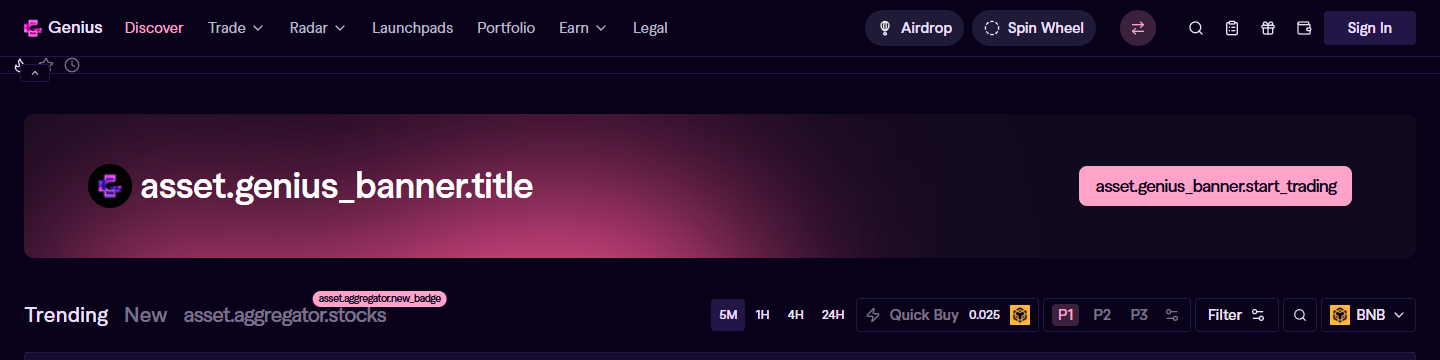
This screen captures both sides of the product well. TradeGenius already feels operational before login, but it also shows polish issues early.
Setup Guide: Logging Into TradeGenius
Getting from the public shell into the authenticated product took more steps than a basic wallet-first DEX.
Step 1: Open The Sign-In Modal
The in-app sign-in entry point opened a structured authentication modal instead of immediately forcing a wallet approval.
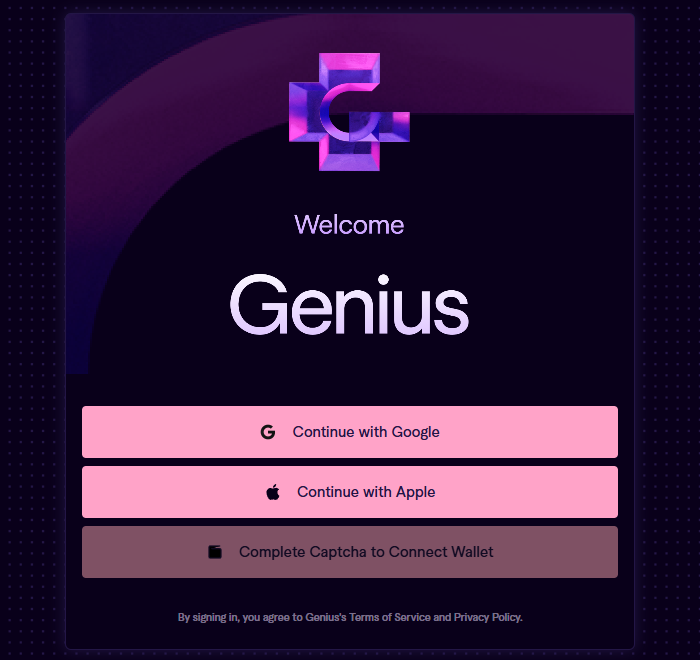
The available paths we saw were:
- Continue with Google
- Continue with Apple
- Connect with Wallet
That is a meaningful product choice. It signals that TradeGenius is built around an account model, not just an extension-only wallet model.
Readers who want the broader infrastructure context behind wallet-to-app connection flows can compare this with Coincu’s explainer on WalletConnect as Web3’s connectivity backbone.
Step 2: Follow The Wallet Handoff
The wallet route did not jump directly into MetaMask confirmation. It inserted an intermediate handoff asking the user to choose the chain family first.
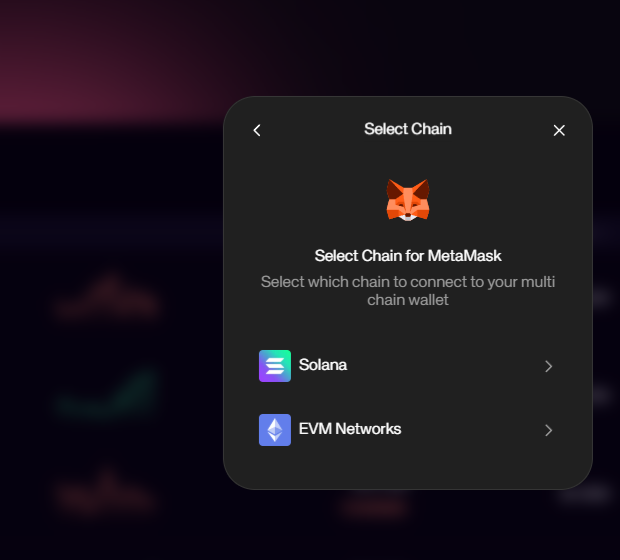
In our test, the wallet flow asked the user to choose between:
- Solana
- EVM Networks
That extra step makes sense for a multi-network terminal, but it also adds more friction than a plain one-click wallet connect.
Step 3: Complete Post-Login Onboarding
TradeGenius did not stop once authentication succeeded. The session continued through a real onboarding sequence inside the app.
The sequence we observed included:
- Terms of Service
- Username
- Two-Factor Authentication
This matters because it changes the product experience substantially. Many traders expect authentication to end at the wallet or OAuth approval. TradeGenius clearly expects users to enter a deeper account environment.
Authenticated Terminal Experience
Once the session reached the authenticated state, the product became meaningfully stronger.
The top bar changed, the Deposit button appeared, and the product exposed a richer account context than the public shell. This is the point where TradeGenius stops feeling like a preview and starts feeling like a real terminal.
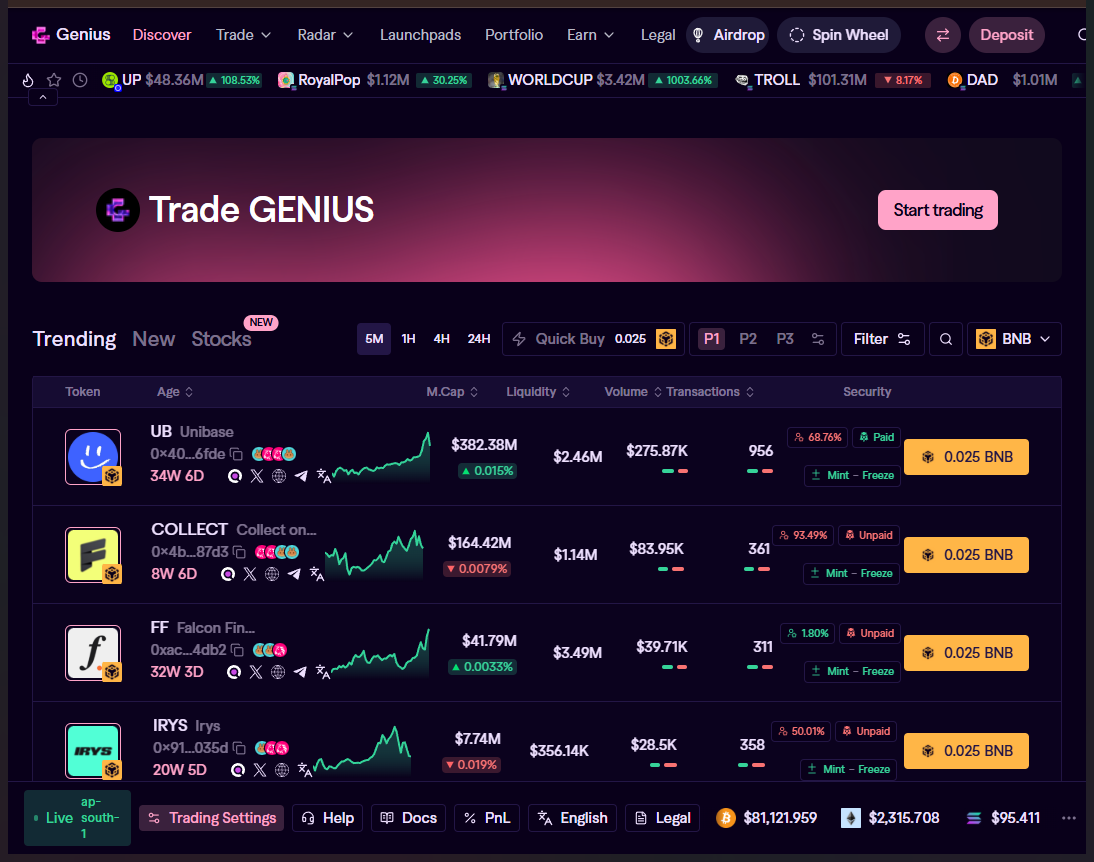
This authenticated shell proved that the product does not collapse after login. It expands.
Fees And Execution Transparency
TradeGenius clearly exposes trading surfaces, but this hands-on pass did not establish a reliable fee picture.
We reached the authenticated trade route, saw live trading modules, and confirmed that the terminal uses distinct surfaces for Swap + Bridge, Perps, and Spot. What we did not verify was the full fee schedule attached to those surfaces. No funded order was placed, no completed swap receipt was captured, and no withdrawal fee or spread behavior was measured.
That means any strong claim about trading costs would be premature. At this stage, the fair reading is simple: TradeGenius looks operational enough to route users toward execution, but this review does not prove whether pricing is competitive, average, or expensive in practice.
Trade Route Review
The authenticated trade route was one of the strongest pieces of evidence in the whole review.
The page exposed:
- Swap + Bridge
- Perps
- Spot
- token selectors
- a disabled Confirm state until assets or selections were made
- footer controls for settings, docs, language, and legal
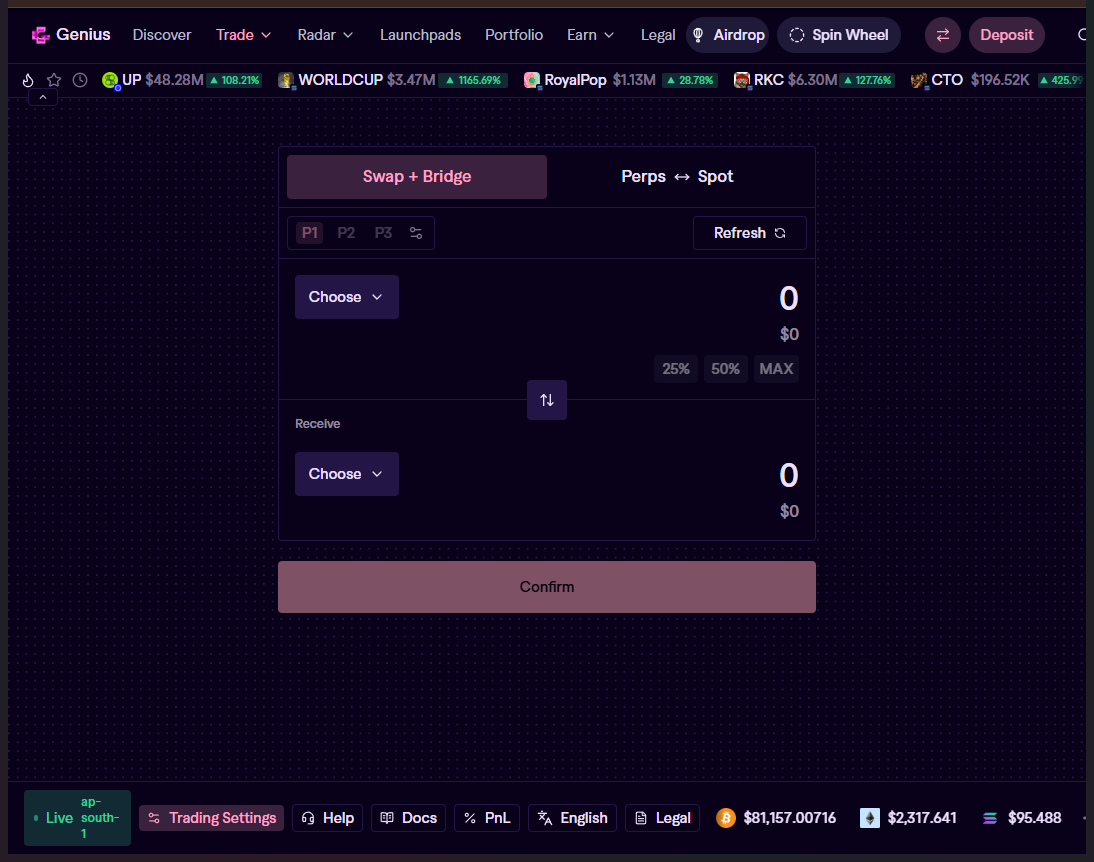
This is enough to say the trade route is real and interactive. It is not enough to say execution quality has been proven, because no funded trade was completed.
Still, the route looks like a serious product surface rather than a placeholder.
That framing fits a wider market pattern Coincu has covered before in its report on perpetual DEX trading volumes rising across the sector. Even though TradeGenius is not the same product type as every perp venue, the same logic applies: if a trading terminal can keep real users active across multiple routes, the product has a much stronger chance of holding attention.
Portfolio Review
The authenticated portfolio route also loaded as a real account page instead of a dead tab.
It showed portfolio tabs, a summary block, and actionable controls like Deposit, Withdraw, and Swap, even though the tested account had no funded positions in this pass.
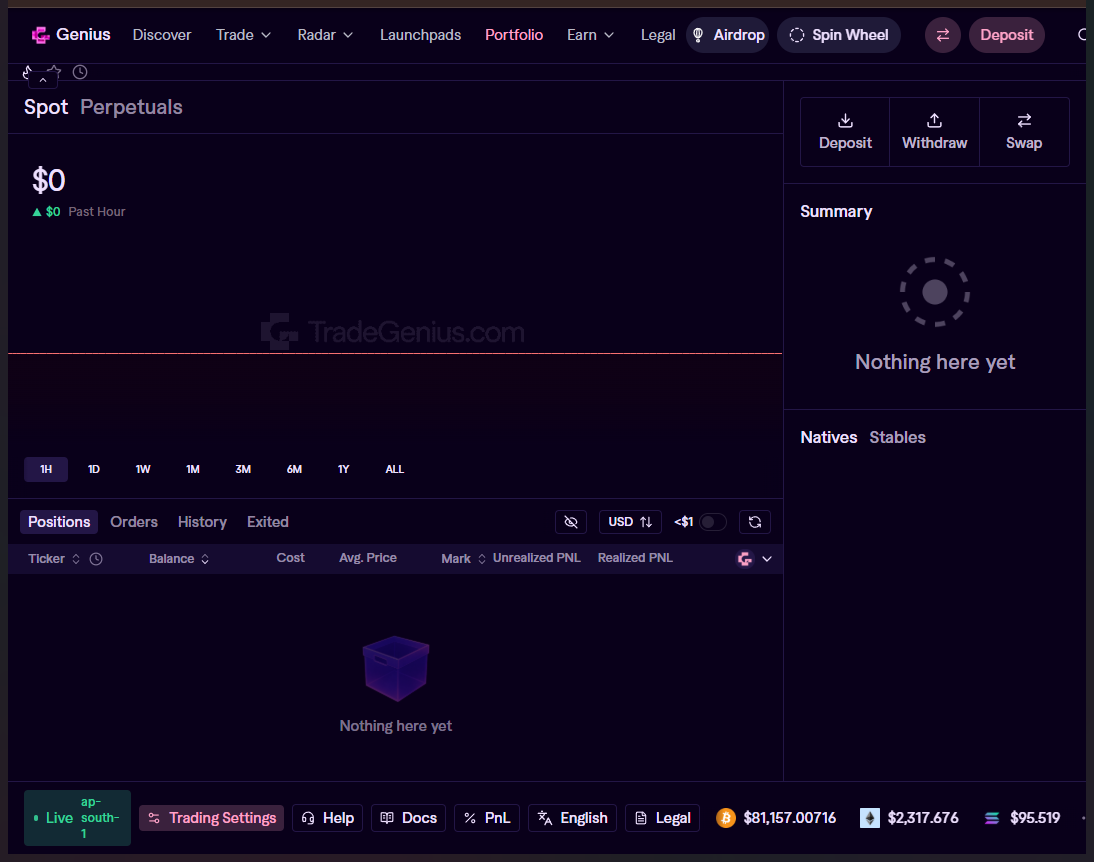
That matters because it confirms the product is broader than one strong trade page.
Supported Networks And Assets: What Was Actually Visible
TradeGenius appears to be positioned as a multi-network terminal, but the evidence we have is still partial rather than exhaustive.
The strongest live signal came from the wallet handoff itself. Before any wallet approval, the app asked the user to choose between Solana and EVM Networks. That is a concrete sign that TradeGenius is not presenting itself as a single-chain interface.
The airdrop flow and token route also surfaced real asset-specific evidence. The platform tied reward flows directly to the GENIUS token, and one captured airdrop state referenced BNB for claim readiness. Together, those screens suggest TradeGenius is built around a token-discovery and token-routing model rather than a narrow one-pair exchange screen.
What we did not confirm is the full supported-asset catalog, the full list of supported chains, or how deep support goes once assets are funded and routed across products. So the honest takeaway is that multi-network intent is visible, but complete network and asset coverage remains unverified in this pass.
Launchpads And Airdrop Review
TradeGenius also held together on secondary routes.
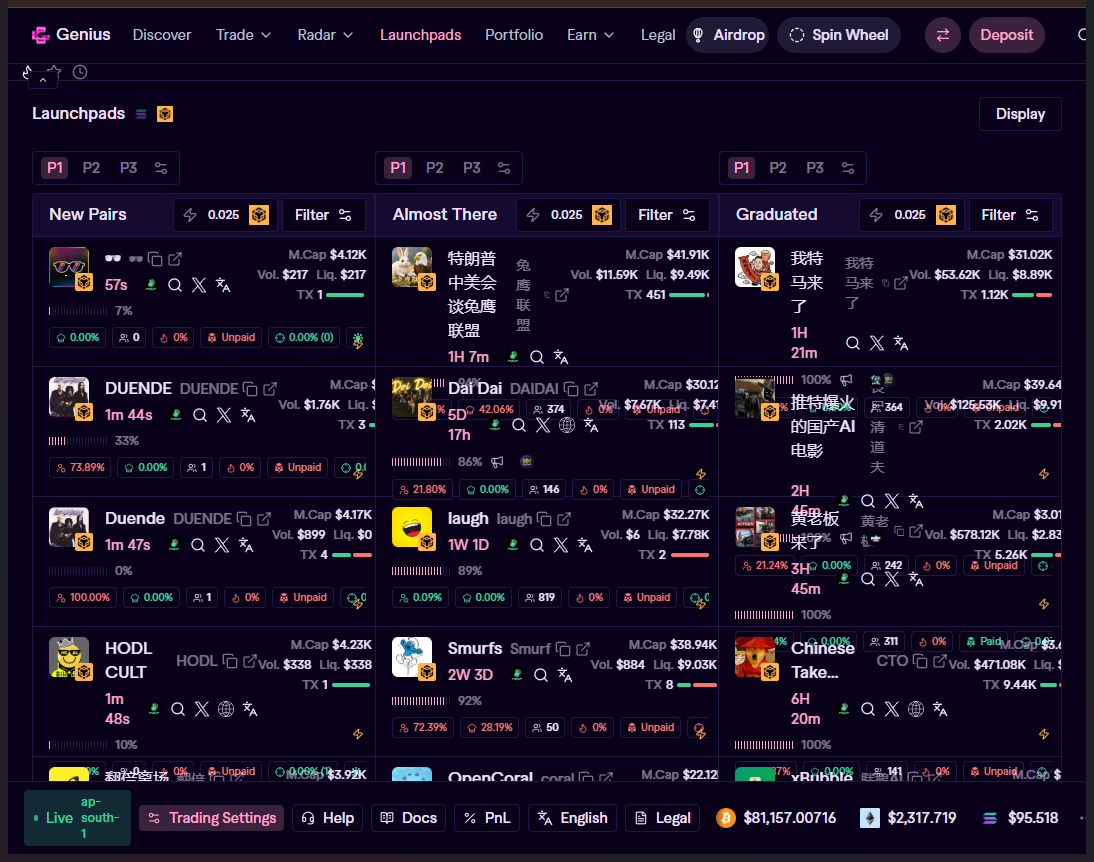
The authenticated launchpads route loaded a dense listing board with stages, filters, liquidity and market-cap information, and a live-feed style layout that felt specific to this route rather than copied from the main terminal.
The authenticated airdrop route tied the terminal more explicitly to the GENIUS token, fee discounts, reward logic, and user participation flows.
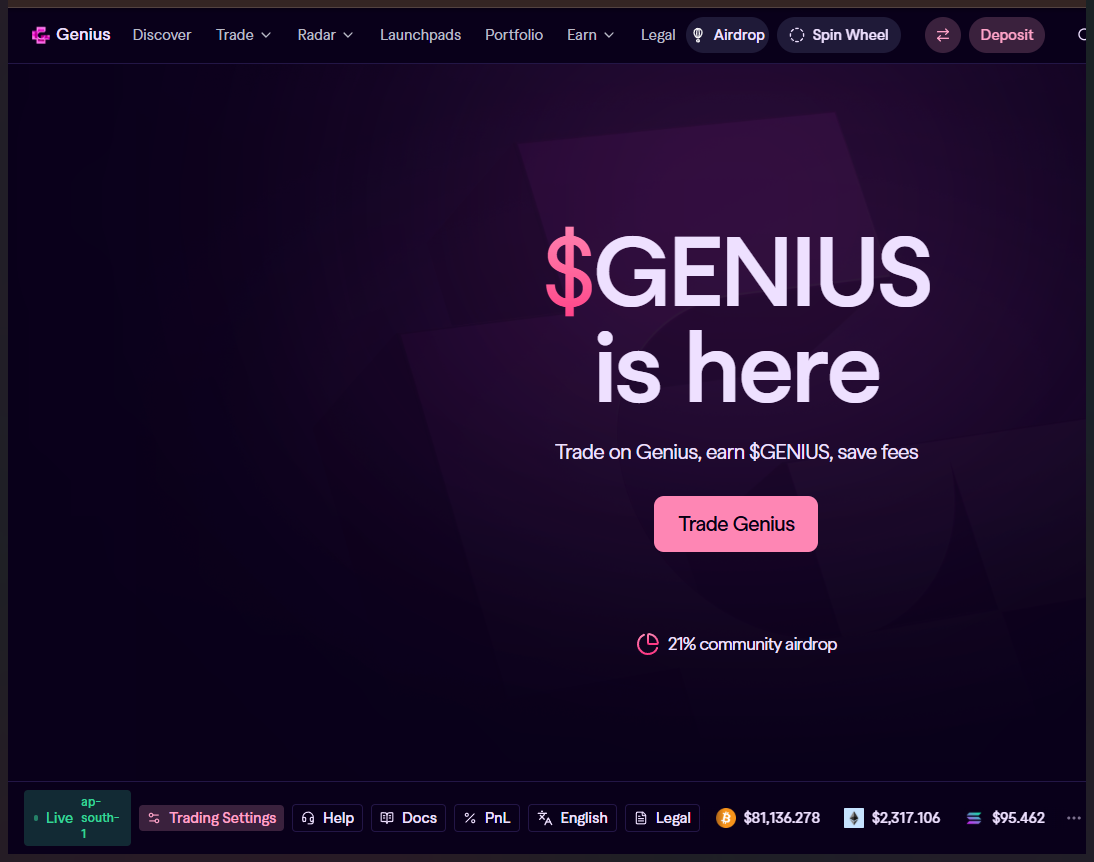
These pages suggest TradeGenius is trying to build an ecosystem around the terminal, not just a trade form with extra tabs.
That kind of discovery-and-reward layer is easier to understand if readers compare it with Coincu’s explainer on what Binance Alpha is and how exchange discovery funnels can amplify early attention. The mechanics are different, but the broader idea is similar: routing, access, and incentive design can matter almost as much as the token itself.
GENIUS Token Route
The live GENIUS token route was one of the best places to judge both depth and quality.
On the positive side, the route showed:
- price
- volume
- liquidity
- buy and sell counts
- a live buy panel
- token information blocks
- route-specific trading context
On the negative side, the same route exposed mixed-language chart UI during testing. Some chart elements appeared in Vietnamese while the rest of the terminal remained in English.
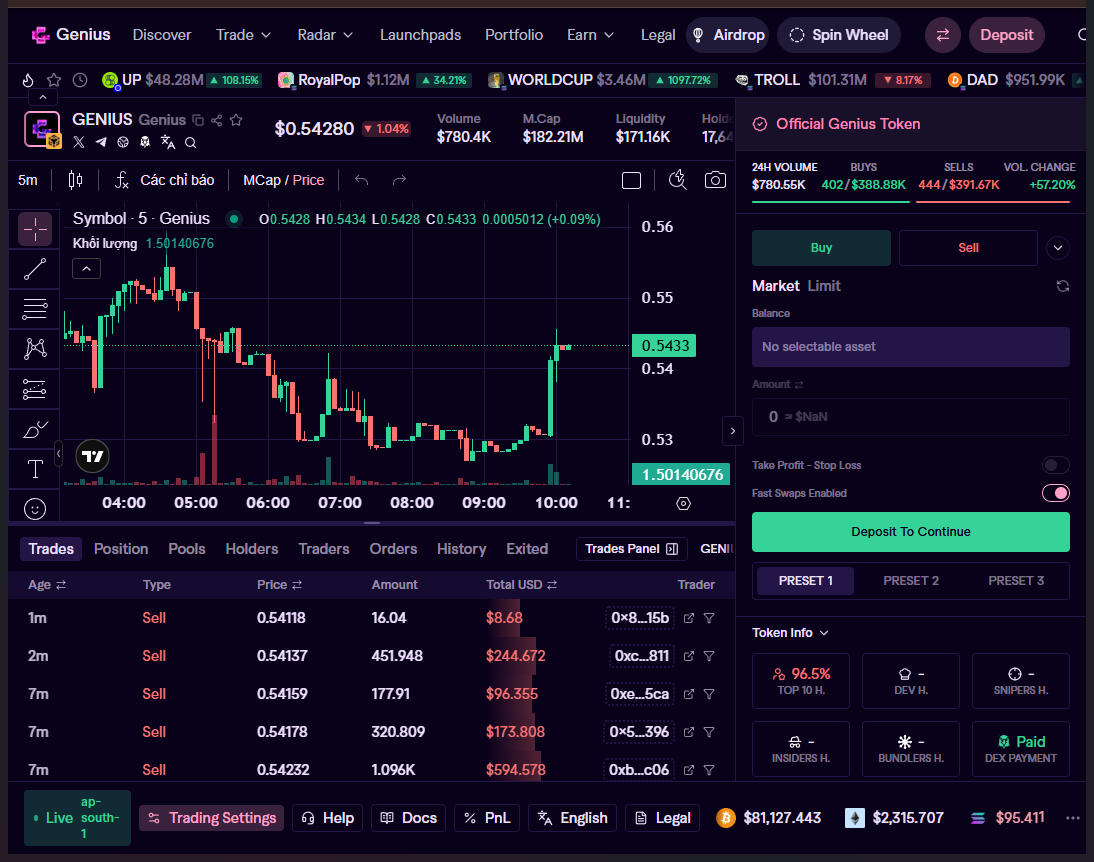
That is not a fatal issue, but it is exactly the kind of interface inconsistency that reduces trust in a trading product.
Security And Trust Model
TradeGenius did not feel like a lightweight anonymous wallet tool during our test. It felt like a more managed terminal stack.
Signals supporting that view include:
- Google and Apple sign-in options
- wallet onboarding with chain selection
- terms acceptance after login
- one-time username creation
- two-factor prompts before the session fully settled
One detail matters more than it might seem at first glance: the Google path handed off to a real authentication route tied to api/auth/turnkey-google during testing. That, combined with username setup and 2FA prompts, points toward an account-layer trust model rather than a pure wallet-session model.
In practical terms, users are not just trusting smart-contract routing or browser-wallet approvals here. They are also stepping into a product that appears to maintain account logic, onboarding state, and security prompts beyond the first login click.
That does not automatically make the product safer or less safe. It simply means users are accepting a more layered trust model than they would with a simple self-custody front end.
Users who want compressed workflow, cross-surface navigation, and a more persistent account experience may like that. Users who want the simplest possible wallet-only path may not.
Docs, Legal, And Help-Center Visibility
TradeGenius did expose footer-level controls for Docs, language, settings, and legal links inside the live terminal. That is a useful positive signal because it shows the product is trying to surface supporting information from within the trading environment rather than hiding everything behind a separate marketing site.
At the same time, the documentation path was not fully clean in our testing. A direct visit to the docs route returned a 404 in an earlier captured session, even though a docs entry was visible from the app. That means readers should not assume that every in-app support or documentation link is stable just because the control is present in the footer.
So the right conclusion here is mixed: legal and help-oriented navigation is visible from the product surface, but documentation discoverability and consistency still need more validation.
UI Quality Issues Seen Live
TradeGenius felt real in use, but not fully polished.
The clearest issues observed during testing were:
- unresolved translation keys on public-shell banner elements
- mixed-language interface elements on the live token route
- occasional roughness in localization consistency between app shell and embedded components
These are not theoretical concerns pulled from documentation. They were visible in the tested session and should count against the product in an honest review.
Pros & Cons
Pros
- Real terminal shell available before login
- Multiple sign-in paths: Google, Apple, and wallet
- Authenticated trade route looks substantial
- Portfolio, launchpads, and airdrop all loaded as real routes
- Wallet onboarding includes explicit chain selection
- Product feels broader than a single swap interface
Cons
- Login flow has more friction than a minimal wallet-first DEX
- Public shell showed unresolved translation keys during live testing
- Token route showed mixed-language chart UI
- No funded proof yet for deposit, execution, or withdrawal
- Product trust still depends on future validation of capital paths
Who Should Use TradeGenius?
TradeGenius looks strongest for:
- traders who want discovery, trading, and account routes in one terminal
- users comfortable with account-based onboarding
- users interested in broader ecosystem features like launchpads and airdrops
TradeGenius looks weaker for:
- users who want the lightest possible wallet-only flow
- users who care more about minimalism than feature density
- traders who require funded proof before trusting a new venue
Verdict
Overall verdict: a promising workflow product with real product depth, but still only partially validated.
TradeGenius passed the most important early test: it behaved like a real product when used live.
The browser session moved from a public terminal shell to a structured sign-in layer, then into post-login onboarding, and then into authenticated trading and account routes that actually loaded and looked purposeful. That is meaningful evidence.
At the same time, the review still stops well short of a strong trading or custody verdict because funded actions were not completed, fees were not verified, and UI consistency issues were visible during testing.
Bottom line: TradeGenius already looks like a genuine account-based trading terminal rather than a hollow shell, but the evidence today supports cautious interest, not a strong endorsement.
What This Review Did Not Prove
This review did not prove:
- funded execution quality
- real slippage behavior
- withdrawal reliability
- perp risk controls under live capital
- best-execution quality across routes
- complete fee transparency
- full supported-chain and supported-asset coverage
- support or help-center responsiveness
That limitation is central to the review and should not be ignored.
Methodology
This article is based on live browser testing performed on May 12-13, 2026. Testing covered the public asset route, the sign-in modal, wallet handoff, post-login onboarding, the authenticated trade route, the authenticated portfolio route, the authenticated launchpads route, the authenticated airdrop route, and the live GENIUS token page.
No funded capital was deployed.
Disclaimer
This review is for informational purposes only and is not financial, legal, or security advice. Crypto products involve custody, execution, smart-contract, and operational risk. Users should verify live conditions and apply their own risk controls before depositing funds.
No tags available.


- China, US Conclude Trade Talks with Focus on Cooperation
- Crypto Weekly: NYSE Backs OKX, Kraken Gets Fed Access, BTC Sells
- Court Upholds Fed’s Rejection of Custodia Bank’s Request
- Former CFO Convicted for $35M Fraudulent Crypto Investment
- DeriW Launches Edge Hour Trading Competition Platform for Derivatives Traders
- Michael Saylor Denies Bitcoin Sell-Off Amid Large BTC Transfer
- Buy Dogecoin on eToro: Step-by-Step Guide for Beginners (2024)
- Kazakhstan Explores Crypto Reserves Backed by National Funds
- JPMorgan Increases Holdings in BlackRock’s Bitcoin ETF
- Nordea Bank Introduces Bitcoin ETP Trading for Nordic Customers
- XRP Spot ETF Launches on Nasdaq Amid Market Fluctuations
- Peter Schiff Challenges Michael Saylor on MSTR’s Business Model
- Thailand Orders Worldcoin to Delete 1.2 Million Biometric Records
- UK Proposes New DeFi Tax Framework to Ease User Burden
- WLFI Under Fire: Analyst Warns Hyperliquid Could Be Next
- Ancient Ethereum Whale Moves $1.19 Billion After Decade
- BlackRock Receives Large Crypto Transfers from Coinbase
- SEC Scrutiny on ALT5 Sigma’s Leadership Disclosure Timing
- Yala Injects $5.5 Million Amid Recovery Efforts
- Radiant Capital Faces $50M Loss in Major Security Breach
- China, US Conclude Trade Talks with Focus on Cooperation
- Crypto Weekly: NYSE Backs OKX, Kraken Gets Fed Access, BTC Sells
- Court Upholds Fed’s Rejection of Custodia Bank’s Request
- Former CFO Convicted for $35M Fraudulent Crypto Investment
- DeriW Launches Edge Hour Trading Competition Platform for Derivatives Traders
- Michael Saylor Denies Bitcoin Sell-Off Amid Large BTC Transfer
- Buy Dogecoin on eToro: Step-by-Step Guide for Beginners (2024)
- Kazakhstan Explores Crypto Reserves Backed by National Funds
- JPMorgan Increases Holdings in BlackRock’s Bitcoin ETF
- Nordea Bank Introduces Bitcoin ETP Trading for Nordic Customers
- XRP Spot ETF Launches on Nasdaq Amid Market Fluctuations
- Peter Schiff Challenges Michael Saylor on MSTR’s Business Model
- Thailand Orders Worldcoin to Delete 1.2 Million Biometric Records
- UK Proposes New DeFi Tax Framework to Ease User Burden
- WLFI Under Fire: Analyst Warns Hyperliquid Could Be Next
- Ancient Ethereum Whale Moves $1.19 Billion After Decade
- BlackRock Receives Large Crypto Transfers from Coinbase
- SEC Scrutiny on ALT5 Sigma’s Leadership Disclosure Timing
- Yala Injects $5.5 Million Amid Recovery Efforts
- Radiant Capital Faces $50M Loss in Major Security Breach
- China, US Conclude Trade Talks with Focus on Cooperation
- Crypto Weekly: NYSE Backs OKX, Kraken Gets Fed Access, BTC Sells
- Court Upholds Fed’s Rejection of Custodia Bank’s Request
- Former CFO Convicted for $35M Fraudulent Crypto Investment
- DeriW Launches Edge Hour Trading Competition Platform for Derivatives Traders
- Michael Saylor Denies Bitcoin Sell-Off Amid Large BTC Transfer
- Buy Dogecoin on eToro: Step-by-Step Guide for Beginners (2024)
- Kazakhstan Explores Crypto Reserves Backed by National Funds
- JPMorgan Increases Holdings in BlackRock’s Bitcoin ETF
- Nordea Bank Introduces Bitcoin ETP Trading for Nordic Customers
- XRP Spot ETF Launches on Nasdaq Amid Market Fluctuations
- Peter Schiff Challenges Michael Saylor on MSTR’s Business Model
- Thailand Orders Worldcoin to Delete 1.2 Million Biometric Records
- UK Proposes New DeFi Tax Framework to Ease User Burden
- WLFI Under Fire: Analyst Warns Hyperliquid Could Be Next
- Ancient Ethereum Whale Moves $1.19 Billion After Decade
- BlackRock Receives Large Crypto Transfers from Coinbase
- SEC Scrutiny on ALT5 Sigma’s Leadership Disclosure Timing
- Yala Injects $5.5 Million Amid Recovery Efforts
- Radiant Capital Faces $50M Loss in Major Security Breach

Strategy Sells 1,690 BTC as Dollar Reserve Reaches $4.65 Billion


Strategy Sells 1,690 BTC, Raises $653 Million From MSTR Shares
Syntetika Launches Tokenization Hub Bringing Regulated Investment Strategies Onchain
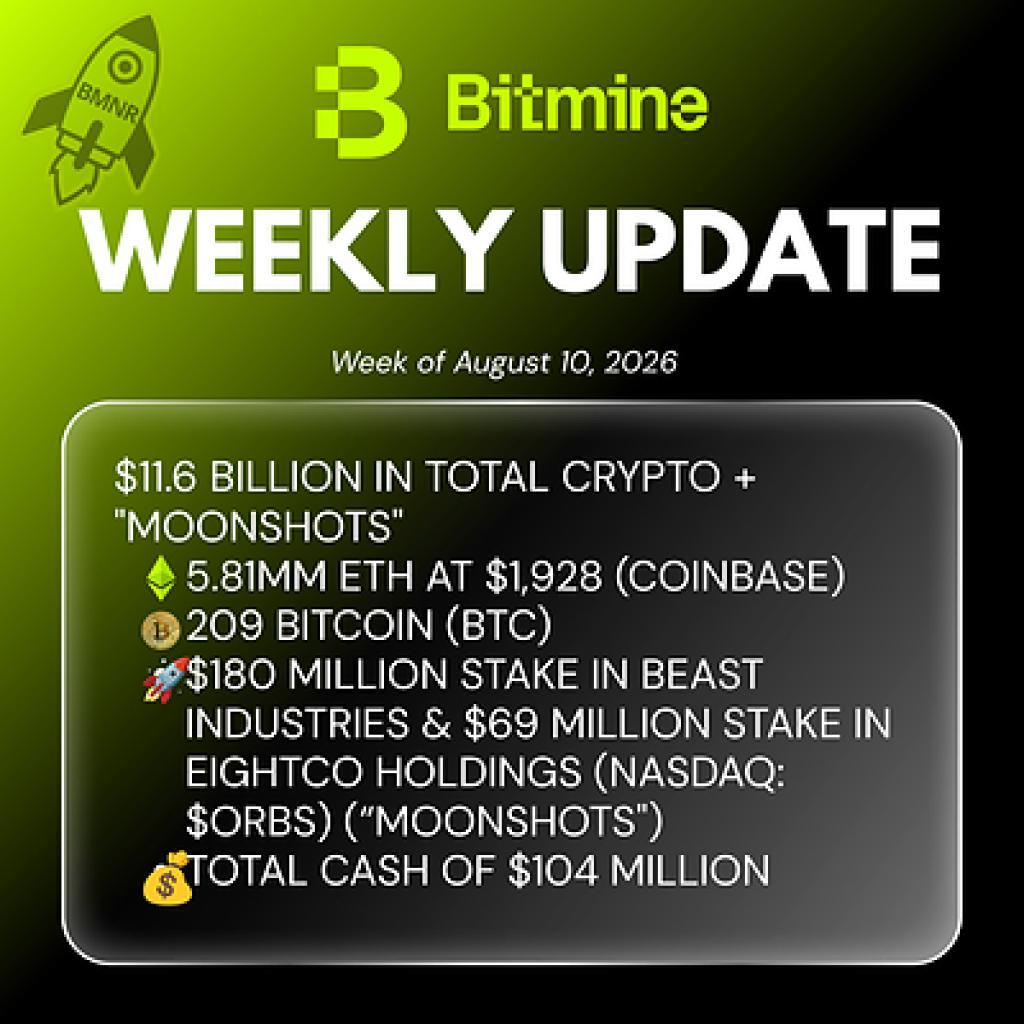
Bitmine Immersion Technologies (BMNR) Announces ETH Holdings Reach 5.81 Million Tokens, and Total Crypto and Total Cash Holdings of $11.6 Billion