Tether (USDT) Review 2026: Reserves, Redemption, Risks, and Stablecoin Verdict
Tether still does the most important job in crypto better than almost anyone else: it moves dollar liquidity across exchanges and blockchains at global scale.
That does not mean it is the cleanest stablecoin for every reader. In 2026, USDT remains dominant because of distribution, trading depth, and cross-border usability, not because the product is especially friendly for small direct redeemers or especially simple from a trust perspective.
That is the right way to review it. Tether is best understood as market infrastructure first, a retail product second.
What to know:
- USDT remains the largest stablecoin by market cap and one of the most heavily traded assets in all of crypto.
- Tether’s latest official reserve disclosures still show a Treasury-heavy backing model, but readers are relying on attestations and reserve reports rather than a completed full audit.
- Direct redemption through Tether is real, but it is built for verified customers with a high minimum size, fees, and operational friction that most casual users will never touch.
Tether at a Glance
| Item | What to know |
|---|---|
| Asset | Tether USDt (USDT) |
| Type | Centralized fiat-backed stablecoin |
| Peg target | 1 USDT = 1 U.S. dollar |
| Launch year | 2014 |
| Core role | Exchange quote asset, settlement rail, dollar proxy, collateral, payments |
| Issuer-facing entity in the current disclosure stack | Tether International, S.A. de C.V. |
| Direct purchase or redemption minimum | $100,000 |
| Main review lens | Liquidity, reserves, redemption reality, chain support, trust model, and operational risk |
Quick Verdict
USDT is still one of the most useful assets in crypto if your priority is liquidity, exchange access, and moving dollars quickly across venues and chains.
It is less impressive if your priority is the cleanest retail redemption path or the highest possible transparency standard. Tether has improved its reporting, and in 2026 it says it has formally engaged a Big Four firm for its first full independent financial statement audit, but as of May 26, 2026 that full audit has not yet been published.
So the honest verdict is this:
- excellent as a trading and liquidity tool
- strong as a cross-border digital dollar rail
- only mixed if you judge it as a retail redeemable product
- still carrying meaningful issuer and transparency risk relative to the ideal version of a fiat-backed stablecoin
Market Position in May 2026
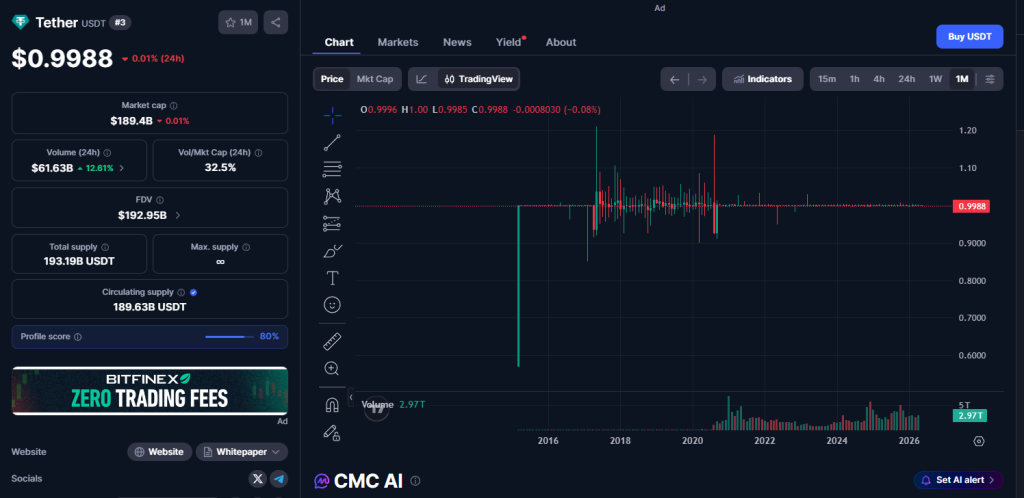
According to CoinMarketCap’s Tether page, checked on May 26, 2026, USDT was trading around $0.9987 with:
- a market cap of about $189.39 billion
- 24-hour volume of about $58.06 billion
- circulating supply of about 189.63 billion USDT
- total supply of about 193.19 billion USDT
Those numbers matter because they explain why Tether remains hard to displace even when critics focus on structure and disclosure.
Liquidity is a product feature. So is distribution. A stablecoin that can be moved almost everywhere, quoted almost everywhere, and used as collateral almost everywhere has a built-in advantage that smaller rivals struggle to match.
What Is Tether?
Tether is a fiat-referenced digital token system designed to track the value of the U.S. dollar. In practice, USDT functions as a blockchain-native dollar proxy that traders, exchanges, OTC desks, payment users, and cross-border participants use as a settlement asset.
Most people casually describe USDT as “digital dollars on-chain,” but a more accurate description is:
- a centrally issued token
- backed by reserves managed off-chain
- distributed across multiple blockchains
- redeemed under issuer terms rather than trustless protocol rules
That distinction matters because USDT is not trying to be decentralized money. It is trying to be usable money inside crypto markets.
A Short History of Tether
USDT launched in 2014 and became one of the first large-scale attempts to put a dollar-linked token into crypto markets. That timing mattered. Exchanges, traders, and international users needed a stable quote asset long before today’s broader stablecoin market matured.
Tether’s historical edge came from solving a simple but painful problem:
- crypto markets needed dollar liquidity
- many exchanges could not offer straightforward banking rails
- users wanted a portable cash-equivalent between venues
USDT filled that gap early, and that early-mover advantage compounded into network effects. Once exchanges, traders, and market makers build around a stablecoin, the asset becomes harder to replace even if competitors later arrive with cleaner branding or different compliance positioning.
How USDT Actually Works
Tether’s structure is easier to understand if you split it into three layers:
1. Issuance and redemption
Tether issues and redeems tokens through verified counterparties in the primary market. This is the part most people never use directly.
2. Secondary-market trading
Most readers interact with USDT by buying, selling, depositing, or withdrawing it through exchanges, wallets, merchants, or OTC desks. This is the real user layer.
3. Reserve management
The peg relies on the issuer holding reserve assets and honoring redemptions under its legal terms.
So when people ask whether USDT “works,” they are really asking whether three things hold together at once:
- the market still accepts USDT as near-dollar collateral
- the issuer’s reserve base remains credible
- redemption and settlement pathways remain functional
How the Peg Tends to Hold
USDT is not kept at $1 by a smart contract. It is kept near $1 by a combination of reserves, redemption confidence, secondary-market arbitrage, and market habit.
The rough mechanism is simple:
- if USDT trades below $1, large players may buy discounted USDT and redeem or reposition it
- if USDT trades above $1, issuance and market making can increase supply where demand is strongest
- if the issuer remains trusted enough and trading venues remain liquid enough, the peg tends to pull back toward parity
That does not mean USDT is mathematically guaranteed to sit at exactly $1 at every moment. It means the system has historically benefited from deep enough liquidity and broad enough acceptance that small deviations tend to be arbitraged quickly.
How Strong Is Tether’s Backing in 2026?
The latest official reserve update is Tether’s Q1 2026 attestation announcement tied to the March 31, 2026 reporting date.
The key figures Tether published were:
- about $191.77 billion in total assets
- about $183.54 billion in total liabilities
- about $8.23 billion in excess reserves
- about $141 billion in direct and indirect U.S. Treasury bill exposure
- about $20 billion in physical gold holdings
- about $7 billion in bitcoin holdings
That is the core of the bull case for USDT.
Tether is not presenting a thin cash-only structure. It is presenting a very large reserve base centered on short-duration U.S. government exposure, with a material excess buffer and smaller allocations to gold and bitcoin.
That makes the backing story better than the weakest versions of the old Tether critique. But it does not eliminate the trust question, because readers are still depending on quarterly reserve reporting and third-party attestations rather than a completed full financial statement audit.
The Transparency Question Still Matters
Tether’s transparency story is better than it used to be, but it is still not the same thing as frictionless certainty.
Two facts can be true at once:
- Tether has become much larger and more institutionally structured.
- Readers can still reasonably want more assurance than an attestation cycle provides.
That is why Tether’s March 24, 2026 announcement matters. The company said it had formally engaged a Big Four firm for its first full independent financial statement audit.
That is a meaningful step, but it is not the same thing as saying the audit is already done. For a 2026 review, the fair read is that Tether’s transparency trajectory is improving, while the final standard many critics want has not yet been fully reached. Coincu’s own coverage of how Tether still faces questions on its audit timeline while targeting larger scale fits this part of the story more naturally than generic market commentary.
Team Behind Tether
Stablecoins are not just code and collateral. They are also operating companies run by identifiable executives.
Tether’s current public leadership page shows four names that matter most to readers evaluating governance and execution:
- Paolo Ardoino, Chief Executive Officer
- Giancarlo Devasini, Chairman
- Simon McWilliams, Chief Financial Officer
- Claudia Lagorio, Chief Operating Officer
That lineup matters because USDT’s real-world strengths depend on execution at the company level: reserve management, compliance posture, exchange relationships, cross-border expansion, and communications under pressure all sit inside a centralized organization.




Direct Redemption: Better Understood as Institutional Plumbing
This is the part many retail readers misunderstand.
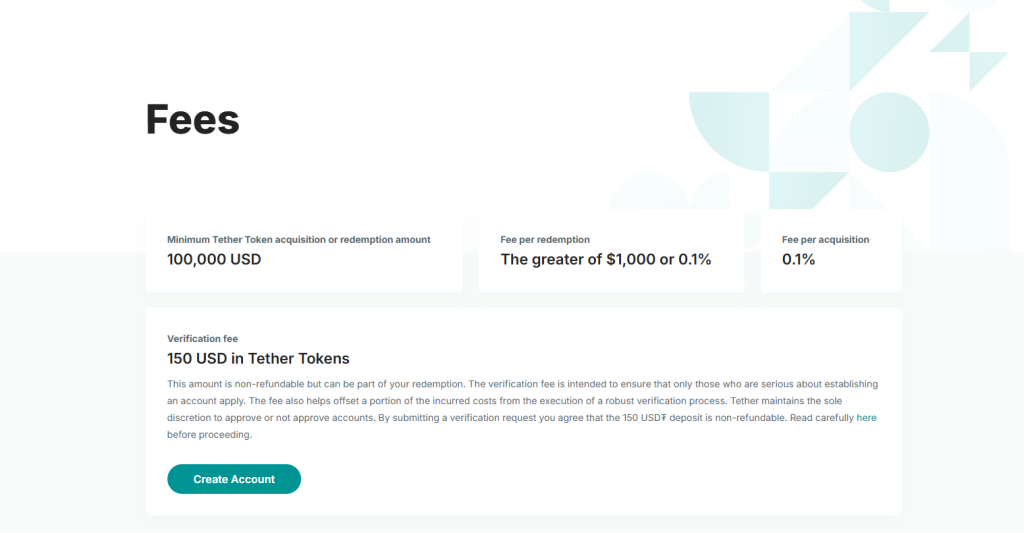
Tether does allow direct primary-market activity, but its own fees page and Relevant Information Document show that the system is not designed like a casual consumer app.
Current official terms include:
- minimum acquisition or redemption amount: $100,000
- redemption fee: the greater of $1,000 or 0.1%
- acquisition fee: 0.1%
- verification fee: 150 USDt
Tether also states that it does not offer wallet functionality for digital tokens and that withdrawal requests for tokens held by Tether can take several days to process.
That does not make the system broken. It makes the system clearer. Direct Tether access is closer to issuer plumbing for larger verified customers than a frictionless retail cash-out lane.
Supported Chains and Why They Matter
One reason USDT remains so sticky is that it exists across multiple important blockchains.
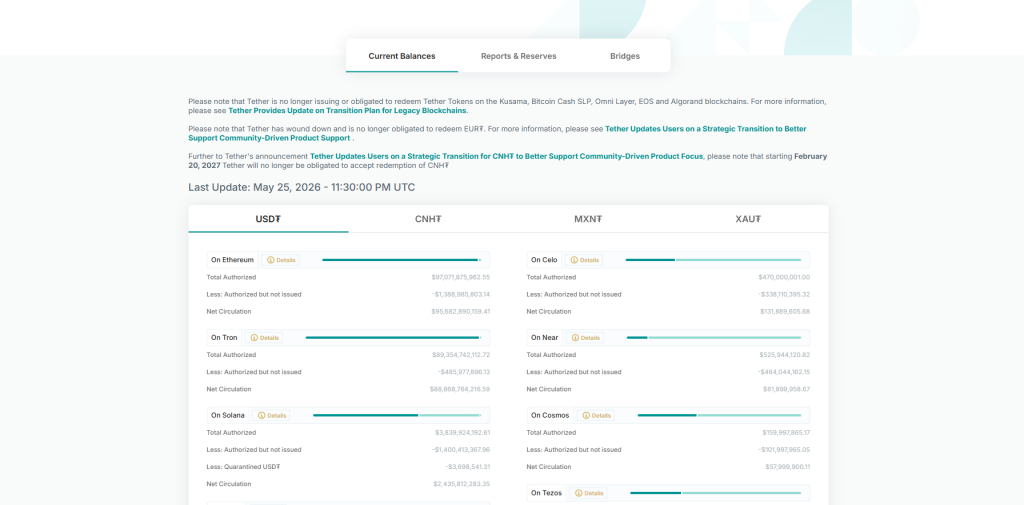
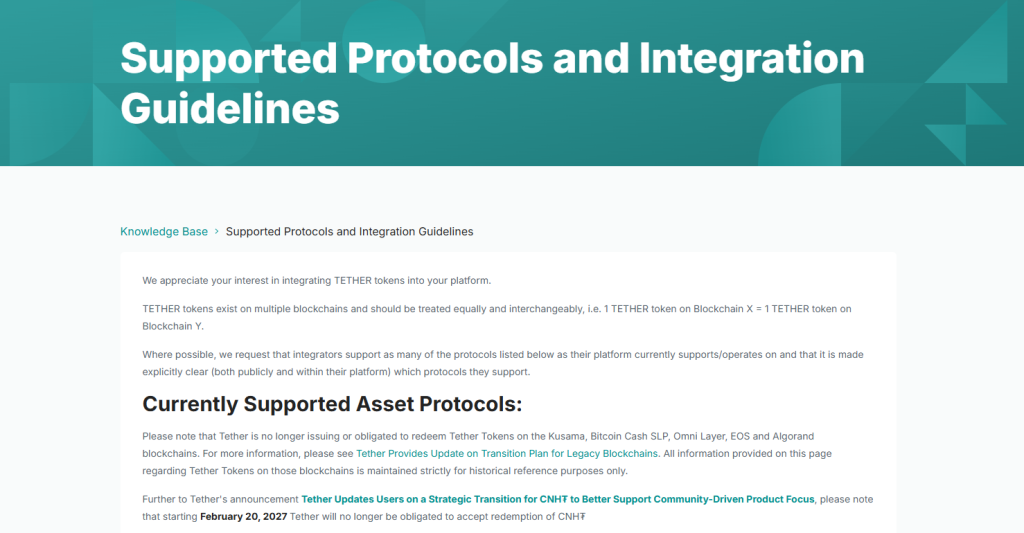
Tether’s supported protocols page lists current support across:
- Ethereum
- Tron
- Solana
- TON
- Aptos
- Avalanche
- BNB Smart Chain
- Celo
- Cosmos via Kava
- Kaia
- Liquid
- Polkadot AssetHub
- Tezos
That range matters more than it may seem.
For users in emerging markets, for desk settlement, for exchange funding, and for traders trying to optimize fees and speed, chain optionality is not a side feature. It is one of the main reasons USDT keeps winning.
There is a tradeoff, though. Tether also notes that it is no longer issuing or obligated to redeem tokens on some legacy rails, including Kusama, Bitcoin Cash SLP, Omni, EOS, and Algorand. That is not necessarily bad, but it is a reminder that “USDT” is a multi-chain system, and chain selection risk is real. It is also why Coincu’s coverage of USDT0’s cross-chain expansion matters: Tether’s newer omnichain distribution layer is an extension of the same network advantage described in this review.
Main Use Cases for USDT
Tether is large because it solves more than one problem at once.
Exchange quote asset
USDT remains one of the default base assets for spot and derivatives markets. On many venues, the fastest path into a token is still through a USDT pair.
Parking capital between trades
Traders use USDT as an easy way to step out of volatility without fully exiting the crypto market.
Cross-exchange settlement
Market participants often move USDT between venues because it is easier and faster than moving fiat through traditional banking rails.
Cross-border transfers
In many regions, users treat USDT as a practical digital dollar rail for savings, business settlement, remittances, or merchant transfer flows. Coincu’s report on how Tether funded Axiym as USDT pushed deeper into regulated payment rails is a useful example of how that use case keeps expanding beyond pure exchange trading.
Collateral and DeFi utility
On some chains and platforms, USDT is also used as collateral, liquidity-pool inventory, and base settlement capital.
Where Tether Is Strongest
1. Exchange liquidity
USDT is still the default quote asset on a huge portion of the crypto market. That makes it useful even for people who do not especially like issuer risk, because market structure itself keeps pulling traders toward it.
2. Cross-border utility
Tether’s strongest real-world use case is not “holding a perfect dollar.” It is moving dollar exposure across places where banking rails are slow, fragile, expensive, or restricted.
3. Multi-chain reach
A stablecoin that can be used on Tron for low-cost transfers, on Ethereum for deeper DeFi compatibility, and on other rails for ecosystem-specific needs has a practical edge that many alternatives still lack.
4. Depth under stress
In crypto, the most useful stablecoin is often the one everyone else is still willing to accept during stress. USDT continues to benefit from that reflexive advantage.
Where Tether Is Weaker
1. Retail redemption is not elegant
The $100,000 minimum alone tells you that direct issuer interaction is not the product most readers think they are getting.
2. Transparency still asks for trust
Reserve reporting is better than vague promises, but it still leaves a gap between “reported and attested” and “fully audited and maximally transparent.”
3. Centralization and freeze risk
Tether’s disclosure documents say the company may delay or suspend redemptions in certain cases and may, at the request of law enforcement or regulators, attempt to freeze tokens held in external wallets. That is part of the compliance model, but it also means USDT is not censorship-resistant money.
4. Chain confusion remains a real user risk
Sending USDT on the wrong network is still one of the most common operational mistakes in crypto. Multi-chain availability is a strength, but only if users understand exactly which rail they are using.
USDT vs Other Stablecoins
The easiest way to understand Tether’s place in the market is to compare what it optimizes for.
Against USDC
USDC usually presents a cleaner institutional and regulatory image, but USDT still tends to win on sheer exchange penetration and international usage.
Against decentralized stablecoins
Decentralized stablecoins can reduce direct issuer dependence, but they often lose on simplicity, global exchange support, or raw liquidity depth.
Against smaller fiat-backed rivals
Smaller rivals may look cleaner on paper, but they often lack the distribution, collateral utility, or market reflex that makes USDT so durable during volatile periods.
That is why Tether keeps its position. It is not necessarily the most elegant stablecoin. It is the one the market has organized itself around most completely.
Who Should Use USDT?
USDT makes the most sense for:
- active traders
- exchange users who need the deepest stablecoin liquidity
- OTC and cross-border settlement users
- users in markets where a digital dollar is more useful than local banking rails
- people who care more about utility and acceptance than about the cleanest possible stablecoin design
USDT makes less sense for:
- readers who want simple small-size direct redemption with the issuer
- users who want the lowest possible centralized-counterparty discomfort
- people who are careless with chain selection and wallet operations
- readers who assume every dollar stablecoin has the same redemption path and legal setup
Is Tether Safe in 2026?
“Safe” is too broad unless you specify what kind of safety you mean.
If you mean market utility, exchange depth, and ability to move size, USDT still looks strong.
If you mean “free of issuer risk,” the answer is no. Tether is a centralized issuer. Its product depends on reserves, compliance controls, banking access, and continuing market confidence.
If you mean “fully settled transparency debate,” the answer is also no. Tether has moved forward materially, but the full audit standard many institutional readers want is still a work in progress as of May 26, 2026.
Final Verdict
Tether remains the most important stablecoin in crypto because it solves a real problem at scale: people need a dollar-like asset that works across exchanges, jurisdictions, and chains faster than traditional banking can.
That utility is real. It is also why USDT still matters more than many cleaner-sounding alternatives.
But a good 2026 review should not stop there. Tether is not a magic dollar and not a trustless one. It is a centralized, reserve-backed, globally distributed liquidity layer whose strengths are obvious in market structure and whose weaknesses are concentrated in transparency expectations, issuer dependence, and retail-unfriendly primary-market access.
For most readers, that leads to a simple conclusion:
- as a crypto liquidity tool, USDT is still top tier
- as a “set and forget” dollar substitute, it deserves more caution
FAQ
Is Tether fully backed in 2026?
Tether says every issued token is backed by reserves, and its latest official reserve reporting for March 31, 2026 showed assets above liabilities. The remaining debate is less about the claim itself and more about the level of external assurance readers require.
Can ordinary users redeem USDT directly with Tether?
Usually not in the way most retail users imagine. Direct access requires verification and currently comes with a $100,000 minimum size plus fees.
Why do so many traders still prefer USDT?
Because liquidity, exchange support, and cross-chain usability are often more important in practice than having the most elegant redemption story on paper.
Does USDT run on its own blockchain?
No. USDT is issued across multiple external blockchains and networks, which is one reason it is so widely usable.
What is the biggest risk with Tether?
The biggest structural risk is still centralized issuer dependence: reserves, compliance, redemptions, and legal controls all sit inside a real corporate and regulatory framework rather than a trustless protocol.
Sources
- CoinMarketCap: Tether price, market cap, volume, and circulating supply
- Tether Q1 2026 attestation and reserve update
- Tether About Us and leadership page
- Tether fees page
- Tether supported protocols page
- Relevant Information Document for Tether International, S.A. de C.V.
- Tether announcement on engaging a Big Four firm for a full audit
Disclaimer
This article is for educational purposes only and does not constitute investment, legal, tax, or financial advice. Stablecoin market data can change quickly, and issuer terms, supported chains, reserve composition, and redemption conditions may change after publication.
No tags available.


Other Posts





- China, US Conclude Trade Talks with Focus on Cooperation
- Crypto Weekly: NYSE Backs OKX, Kraken Gets Fed Access, BTC Sells
- DeriW Launches Edge Hour Trading Competition Platform for Derivatives Traders
- Court Upholds Fed’s Rejection of Custodia Bank’s Request
- Former CFO Convicted for $35M Fraudulent Crypto Investment
- Michael Saylor Denies Bitcoin Sell-Off Amid Large BTC Transfer
- Kazakhstan Explores Crypto Reserves Backed by National Funds
- JPMorgan Increases Holdings in BlackRock’s Bitcoin ETF
- Nordea Bank Introduces Bitcoin ETP Trading for Nordic Customers
- Buy Dogecoin on eToro: Step-by-Step Guide for Beginners (2024)
- XRP Spot ETF Launches on Nasdaq Amid Market Fluctuations
- Crypto Leaders Address Macro Volatility Amid Market Shifts
- Peter Schiff Challenges Michael Saylor on MSTR’s Business Model
- Thailand Orders Worldcoin to Delete 1.2 Million Biometric Records
- UK Proposes New DeFi Tax Framework to Ease User Burden
- WLFI Under Fire: Analyst Warns Hyperliquid Could Be Next
- Ancient Ethereum Whale Moves $1.19 Billion After Decade
- BlackRock Receives Large Crypto Transfers from Coinbase
- SEC Scrutiny on ALT5 Sigma’s Leadership Disclosure Timing
- MoonPay Gains Trust License for Crypto Operations in New York
- China, US Conclude Trade Talks with Focus on Cooperation
- Crypto Weekly: NYSE Backs OKX, Kraken Gets Fed Access, BTC Sells
- DeriW Launches Edge Hour Trading Competition Platform for Derivatives Traders
- Court Upholds Fed’s Rejection of Custodia Bank’s Request
- Former CFO Convicted for $35M Fraudulent Crypto Investment
- Michael Saylor Denies Bitcoin Sell-Off Amid Large BTC Transfer
- Kazakhstan Explores Crypto Reserves Backed by National Funds
- JPMorgan Increases Holdings in BlackRock’s Bitcoin ETF
- Nordea Bank Introduces Bitcoin ETP Trading for Nordic Customers
- Buy Dogecoin on eToro: Step-by-Step Guide for Beginners (2024)
- XRP Spot ETF Launches on Nasdaq Amid Market Fluctuations
- Crypto Leaders Address Macro Volatility Amid Market Shifts
- Peter Schiff Challenges Michael Saylor on MSTR’s Business Model
- Thailand Orders Worldcoin to Delete 1.2 Million Biometric Records
- UK Proposes New DeFi Tax Framework to Ease User Burden
- WLFI Under Fire: Analyst Warns Hyperliquid Could Be Next
- Ancient Ethereum Whale Moves $1.19 Billion After Decade
- BlackRock Receives Large Crypto Transfers from Coinbase
- SEC Scrutiny on ALT5 Sigma’s Leadership Disclosure Timing
- MoonPay Gains Trust License for Crypto Operations in New York
- China, US Conclude Trade Talks with Focus on Cooperation
- Crypto Weekly: NYSE Backs OKX, Kraken Gets Fed Access, BTC Sells
- DeriW Launches Edge Hour Trading Competition Platform for Derivatives Traders
- Court Upholds Fed’s Rejection of Custodia Bank’s Request
- Former CFO Convicted for $35M Fraudulent Crypto Investment
- Michael Saylor Denies Bitcoin Sell-Off Amid Large BTC Transfer
- Kazakhstan Explores Crypto Reserves Backed by National Funds
- JPMorgan Increases Holdings in BlackRock’s Bitcoin ETF
- Nordea Bank Introduces Bitcoin ETP Trading for Nordic Customers
- Buy Dogecoin on eToro: Step-by-Step Guide for Beginners (2024)
- XRP Spot ETF Launches on Nasdaq Amid Market Fluctuations
- Crypto Leaders Address Macro Volatility Amid Market Shifts
- Peter Schiff Challenges Michael Saylor on MSTR’s Business Model
- Thailand Orders Worldcoin to Delete 1.2 Million Biometric Records
- UK Proposes New DeFi Tax Framework to Ease User Burden
- WLFI Under Fire: Analyst Warns Hyperliquid Could Be Next
- Ancient Ethereum Whale Moves $1.19 Billion After Decade
- BlackRock Receives Large Crypto Transfers from Coinbase
- SEC Scrutiny on ALT5 Sigma’s Leadership Disclosure Timing
- MoonPay Gains Trust License for Crypto Operations in New York

Upbit Lists OpenGradient (OPG) With BTC and USDT Trading Pairs

Tokenized Pokemon Card Sales on Solana, Other Blockchains Hit $230M in May


Comparing Partner Exchanges on TetherBack, the Crypto Cashback Platform
Bitmine Immersion Technologies Announces Initial Dividends and NYSE Listing for Series A Preferred Stock