Circle reportedly issued another 250 million USDC on Solana, lifting the stablecoin’s reported 2026 issuance total on the network to 72.01 billion. The mint expands USDC supply on a major chain, though the current research pass has not independently verified either figure.
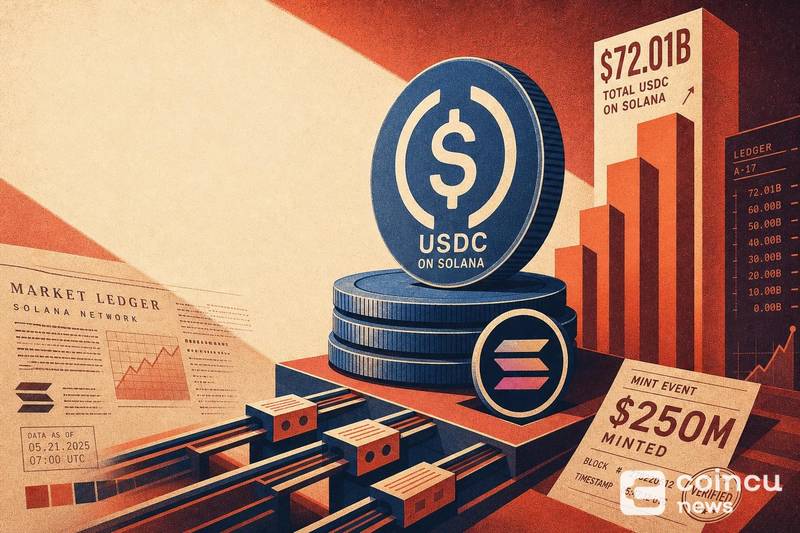
The reported mint adds new USDC directly on Solana, the chain Circle uses as one of its primary issuance venues. On its own, a single issuance is a routine supply operation rather than proof of a demand surge, and it should be read as an expansion of circulating supply on the chain. For related coverage, see BitMEX to Shut Down on September 23, 2026: What Users Need to Know.
The reported 2026 total is the larger signal than a single mint
A one-off issuance matters less to readers than the cumulative figure behind it. The reported year-to-date total of 72.01 billion frames the scale of USDC activity on Solana across 2026, well beyond what any single mint would indicate. USDC supply across chains can be monitored on Solana’s stablecoin dashboards. For related coverage, see Odos to Shut Down and Cease Services on July 30: What Users Need to Know.
That cumulative number should be read as a reported total, not as an independently confirmed fact from this pass. Because no market data was captured in the current research, the useful context here is issuance magnitude, not price action or projected demand.
This article avoids comparisons to prior years or rival stablecoins, since no such figures are supported by the available evidence.
Why Solana sits at the center of this USDC story
The chain choice is part of the story, not just a distribution footnote. Circle’s decision to mint on Solana concentrates new dollar liquidity on a network whose market and on-chain activity readers already follow closely.
Readers following Solana care about USDC supply because the stablecoin underpins trading pairs, transfers, and settlement across the ecosystem. Any specific claim about liquidity, DeFi utility, or transfer volume remains conditional until later sourcing confirms it.
USDC’s role as settlement collateral is also why incidents involving the token draw scrutiny, from the AFX cross-chain bridge exploit that drained USDC to the Ostium price-data attack that lost USDC. Those cases involved other venues, but they show how closely USDC balances are watched wherever the token moves.
What remains unverified in the current evidence set
Verification status for this story is partial. The research pass carries a low confidence level and an empty verified-facts record, meaning the headline figures have not been independently confirmed here.
The research also notes missing evidence because the fetch budget was exceeded and competitor scanning was left incomplete. Market reaction, on-chain proof of the mint, and any differentiation from other stablecoins are therefore not established. A separate USDC liquidity event on Ostium shows how quickly stablecoin balances can shift.
Readers should treat the reported issuance and the year-to-date total as reported rather than proven until a block explorer entry or Circle disclosure confirms them.
FAQ
Did Circle confirm another 250 million USDC mint on Solana?
The mint is reported in this story’s headline claim, but the current research did not independently verify it. No Circle disclosure or Solana block explorer record was captured in this pass to confirm the issuance.
What does the reported 72.01 billion 2026 total refer to?
It is described as the cumulative USDC issuance figure on Solana for 2026, presented as a reported total. It has not been independently confirmed against verified on-chain or issuer data here.
Does this mint automatically signal a price move for SOL or broader crypto markets?
No. New stablecoin issuance is a supply event and does not by itself prove demand or predict a price move. No market data supports any price conclusion in the current evidence set.
Disclaimer: This article is for informational purposes only and does not constitute financial or investment advice. Cryptocurrency and digital asset markets carry significant risk. Always do your own research before making decisions.
No tags available.


Other Posts







- China, US Conclude Trade Talks with Focus on Cooperation
- Crypto Weekly: NYSE Backs OKX, Kraken Gets Fed Access, BTC Sells
- Court Upholds Fed’s Rejection of Custodia Bank’s Request
- Former CFO Convicted for $35M Fraudulent Crypto Investment
- DeriW Launches Edge Hour Trading Competition Platform for Derivatives Traders
- Michael Saylor Denies Bitcoin Sell-Off Amid Large BTC Transfer
- Buy Dogecoin on eToro: Step-by-Step Guide for Beginners (2024)
- Kazakhstan Explores Crypto Reserves Backed by National Funds
- JPMorgan Increases Holdings in BlackRock’s Bitcoin ETF
- Nordea Bank Introduces Bitcoin ETP Trading for Nordic Customers
- XRP Spot ETF Launches on Nasdaq Amid Market Fluctuations
- Peter Schiff Challenges Michael Saylor on MSTR’s Business Model
- Thailand Orders Worldcoin to Delete 1.2 Million Biometric Records
- UK Proposes New DeFi Tax Framework to Ease User Burden
- WLFI Under Fire: Analyst Warns Hyperliquid Could Be Next
- Ancient Ethereum Whale Moves $1.19 Billion After Decade
- BlackRock Receives Large Crypto Transfers from Coinbase
- SEC Scrutiny on ALT5 Sigma’s Leadership Disclosure Timing
- Yala Injects $5.5 Million Amid Recovery Efforts
- Radiant Capital Faces $50M Loss in Major Security Breach
- China, US Conclude Trade Talks with Focus on Cooperation
- Crypto Weekly: NYSE Backs OKX, Kraken Gets Fed Access, BTC Sells
- Court Upholds Fed’s Rejection of Custodia Bank’s Request
- Former CFO Convicted for $35M Fraudulent Crypto Investment
- DeriW Launches Edge Hour Trading Competition Platform for Derivatives Traders
- Michael Saylor Denies Bitcoin Sell-Off Amid Large BTC Transfer
- Buy Dogecoin on eToro: Step-by-Step Guide for Beginners (2024)
- Kazakhstan Explores Crypto Reserves Backed by National Funds
- JPMorgan Increases Holdings in BlackRock’s Bitcoin ETF
- Nordea Bank Introduces Bitcoin ETP Trading for Nordic Customers
- XRP Spot ETF Launches on Nasdaq Amid Market Fluctuations
- Peter Schiff Challenges Michael Saylor on MSTR’s Business Model
- Thailand Orders Worldcoin to Delete 1.2 Million Biometric Records
- UK Proposes New DeFi Tax Framework to Ease User Burden
- WLFI Under Fire: Analyst Warns Hyperliquid Could Be Next
- Ancient Ethereum Whale Moves $1.19 Billion After Decade
- BlackRock Receives Large Crypto Transfers from Coinbase
- SEC Scrutiny on ALT5 Sigma’s Leadership Disclosure Timing
- Yala Injects $5.5 Million Amid Recovery Efforts
- Radiant Capital Faces $50M Loss in Major Security Breach
- China, US Conclude Trade Talks with Focus on Cooperation
- Crypto Weekly: NYSE Backs OKX, Kraken Gets Fed Access, BTC Sells
- Court Upholds Fed’s Rejection of Custodia Bank’s Request
- Former CFO Convicted for $35M Fraudulent Crypto Investment
- DeriW Launches Edge Hour Trading Competition Platform for Derivatives Traders
- Michael Saylor Denies Bitcoin Sell-Off Amid Large BTC Transfer
- Buy Dogecoin on eToro: Step-by-Step Guide for Beginners (2024)
- Kazakhstan Explores Crypto Reserves Backed by National Funds
- JPMorgan Increases Holdings in BlackRock’s Bitcoin ETF
- Nordea Bank Introduces Bitcoin ETP Trading for Nordic Customers
- XRP Spot ETF Launches on Nasdaq Amid Market Fluctuations
- Peter Schiff Challenges Michael Saylor on MSTR’s Business Model
- Thailand Orders Worldcoin to Delete 1.2 Million Biometric Records
- UK Proposes New DeFi Tax Framework to Ease User Burden
- WLFI Under Fire: Analyst Warns Hyperliquid Could Be Next
- Ancient Ethereum Whale Moves $1.19 Billion After Decade
- BlackRock Receives Large Crypto Transfers from Coinbase
- SEC Scrutiny on ALT5 Sigma’s Leadership Disclosure Timing
- Yala Injects $5.5 Million Amid Recovery Efforts
- Radiant Capital Faces $50M Loss in Major Security Breach

Odos to Shut Down and Cease Services on July 30: What Users Need to Know


Zhibao Plans $220M Bitcoin-Funded Share Sale as Buyer Could Win Board Majority

Zoomex X Space Recap With Fernando Llorente and the World Cup Final Panel
CoinRabbit and GoMining Report: Managing Bitcoin Matters More Than Mining Volume