Binance Withdraws Greek MiCA License Application, What It Means
Binance has withdrawn its application for a Markets in Crypto-Assets (MiCA) license in Greece, a move that raises questions about the exchange’s regulatory strategy across the European Union as MiCA’s transitional period comes to a close.
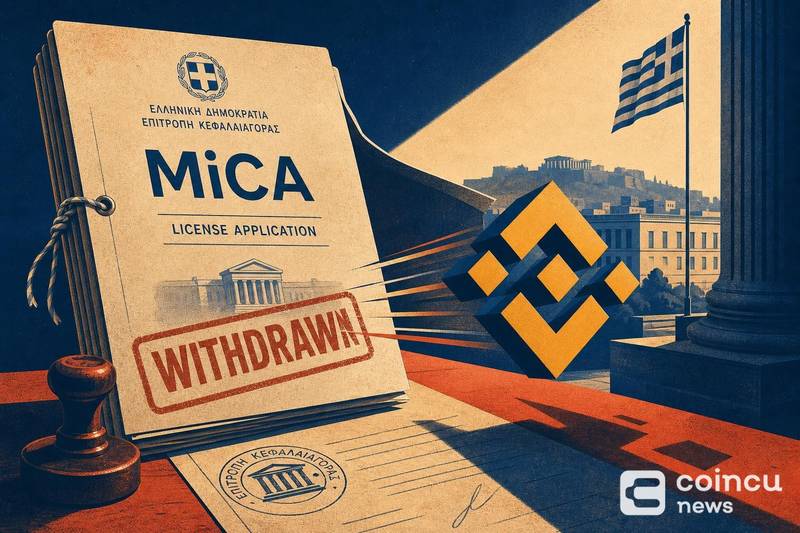
The withdrawal means Binance will not pursue authorization as a crypto-asset service provider (CASP) through Greece’s national regulator. The decision comes as the EU-wide MiCA framework reaches full implementation, with the European Securities and Markets Authority (ESMA) issuing a public statement on the end of MiCA’s transitional period. For related coverage, see Binance Adds AMDB, EWYB, INTCB and MSTRB bStocks Trading Pairs.
What the Greek MiCA Application Withdrawal Means
Under MiCA, crypto exchanges must obtain authorization in at least one EU member state to operate across the bloc. Greece was one of the jurisdictions where Binance had filed for this authorization. For related coverage, see Binance Alpha to List Arcium (ARX): Key Details and Market Focus.
Withdrawing an application is not the same as exiting a market. Binance has previously signaled its intent to remain in Europe and seek other EU operating authorizations, suggesting the Greek withdrawal may reflect a shift in which jurisdiction the exchange prioritizes rather than an abandonment of European operations.
Binance has addressed its broader regulatory approach in an official blog post on regulation, outlining its compliance commitments across multiple jurisdictions.
Why MiCA Licensing Decisions Matter Now
MiCA established a unified licensing regime for crypto-asset service providers across all 27 EU member states. The framework replaced the previous patchwork of national registration systems that exchanges like Binance had navigated for years.
With ESMA confirming the transitional period has ended, exchanges that lack MiCA authorization in at least one EU country face restrictions on offering services to European customers. This makes the choice of licensing jurisdiction a strategic decision with operational consequences.
For large exchanges, the decision of where to apply involves weighing regulatory timelines, supervisory approaches, and operational infrastructure. Pulling an application in one country while potentially pursuing authorization elsewhere is a recognized strategic maneuver in multi-jurisdiction compliance.
Binance’s Broader European Positioning
Binance has pursued registrations and licenses across multiple European countries in recent years. The exchange has secured approvals in several jurisdictions while facing regulatory scrutiny in others.
The Greek withdrawal should be viewed alongside Binance’s wider European activity. The exchange continues to expand its product offerings, including recent moves to launch new perpetual contracts and add new trading pairs, indicating ongoing operational investment.
Market observers should watch for whether Binance redirects its MiCA application to another EU member state. A filing in a jurisdiction with a more established crypto regulatory track record, such as France or Austria, would signal a reprioritization rather than a retreat.
What Greek Users Should Expect
The withdrawal of a license application does not necessarily mean immediate changes for Greek users. Service availability depends on whether Binance holds authorization in another EU member state that allows passporting of services across the bloc.
If Binance secures MiCA authorization elsewhere in the EU, Greek users could continue accessing the platform under the passporting provisions built into the regulation. Without any EU authorization, however, the exchange would face restrictions on serving customers in Greece and other member states.
Greek crypto users should monitor official communications from Binance regarding any changes to service availability in their jurisdiction.
FAQ About Binance, Greece, and MiCA
Is Binance leaving Greece?
Withdrawing a license application is not the same as leaving a market. Binance may continue serving Greek users if it obtains MiCA authorization in another EU member state, which allows cross-border passporting of services.
What is MiCA and why does it matter here?
MiCA is the EU’s comprehensive regulatory framework for crypto-asset service providers. It requires exchanges to obtain authorization in at least one EU country to legally serve customers across the bloc. Greece was one jurisdiction where Binance had sought this authorization.
What should market observers watch next from Binance in Europe?
The key signal is whether Binance files or advances a MiCA application in another EU jurisdiction. A new application would confirm the Greek withdrawal was a strategic pivot, not a European exit. Binance’s continued high trading volumes suggest the exchange remains committed to serving European markets.
Does this affect Binance’s global operations?
No. The withdrawal is specific to Greece’s national regulatory process under MiCA. Binance operates in dozens of countries worldwide, and its licensing decisions in one EU jurisdiction do not directly affect its operations in non-EU markets.
Disclaimer: This article is for informational purposes only and does not constitute financial or investment advice. Cryptocurrency and digital asset markets carry significant risk. Always do your own research before making decisions.
No tags available.


Other Posts








- China, US Conclude Trade Talks with Focus on Cooperation
- Crypto Weekly: NYSE Backs OKX, Kraken Gets Fed Access, BTC Sells
- Court Upholds Fed’s Rejection of Custodia Bank’s Request
- Former CFO Convicted for $35M Fraudulent Crypto Investment
- DeriW Launches Edge Hour Trading Competition Platform for Derivatives Traders
- Michael Saylor Denies Bitcoin Sell-Off Amid Large BTC Transfer
- Buy Dogecoin on eToro: Step-by-Step Guide for Beginners (2024)
- Kazakhstan Explores Crypto Reserves Backed by National Funds
- JPMorgan Increases Holdings in BlackRock’s Bitcoin ETF
- Nordea Bank Introduces Bitcoin ETP Trading for Nordic Customers
- XRP Spot ETF Launches on Nasdaq Amid Market Fluctuations
- Peter Schiff Challenges Michael Saylor on MSTR’s Business Model
- Thailand Orders Worldcoin to Delete 1.2 Million Biometric Records
- UK Proposes New DeFi Tax Framework to Ease User Burden
- WLFI Under Fire: Analyst Warns Hyperliquid Could Be Next
- Ancient Ethereum Whale Moves $1.19 Billion After Decade
- BlackRock Receives Large Crypto Transfers from Coinbase
- SEC Scrutiny on ALT5 Sigma’s Leadership Disclosure Timing
- Yala Injects $5.5 Million Amid Recovery Efforts
- Radiant Capital Faces $50M Loss in Major Security Breach
- China, US Conclude Trade Talks with Focus on Cooperation
- Crypto Weekly: NYSE Backs OKX, Kraken Gets Fed Access, BTC Sells
- Court Upholds Fed’s Rejection of Custodia Bank’s Request
- Former CFO Convicted for $35M Fraudulent Crypto Investment
- DeriW Launches Edge Hour Trading Competition Platform for Derivatives Traders
- Michael Saylor Denies Bitcoin Sell-Off Amid Large BTC Transfer
- Buy Dogecoin on eToro: Step-by-Step Guide for Beginners (2024)
- Kazakhstan Explores Crypto Reserves Backed by National Funds
- JPMorgan Increases Holdings in BlackRock’s Bitcoin ETF
- Nordea Bank Introduces Bitcoin ETP Trading for Nordic Customers
- XRP Spot ETF Launches on Nasdaq Amid Market Fluctuations
- Peter Schiff Challenges Michael Saylor on MSTR’s Business Model
- Thailand Orders Worldcoin to Delete 1.2 Million Biometric Records
- UK Proposes New DeFi Tax Framework to Ease User Burden
- WLFI Under Fire: Analyst Warns Hyperliquid Could Be Next
- Ancient Ethereum Whale Moves $1.19 Billion After Decade
- BlackRock Receives Large Crypto Transfers from Coinbase
- SEC Scrutiny on ALT5 Sigma’s Leadership Disclosure Timing
- Yala Injects $5.5 Million Amid Recovery Efforts
- Radiant Capital Faces $50M Loss in Major Security Breach
- China, US Conclude Trade Talks with Focus on Cooperation
- Crypto Weekly: NYSE Backs OKX, Kraken Gets Fed Access, BTC Sells
- Court Upholds Fed’s Rejection of Custodia Bank’s Request
- Former CFO Convicted for $35M Fraudulent Crypto Investment
- DeriW Launches Edge Hour Trading Competition Platform for Derivatives Traders
- Michael Saylor Denies Bitcoin Sell-Off Amid Large BTC Transfer
- Buy Dogecoin on eToro: Step-by-Step Guide for Beginners (2024)
- Kazakhstan Explores Crypto Reserves Backed by National Funds
- JPMorgan Increases Holdings in BlackRock’s Bitcoin ETF
- Nordea Bank Introduces Bitcoin ETP Trading for Nordic Customers
- XRP Spot ETF Launches on Nasdaq Amid Market Fluctuations
- Peter Schiff Challenges Michael Saylor on MSTR’s Business Model
- Thailand Orders Worldcoin to Delete 1.2 Million Biometric Records
- UK Proposes New DeFi Tax Framework to Ease User Burden
- WLFI Under Fire: Analyst Warns Hyperliquid Could Be Next
- Ancient Ethereum Whale Moves $1.19 Billion After Decade
- BlackRock Receives Large Crypto Transfers from Coinbase
- SEC Scrutiny on ALT5 Sigma’s Leadership Disclosure Timing
- Yala Injects $5.5 Million Amid Recovery Efforts
- Radiant Capital Faces $50M Loss in Major Security Breach


Former FBI Agent Charged With Stealing Nearly $1 Million in Crypto

Coldcard Exploit Raises Questions About Air-Gapped Bitcoin Wallet Security

Bybit.eu Expands European Offering as Bybit Payments GmbH Secures Electronic Money Institution Licence

1win Introduces Seamless Web3 Login and Crypto Deposits via Trust Wallet, MetaMask, and WalletConnect