Terra Classic (LUNC) Explained: Burns, Staking, Governance, and Risks
At first glance, Terra Classic looks like the kind of token most readers think they already understand. The name brings back the 2022 collapse. The supply looks enormous. The instinctive conclusion is simple: this is a broken asset living on borrowed time.
That first impression is not entirely wrong, but it is incomplete. The more useful framework is narrower and more mechanical. Terra Classic is best understood as a legacy chain whose economic story now depends on burns, staking, validator-led governance, and a community-maintained survival model rather than on a fresh high-growth narrative.
Many readers still approach LUNC through outdated shortcuts. Some see only the collapse. Others see only the huge total supply. Neither shortcut explains why the asset still gets recurring attention. Terra Classic is the original Terra chain that remained online after the collapse, while Terra 2.0 became a separate network. LUNC is the token of that legacy chain, and its story now revolves around how much supply has been burned, how much supply is bonded in staking, how governance power is distributed across validators and delegators, and how much structural risk still remains.
Table of Contents
Key Takeaways
- Terra Classic is the original Terra chain that survived after the 2022 collapse and now operates as a community-run network separate from Terra 2.0.
- The most important way to understand LUNC is through supply structure, especially the relationship between total supply, circulating supply, burned supply, and bonded staking.
- Burns matter because they reduce supply permanently, but they do not automatically solve LUNC’s tokenomics problem on their own.
- Staking matters because bonded supply is not instantly liquid, which can make visible float tighter than the headline supply first suggests.
What Is Terra Classic?
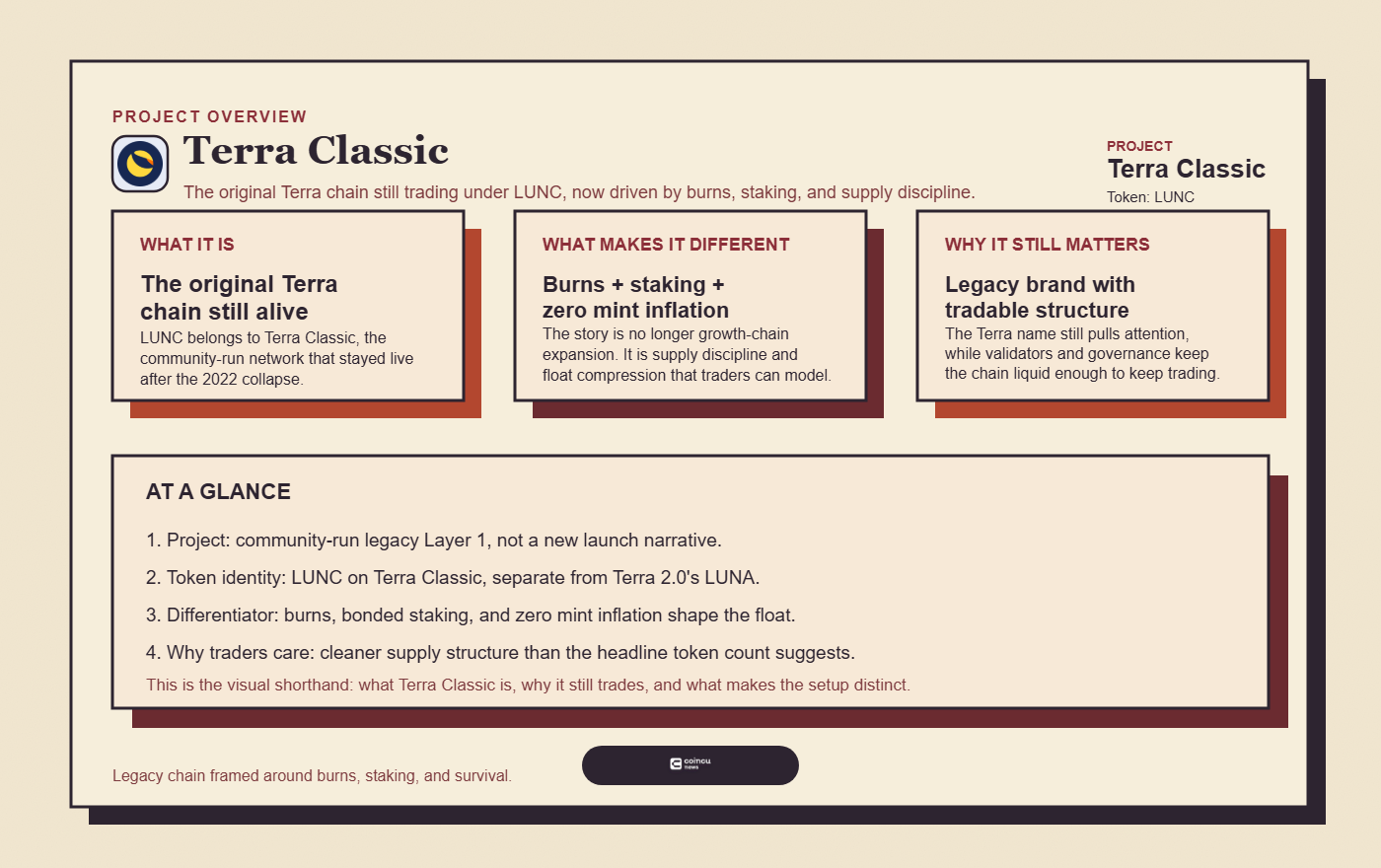
To understand Terra Classic, it helps to start with the split that many casual readers still blur together. Terra Classic is the original Terra blockchain that remained online after the collapse of the original Terra ecosystem in 2022. Terra 2.0 is a separate network launched later. That separation is essential, because many readers still confuse LUNC with the newer LUNA asset.
Once that split is clear, the modern picture becomes easier to read. Today, Terra Classic is better described as a community-run legacy Layer 1 than as a conventional restart story. The chain still has validators, staking, governance, public infrastructure, and a community ecosystem hub. It is no longer selling a clean frontier-growth narrative. Instead, it survives through a combination of community persistence, supply-repair mechanics, and enough infrastructure to remain tradable and usable. Coincu’s earlier coverage of the Terra Classic parity upgrade is a useful reminder that the network did not simply freeze after the collapse.
The Terra Classic ecosystem hub also frames the network as community-owned rather than company-owned, which is a useful clue about how the chain should be analyzed. This is not a project where one centralized operating company can simply be treated as the whole story.
Once that identity is clear, the next question almost always becomes a supply question. That is where most of the confusion around LUNC starts, and it is also where the token becomes easier to understand.
How LUNC Supply Works
The cleanest way to understand LUNC is to stop staring at one huge number on a screen and start separating supply into buckets. That shift sounds minor, but it changes the whole interpretation of the token.
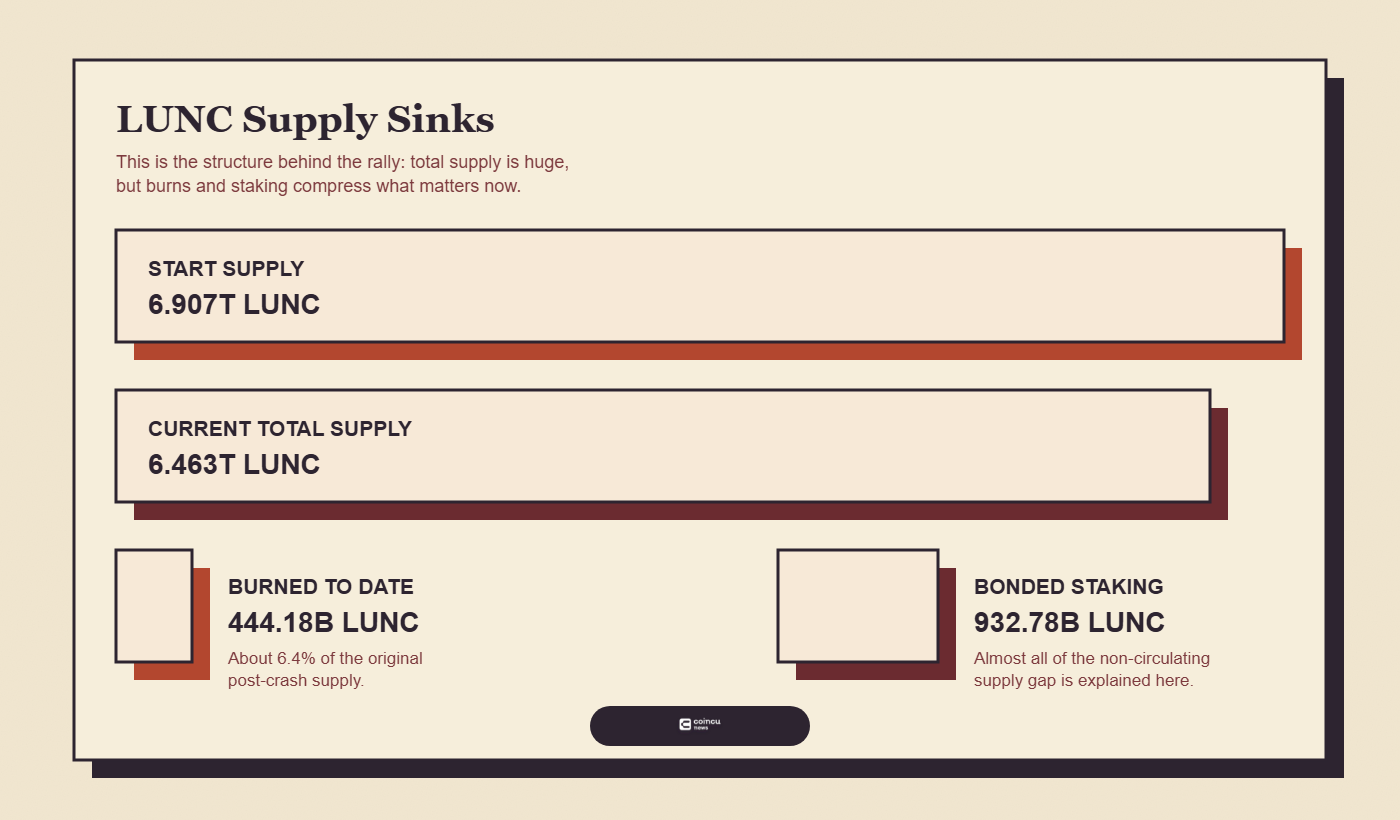
Total supply is the broadest number. It reflects how many LUNC tokens currently exist.
Circulating supply is smaller. It is meant to reflect the portion of supply considered available to the market.
Then there is the non-circulating gap, which is the difference between total supply and circulating supply. For Terra Classic, that gap matters because a meaningful portion of it can sit in bonded staking rather than in instantly tradable form.
This is why LUNC often looks simpler on paper than it really is in practice. On the surface, the token can look impossibly large. Underneath, the market is dealing with a more layered structure: some supply has already been removed, some is still circulating, and some is tied up in staking rails that do not move instantly.
That naturally leads to the next layer of the story. Once supply is broken into buckets, the first mechanism readers need to understand is burning, because burning is what permanently changes the base.
How Burns Affect LUNC
Burning means tokens are sent to addresses or mechanisms that remove them from usable circulation permanently. For readers who want a quick background refresher, Coincu’s crypto glossary includes the basic token-burn concept. For LUNC, burns matter because the chain is trying to repair a supply base that ballooned after the collapse.
That gives burns a clear narrative role. Every burn reduces the remaining supply and helps support the long-running deflation story around Terra Classic.
But the burn story has limits, and that is where many simplified LUNC narratives go wrong. Burns are not the same thing as a full fundamental recovery. They do not automatically create new usage, and they do not automatically turn a very large token base into a scarce asset overnight. The right way to think about burns is that they improve the structure over time. They do not erase all legacy supply problems by themselves.
And that is exactly why the LUNC story does not stop at burns. Even after tokens are removed permanently, the market still has to deal with the supply that remains, which is where staking starts to matter.
How Staking Changes the Visible Float
Staking is one of the most important parts of the modern LUNC story because it changes how much supply feels immediately available to the market. Readers who want a broader conceptual refresher can compare this with Coincu’s Proof-of-Stake explainer. In other words, burns explain how the supply base shrinks, while staking helps explain why the live float can feel tighter than the headline numbers imply.
When LUNC is bonded to validators, it is no longer instantly liquid. It can still come back later, but not on demand. According to the Terra Classic staking documentation, the default unbonding period is three weeks. That delay matters because the market does not treat delayed supply the same way it treats instantly tradeable supply.
This is why bonded supply remains one of the most closely watched structural metrics. If a large amount of LUNC is staked, the effective float can look tighter than the total supply number first suggests. That does not make staked supply permanently gone. It does make the live market structure more constrained, and that difference is large enough to shape how people interpret the token.
Once supply mechanics are laid out that way, another question follows almost automatically: if this is a community-run chain now, who is actually making decisions and steering upgrades?
Who Runs Terra Classic Now?
This is the wrong question if it is asked in the old startup sense and the right question if it is asked as a power-structure question. Terra Classic still has people and institutions behind it, but not in the neat founder-investor-operator stack that readers might expect from a newer project. There is no clean single protagonist standing on stage and speaking for the chain.
Historically, Terra came from Terraform Labs and Do Kwon. That legacy remains part of the asset’s baggage and still matters for trust. But the current operating model is different enough that readers need a new mental map. Terra Classic now runs through three linked rails: code maintainers ship changes, governance proposals move those changes onto the chain’s decision track, and validators plus delegators decide whether the upgrade path actually goes live. Coincu’s earlier note on Terra Classic and Terra tokens surging amid market speculation shows how quickly that legacy narrative can resurface, even when the underlying operating model has already changed.
| Power rail | Who matters most | Why it matters |
|---|---|---|
| Code maintenance | A small recurring contributor set in the classic-terra repositories | They write, review, and publish the upgrades that later reach governance |
| Governance and validation | Bonded validators, especially the upper tier by stake | They shape proposal momentum and secure the chain once upgrades are approved |
| Delegated voting power | Delegators who decide where stake sits and whether to override validator votes | They do not write code, but they determine which validators keep influence |
The rules are explicit in the documentation. Terra describes itself as a decentralized public blockchain governed by community members. One staked Luna equals one vote. If a delegator does not cast a vote, that vote defaults to the validator they are staked to, while validators vote with their full stake unless delegators override them. Proposals currently face a seven-day voting period, a 40% quorum requirement, a simple-majority threshold above 50%, and a 33.4% veto threshold. That means governance power is not abstract reputation. It is directly tied to staked weight and voting participation.
The validator side of that system is concentrated enough to matter. Terra’s protocol docs say only the top 130 validators by stake can participate in consensus. A full validator pull from the PublicNode staking endpoint on April 28, 2026 returned 646 validators in total but only 94 in bonded status, which means the active bonded set currently sits below the theoretical maximum. Within that bonded set, the weight is far from evenly distributed: the largest bonded validator alone, DutchLUNC, held about 15.28% of bonded stake at the time of check. The top three bonded validators controlled about 30.15%, and the top ten controlled about 55.23%.
| Current validator power map | Point-in-time reading on April 28, 2026 |
|---|---|
| Bonded validators | 94 |
| Top validator share | DutchLUNC at 15.28% of bonded stake |
| Top 3 validator share | 30.15% of bonded stake |
| Top 10 validator share | 55.23% of bonded stake |
| Large visible validator brands | DutchLUNC, Allnodes, HappyCattyCrypto, LUNCLIVE, KuCoin LUNC Node |
That concentration does not mean Terra Classic is secretly a corporation in disguise. Delegators can reallocate stake, and governance rules formally give them the right to override validator voting. But it does mean the upper layer of validator operators has outsized influence over proposal momentum, consensus participation, and the social direction of the chain.
Bonded-stake concentration is a useful signal of influence, but it is not identical to a full historical analysis of governance outcomes.
The code side tells a similar story of decentralization with a small visible working core. The classic-terra GitHub organization currently shows 61 public repositories, but no public organization members are listed on GitHub, which makes the human roster less transparent than the code itself. The better signal is recent activity. The classic-terra/core repository was updated on April 27, 2026, and a v4.0.1 prerelease was published the same day. In the most recent 40 commits checked for this review, the heaviest visible commit activity came from StrathCole, Kien Trinh, DevOrbitlabs, Tuan Tran, and Till Ziegler. That does not prove a formal “core team” in the startup sense. It does show a recurring group of contributors carrying maintenance work in public.
The most useful current example is how those rails connect in real time. On April 27, 2026, the classic-terra/core repository published v4.0.1 as a prerelease. On April 28, 2026, on-chain proposal 12221 entered voting as a software upgrade to v4.0.1, with a voting window running through May 5, 2026. That single chain of events captures how Terra Classic is run now: code is prepared off-chain, but chain-level legitimacy still has to pass through governance and bonded voting power before an upgrade becomes reality.
So the right conclusion is not that Terra Classic has no one behind it. The better conclusion is that it is run by a layered power structure: a small visible contributor group maintains the code, a concentrated validator class holds a large share of bonded influence, and delegators remain the final swing force because their stake determines which validators keep that influence in the first place.
That distributed structure is part of what keeps the chain alive, but it also creates the next part of the analysis. A system like this can function without a single founder in charge, yet still carry very real structural risks.
Main Risks of Holding or Trading LUNC
The first major risk is reputational damage. Terra Classic still carries the memory of one of crypto’s most destructive collapses. That does not disappear just because the surviving chain is now community-run. Every new argument in favor of LUNC still has to pass through that shadow first, and Coincu’s coverage of Do Kwon’s legal overhang is part of why that baggage remains relevant.
The second risk is supply scale. Even with burns, the remaining supply base is still very large, which means the tokenomics problem has been improved rather than eliminated. The story has moved from runaway damage to partial repair, not from damage to full reset.
The third risk is staking reversal. Bonded supply is not permanently locked away. If market conditions change, staked LUNC can eventually re-enter the market after the unbonding period. The same general release-pressure logic appears in Coincu’s explainer on token unlock risk, even though LUNC reaches that problem through staking rather than a standard VC unlock calendar.
The fourth risk is governance concentration. Terra Classic is community-run, but community-run does not mean influence is evenly spread. A relatively small upper tier of validators can still shape proposal momentum and operational direction.
The fifth risk is thesis confusion. LUNC can attract attention because of supply compression, legacy volatility, or recovery narrative reflexivity, but those are not the same as a proven long-term ecosystem renaissance.
| Structural risk | Why it matters |
|---|---|
| Collapse-era baggage | Trust remains fragile |
| Large remaining supply base | Burns help, but do not finish the repair story alone |
| Staked supply can return later | Tight float is real, but not permanent |
| Uneven validator influence | Governance power is not perfectly distributed |
| Narrative can outrun fundamentals | Traders may overread supply mechanics as full recovery |
Those risks are exactly why LUNC remains a divisive asset. They do not erase the reasons people keep watching it, but they do explain why attention around the token never comes with simple consensus.
Why LUNC Still Gets Attention
LUNC still gets attention because its structure keeps posing live questions that many failed chains no longer can. Readers still want to know how much supply is actually gone for good, how much is bonded rather than instantly tradeable, and who carries upgrade responsibility now that the founder-era project is gone. Those are not marketing questions. They are operating questions, and Terra Classic still has to answer them in public.
That does not mean Terra Classic has reclaimed leadership as a growth chain. The more durable explanation is narrower. LUNC remains structurally relevant because its supply profile is more complex than a single total-supply number, and because burns, staking, and governance concentration still shape how the chain is interpreted.
This is why Terra Classic remains relevant even without a simple comeback narrative. The collapse explains why the token is controversial. The post-collapse mechanics explain why it refuses to become irrelevant. For readers, that makes LUNC less a clean recovery story than a continuing case study in how a damaged crypto network can keep functioning through supply repair, delegated governance, and community maintenance.
That broader explanation is the evergreen part. The numbers underneath it will change, which is why it makes sense to separate the mechanism from the latest snapshot.
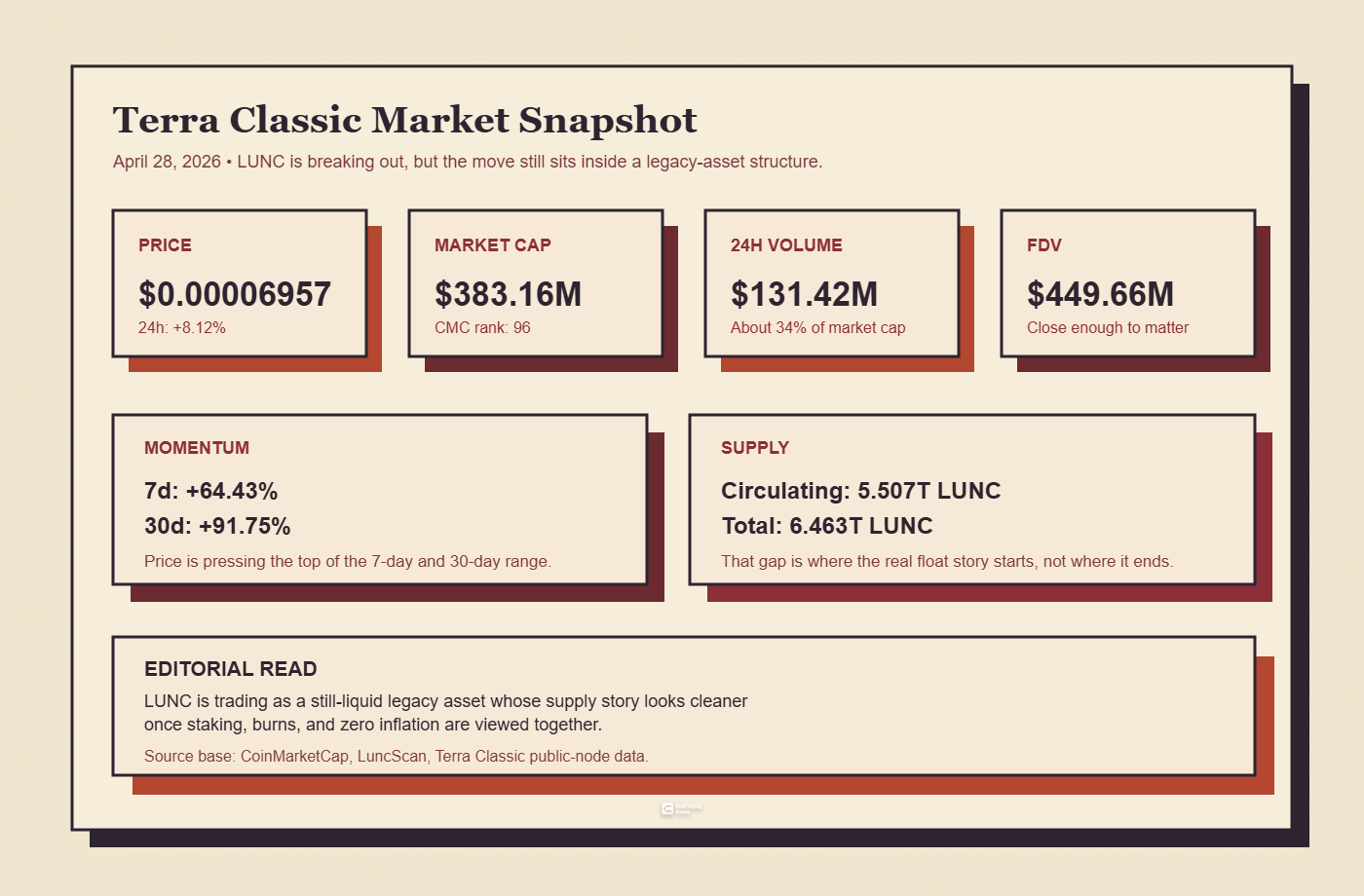
Current LUNC Snapshot
Last updated: April 28, 2026
The sections above are meant to stay useful over time. The figures below are the point-in-time snapshot checked for this update cycle.
| Metric | Value |
|---|---|
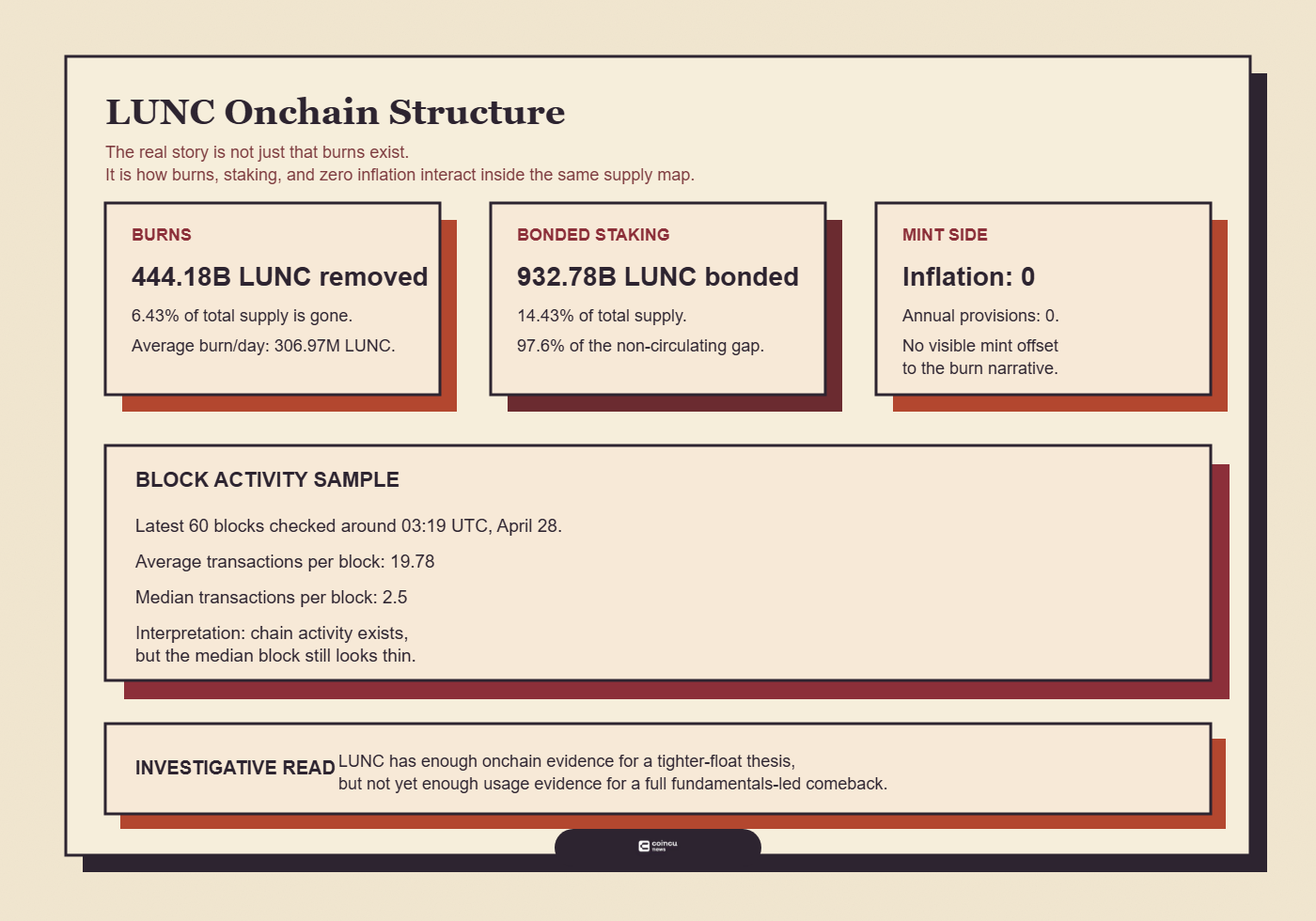
| Burned to date | 444.30B LUNC |
| Burned share of total supply | 6.43% |
| Total supply | 6.463T LUNC |
| Circulating supply | 5.524T LUNC |
| Gap between total and circulating | 939.09B LUNC |
| Bonded supply | 931.25B LUNC |
| Bonded share of total supply | 14.41% |
| Bonded share of circulating supply | 16.86% |
| Bonded share of total-minus-circulating gap | 99.2% |
| Average burn per day | 307.05M LUNC |
| Mint inflation | 0 |
| Annual provisions | 0 |
| Validators returned in full pull | 646 |
| Bonded validators in full pull | 94 |
| Top 3 bonded validators share | 30.15% of bonded supply |
| Top 10 bonded validators share | 55.23% of bonded supply |
At the time of the validator check, the largest bonded validator names included DutchLUNC, Allnodes, HappyCattyCrypto, LUNCLIVE, and KuCoin LUNC Node. That snapshot should be treated as a current example of validator concentration rather than as a timeless fixed ranking.
Methodology
This explainer is based on public materials checked on April 28, 2026. LuncScan burn and supply figures were taken from the LUNC Burn Tracker page updated at 13:59:02 UTC. Terra Classic staking, inflation, annual provision, governance parameter, and live proposal figures were checked directly from the PublicNode LCD endpoints between 14:30 UTC and 15:05 UTC. Validator concentration figures were derived from a full PublicNode validator pull completed on the same date. The article also used the Terra Classic community ecosystem hub, the official Terra Classic documentation, and the public classic-terra GitHub organization and core repository pages for project context, maintenance activity, and governance structure clues.
The core body is written as a system explainer first. Current figures are isolated in the snapshot section so the page can be updated without rewriting the full thesis.
Disclaimer
This article is for research and informational purposes only and should not be treated as financial advice. Terra Classic remains a highly volatile legacy crypto asset, and even structurally cleaner supply conditions do not remove the risk of sharp reversals.
Sources
CoinMarketCap, Terra Classic page: https://coinmarketcap.com/currencies/terra-luna/
LuncScan, LUNC Burn Tracker: https://luncscan.com/burn/lunc
Terra Classic ecosystem hub: https://terra-classic.io/
Terra Classic docs, protocol overview: https://classic-docs.terra.money/docs/learn/protocol.html
Terra Classic docs, staking specification: https://classic-docs.terra.money/docs/develop/module-specifications/spec-staking.html
Terra Classic PublicNode LCD, staking pool: https://terra-classic-lcd.publicnode.com/cosmos/staking/v1beta1/pool
Terra Classic PublicNode LCD, validators: https://terra-classic-lcd.publicnode.com/cosmos/staking/v1beta1/validators
Terra Classic PublicNode LCD, mint inflation: https://terra-classic-lcd.publicnode.com/cosmos/mint/v1beta1/inflation
Terra Classic PublicNode LCD, annual provisions: https://terra-classic-lcd.publicnode.com/cosmos/mint/v1beta1/annual_provisions
Terra Classic GitHub organization: https://github.com/classic-terra
Terra Classic core repository: https://github.com/classic-terra/core
Terra Classic core release v4.0.1: https://github.com/classic-terra/core/releases/tag/v4.0.1
Recent core commit, April 27, 2026: https://github.com/classic-terra/core/commit/9a5ee563874ce3906c3ca7069f0160de51f89c40
Recent core commit, April 24, 2026: https://github.com/classic-terra/core/commit/dcea6a8174bda20a9aa8f2d6f647d65fc3ac3c73
Terra Classic PublicNode LCD, governance voting params: https://terra-classic-lcd.publicnode.com/cosmos/gov/v1/params/voting
Terra Classic PublicNode LCD, governance tallying params: https://terra-classic-lcd.publicnode.com/cosmos/gov/v1/params/tallying
Terra Classic PublicNode LCD, proposal 12221: https://terra-classic-lcd.publicnode.com/cosmos/gov/v1/proposals/12221
Terra Classic documents repository, v14_2 proposal: https://github.com/classic-terra/documents/blob/main/proposals/v14_2-proposal.md
No tags available.


Other Posts





- China, US Conclude Trade Talks with Focus on Cooperation
- Crypto Weekly: NYSE Backs OKX, Kraken Gets Fed Access, BTC Sells
- Court Upholds Fed’s Rejection of Custodia Bank’s Request
- Former CFO Convicted for $35M Fraudulent Crypto Investment
- DeriW Launches Edge Hour Trading Competition Platform for Derivatives Traders
- Michael Saylor Denies Bitcoin Sell-Off Amid Large BTC Transfer
- Buy Dogecoin on eToro: Step-by-Step Guide for Beginners (2024)
- Kazakhstan Explores Crypto Reserves Backed by National Funds
- JPMorgan Increases Holdings in BlackRock’s Bitcoin ETF
- Nordea Bank Introduces Bitcoin ETP Trading for Nordic Customers
- XRP Spot ETF Launches on Nasdaq Amid Market Fluctuations
- Peter Schiff Challenges Michael Saylor on MSTR’s Business Model
- Thailand Orders Worldcoin to Delete 1.2 Million Biometric Records
- UK Proposes New DeFi Tax Framework to Ease User Burden
- WLFI Under Fire: Analyst Warns Hyperliquid Could Be Next
- Ancient Ethereum Whale Moves $1.19 Billion After Decade
- BlackRock Receives Large Crypto Transfers from Coinbase
- SEC Scrutiny on ALT5 Sigma’s Leadership Disclosure Timing
- Yala Injects $5.5 Million Amid Recovery Efforts
- Radiant Capital Faces $50M Loss in Major Security Breach
- China, US Conclude Trade Talks with Focus on Cooperation
- Crypto Weekly: NYSE Backs OKX, Kraken Gets Fed Access, BTC Sells
- Court Upholds Fed’s Rejection of Custodia Bank’s Request
- Former CFO Convicted for $35M Fraudulent Crypto Investment
- DeriW Launches Edge Hour Trading Competition Platform for Derivatives Traders
- Michael Saylor Denies Bitcoin Sell-Off Amid Large BTC Transfer
- Buy Dogecoin on eToro: Step-by-Step Guide for Beginners (2024)
- Kazakhstan Explores Crypto Reserves Backed by National Funds
- JPMorgan Increases Holdings in BlackRock’s Bitcoin ETF
- Nordea Bank Introduces Bitcoin ETP Trading for Nordic Customers
- XRP Spot ETF Launches on Nasdaq Amid Market Fluctuations
- Peter Schiff Challenges Michael Saylor on MSTR’s Business Model
- Thailand Orders Worldcoin to Delete 1.2 Million Biometric Records
- UK Proposes New DeFi Tax Framework to Ease User Burden
- WLFI Under Fire: Analyst Warns Hyperliquid Could Be Next
- Ancient Ethereum Whale Moves $1.19 Billion After Decade
- BlackRock Receives Large Crypto Transfers from Coinbase
- SEC Scrutiny on ALT5 Sigma’s Leadership Disclosure Timing
- Yala Injects $5.5 Million Amid Recovery Efforts
- Radiant Capital Faces $50M Loss in Major Security Breach
- China, US Conclude Trade Talks with Focus on Cooperation
- Crypto Weekly: NYSE Backs OKX, Kraken Gets Fed Access, BTC Sells
- Court Upholds Fed’s Rejection of Custodia Bank’s Request
- Former CFO Convicted for $35M Fraudulent Crypto Investment
- DeriW Launches Edge Hour Trading Competition Platform for Derivatives Traders
- Michael Saylor Denies Bitcoin Sell-Off Amid Large BTC Transfer
- Buy Dogecoin on eToro: Step-by-Step Guide for Beginners (2024)
- Kazakhstan Explores Crypto Reserves Backed by National Funds
- JPMorgan Increases Holdings in BlackRock’s Bitcoin ETF
- Nordea Bank Introduces Bitcoin ETP Trading for Nordic Customers
- XRP Spot ETF Launches on Nasdaq Amid Market Fluctuations
- Peter Schiff Challenges Michael Saylor on MSTR’s Business Model
- Thailand Orders Worldcoin to Delete 1.2 Million Biometric Records
- UK Proposes New DeFi Tax Framework to Ease User Burden
- WLFI Under Fire: Analyst Warns Hyperliquid Could Be Next
- Ancient Ethereum Whale Moves $1.19 Billion After Decade
- BlackRock Receives Large Crypto Transfers from Coinbase
- SEC Scrutiny on ALT5 Sigma’s Leadership Disclosure Timing
- Yala Injects $5.5 Million Amid Recovery Efforts
- Radiant Capital Faces $50M Loss in Major Security Breach



Performa Marks One Year Live with Major Upgrade for Digital-Native SMBs

Zoomex to Attend Coinfest Asia 2026 as Gold Sponsor and Host Summer Bay Party in Bali