ETH perpetual futures across major exchanges currently show an 8-hour average funding rate near 0.0025%, a mild positive reading that suggests slightly more long-side demand than short, but falls well short of overheated leverage territory. The figure, originally reported by Chinese crypto outlet ChainCatcher citing Coinglass data, provides a single-snapshot gauge of derivatives sentiment for Ethereum at a time when the broader market Fear & Greed Index sits deep in “Extreme Fear.”
ETH 8-Hour Average Funding Rate Near 0.0025%: What the Number Means
What Is a Funding Rate?
In perpetual futures contracts, funding rates are periodic payments exchanged between long and short holders. Unlike traditional futures with expiry dates, perpetual contracts use this mechanism to keep the contract price tethered to the underlying spot price.
When the funding rate is positive, traders holding long positions pay a fee to short holders. When negative, the reverse applies. The payment occurs at fixed intervals, typically every 8 hours on most major exchanges.
Why the 8-Hour Average Matters
A single exchange’s funding rate can be skewed by localized order-book dynamics. The “network-wide 8-hour average” aggregates readings across multiple venues, smoothing out exchange-specific noise and offering a broader picture of derivatives positioning.
According to unconfirmed reports from ChainCatcher, the Coinglass aggregate placed ETH’s network-wide 8-hour average funding rate at 0.0025%. A separate data recovery from the Coinglass funding rate dashboard returned a latest 8-hour average of 0.00292%, close to but not identical to the headline figure.
The discrepancy likely stems from timestamp differences; Coinglass recalculates the aggregate continuously, and a few minutes’ gap can shift the weighted average as new settlement prints roll in from exchanges operating on slightly different schedules.
Why 0.0025% Reads as Mildly Bullish, Not Extreme
Positive Funding and Market Sentiment
A positive funding rate indicates that long traders outnumber or outsize short traders enough that longs must pay shorts to maintain their positions. At 0.0025% per 8-hour period, the annualized cost for holding a long position works out to roughly 2.7%, a modest carry cost by crypto perpetual standards.
For comparison, during euphoric rallies funding rates on major pairs have spiked above 0.1% per period, implying annualized costs exceeding 100%. The current reading is an order of magnitude below such extremes, placing it firmly in “mild lean-long” territory rather than signaling aggressive leveraged speculation.
Cross-exchange settlement data confirms the positive but restrained picture. Binance’s latest ETHUSDT settlement printed at 0.008271% on April 12, 2026. Bybit’s corresponding print came in at 0.009038%, while OKX settled at 0.00814%.
All three readings are positive, confirming net long-side demand across the largest derivatives venues. The differences between them illustrate why a network-wide average is more representative than any single exchange’s print.
Context: Extreme Fear in the Broader Market
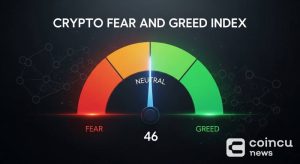
The positive funding rate exists against a backdrop of weak risk appetite. The Fear & Greed Index registered 16 at the time of this data, classified as “Extreme Fear.”
This divergence, positive derivatives funding alongside deep fear in sentiment gauges, can mean several things. It may reflect a core group of conviction longs maintaining positions even as broader sentiment deteriorates. It could also indicate that short interest has declined enough to tilt the balance even without aggressive new long entries.
ETH itself traded at $2,283.99 with a 24-hour gain of roughly 2%, a 24-hour trading volume of $12.78 billion, and a market capitalization near $275.6 billion.
What a Single Funding-Rate Reading Cannot Tell You
Funding rate snapshots are descriptive, not predictive. A positive 8-hour average tells you that, at the moment of measurement, longs were paying shorts. It does not guarantee the rate will remain positive in the next settlement window, nor does it confirm a directional move is underway.
The metric also says nothing about position sizing. A handful of large traders can tilt funding on a thinner venue without indicating broad market consensus. The network-wide average mitigates this somewhat, but cannot eliminate it entirely.
Open interest is a critical companion variable. Rising open interest alongside positive funding suggests new capital entering long positions. Flat or declining open interest with positive funding may simply reflect short closures rather than fresh bullish conviction. The current dataset does not include open interest figures.
Volume matters too. The recent buildup of $893 million in short liquidation risk near the $2,346 level demonstrates how funding and liquidation dynamics interact; a positive funding print combined with significant short liquidation thresholds can amplify moves in either direction.
Exchange-level variation is another consideration. The Binance, Bybit, and OKX prints cited above ranged from 0.008% to 0.009%, a relatively tight band. When spreads between exchanges widen significantly, arbitrage opportunities emerge that can rapidly compress funding back toward neutral.
Practical Takeaways for Different Market Participants
For short-term traders monitoring perpetual positions, the current positive funding represents a minor carry cost for longs and a minor income stream for shorts. At this magnitude, funding alone is unlikely to force position changes, but it should be tracked for directional shifts.
If the 8-hour average begins climbing consistently above 0.01%, that would signal escalating long-side leverage, a condition that historically precedes either sharp continuations or violent squeezes depending on whether spot price supports the positioning. The $1.057 billion in BTC short liquidation risk building on major centralized exchanges offers a parallel example of how derivatives positioning creates price-relevant thresholds across the crypto complex.
For neutral observers and analysts, the funding rate functions as a sentiment thermometer. The current reading says the market leans slightly long on ETH, nothing more. Pairing it with spot price direction, volume trends, and the broader fear index reading of 16 provides a richer picture than any single metric alone.
Traders should note that funding rates can flip rapidly. A sudden spot sell-off can push funding negative within a single settlement period as longs exit and shorts pile in. Conversely, a spot rally can escalate funding as momentum traders add leveraged longs.
FAQ: ETH Funding Rate 0.0025%
Does a positive funding rate mean ETH is definitely going up?
No. A positive funding rate means long traders are currently paying short traders, indicating that long-side demand exceeds short-side demand in perpetual contracts. This reflects current positioning, not future price direction. Prices can fall even while funding remains positive if spot selling overwhelms derivatives demand.
What is the difference between an 8-hour average funding rate and a single settlement rate?
Most exchanges settle funding every 8 hours at fixed times (00:00, 08:00, 16:00 UTC on Binance, for instance). The “8-hour average funding rate” aggregated by platforms like Coinglass takes the weighted average of these settlement prints across multiple exchanges, smoothing venue-specific outliers. A single settlement rate from one exchange, such as Binance’s 0.008271% print, reflects only that platform’s order-book dynamics at that specific moment.
Why is a network-wide average more useful than a single exchange’s rate?
Individual exchanges can experience localized demand imbalances. A whale opening a large long on one platform can spike that venue’s rate without reflecting broader market sentiment. The network-wide average captures the consensus across Binance, Bybit, OKX, and other venues simultaneously, making it a more reliable gauge of overall derivatives positioning. However, as dramatic single-day moves like SkyAI’s 70% surge show, crypto markets can shift far faster than aggregate metrics capture.
Disclaimer: This article is for informational purposes only and does not constitute financial or investment advice. Cryptocurrency and digital asset markets carry significant risk. Always do your own research before making decisions.
No tags available.


Other Posts



- Amplify 2024: Ohio’s Premier Blockchain Summit
- China, US Conclude Trade Talks with Focus on Cooperation
- Crypto Weekly: NYSE Backs OKX, Kraken Gets Fed Access, BTC Sells
- DeriW Launches Edge Hour Trading Competition Platform for Derivatives Traders
- Michael Saylor Denies Bitcoin Sell-Off Amid Large BTC Transfer
- Court Upholds Fed’s Rejection of Custodia Bank’s Request
- Former CFO Convicted for $35M Fraudulent Crypto Investment
- EU Opens Antitrust Probe Into Deutsche Boerse and Nasdaq Derivatives Dealings
- Kazakhstan Explores Crypto Reserves Backed by National Funds
- JPMorgan Increases Holdings in BlackRock’s Bitcoin ETF
- Nordea Bank Introduces Bitcoin ETP Trading for Nordic Customers
- XRP Spot ETF Launches on Nasdaq Amid Market Fluctuations
- JPMorgan Chase Launches 24/7 Digital Deposit Token for Clients
- Crypto Leaders Address Macro Volatility Amid Market Shifts
- Buy Dogecoin on eToro: Step-by-Step Guide for Beginners (2024)
- Peter Schiff Challenges Michael Saylor on MSTR’s Business Model
- Thailand Orders Worldcoin to Delete 1.2 Million Biometric Records
- UK Proposes New DeFi Tax Framework to Ease User Burden
- U.S. Treasury Proposes New Tax Relief Regulations
- Uniswap’s UNIfication Proposal Gains Massive Preliminary Support
- Amplify 2024: Ohio’s Premier Blockchain Summit
- China, US Conclude Trade Talks with Focus on Cooperation
- Crypto Weekly: NYSE Backs OKX, Kraken Gets Fed Access, BTC Sells
- DeriW Launches Edge Hour Trading Competition Platform for Derivatives Traders
- Michael Saylor Denies Bitcoin Sell-Off Amid Large BTC Transfer
- Court Upholds Fed’s Rejection of Custodia Bank’s Request
- Former CFO Convicted for $35M Fraudulent Crypto Investment
- EU Opens Antitrust Probe Into Deutsche Boerse and Nasdaq Derivatives Dealings
- Kazakhstan Explores Crypto Reserves Backed by National Funds
- JPMorgan Increases Holdings in BlackRock’s Bitcoin ETF
- Nordea Bank Introduces Bitcoin ETP Trading for Nordic Customers
- XRP Spot ETF Launches on Nasdaq Amid Market Fluctuations
- JPMorgan Chase Launches 24/7 Digital Deposit Token for Clients
- Crypto Leaders Address Macro Volatility Amid Market Shifts
- Buy Dogecoin on eToro: Step-by-Step Guide for Beginners (2024)
- Peter Schiff Challenges Michael Saylor on MSTR’s Business Model
- Thailand Orders Worldcoin to Delete 1.2 Million Biometric Records
- UK Proposes New DeFi Tax Framework to Ease User Burden
- U.S. Treasury Proposes New Tax Relief Regulations
- Uniswap’s UNIfication Proposal Gains Massive Preliminary Support
- Amplify 2024: Ohio’s Premier Blockchain Summit
- China, US Conclude Trade Talks with Focus on Cooperation
- Crypto Weekly: NYSE Backs OKX, Kraken Gets Fed Access, BTC Sells
- DeriW Launches Edge Hour Trading Competition Platform for Derivatives Traders
- Michael Saylor Denies Bitcoin Sell-Off Amid Large BTC Transfer
- Court Upholds Fed’s Rejection of Custodia Bank’s Request
- Former CFO Convicted for $35M Fraudulent Crypto Investment
- EU Opens Antitrust Probe Into Deutsche Boerse and Nasdaq Derivatives Dealings
- Kazakhstan Explores Crypto Reserves Backed by National Funds
- JPMorgan Increases Holdings in BlackRock’s Bitcoin ETF
- Nordea Bank Introduces Bitcoin ETP Trading for Nordic Customers
- XRP Spot ETF Launches on Nasdaq Amid Market Fluctuations
- JPMorgan Chase Launches 24/7 Digital Deposit Token for Clients
- Crypto Leaders Address Macro Volatility Amid Market Shifts
- Buy Dogecoin on eToro: Step-by-Step Guide for Beginners (2024)
- Peter Schiff Challenges Michael Saylor on MSTR’s Business Model
- Thailand Orders Worldcoin to Delete 1.2 Million Biometric Records
- UK Proposes New DeFi Tax Framework to Ease User Burden
- U.S. Treasury Proposes New Tax Relief Regulations
- Uniswap’s UNIfication Proposal Gains Massive Preliminary Support
Latest


Kraken Plans US-Compliant Bitcoin Perpetual Contracts Launch Within 30 Days
Press Release
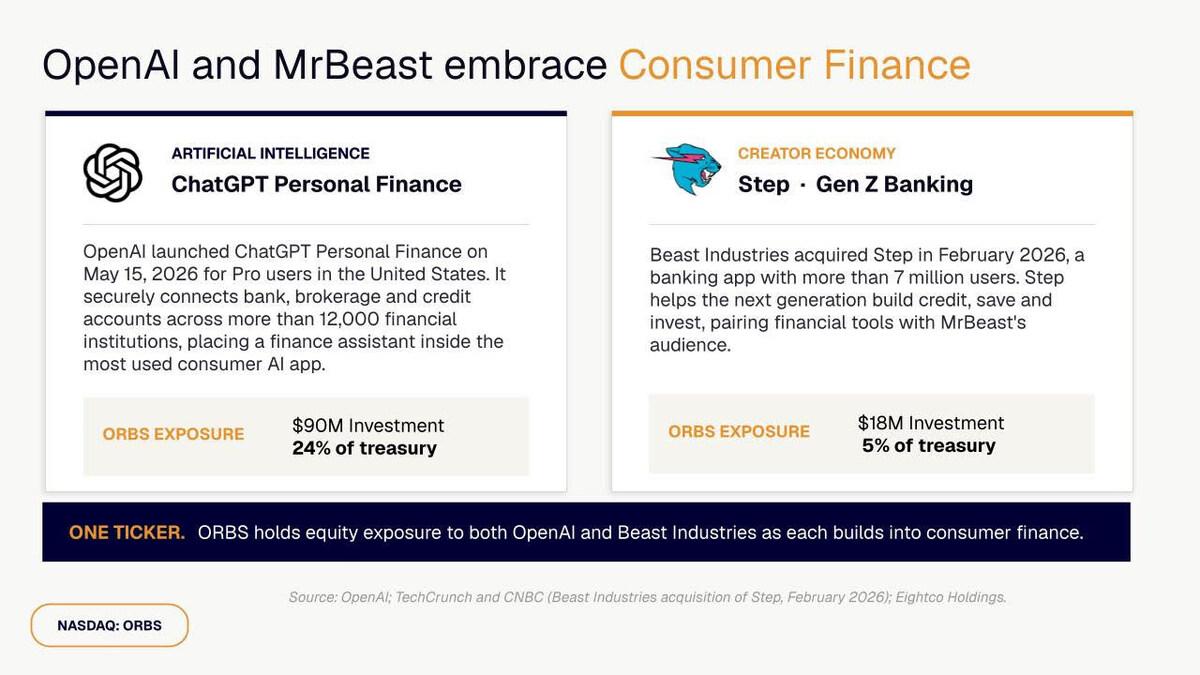
Eightco (NASDAQ: ORBS) Reports $374M Holdings Across OpenAI, WLD, ETH and Strategic Investments