Bitcoin reclaimed $77,000 on May 23, 2026, bouncing sharply from a low near $74,000 after President Trump announced a largely negotiated peace agreement between the United States and Iran. The recovery, fueled by a single Truth Social post, arrived against a backdrop of $2.26 billion in spot ETF outflows and a Fear & Greed Index stuck at 28.
BTC Recovers to $77,000: The Drop, the Catalyst, the Bounce
Bitcoin fell roughly 4% from the $77,700 range to a low of approximately $74,000 late Friday into early Saturday before staging a rapid recovery. The 24-hour high reached $77,084, with BTC settling around $76,605, up 1.06% on the day.
Bitcoin Price (May 23, 2026)
$77,003
Recovered from ~$74,000 low — +1.06% on the day. Source: CoinDesk
The catalyst was a post on Truth Social from President Trump: “An Agreement has been largely negotiated, subject to finalization between the United States of America, the Islamic Republic of Iran, and the various other Countries.” The deal includes a provision to reopen the Strait of Hormuz, a critical oil transit corridor whose closure risk had been weighing on global markets.
At press time, Bitcoin’s market cap stood at approximately $1.537 trillion with 24-hour trading volume near $32.29 billion. For context, $77,000 is not a new all-time high; BTC’s ATH remains $126,080, reached on October 6, 2025. The current price sits roughly 39% below that peak.
$580M Liquidation Cascade: 95% Were Longs
The drop below $77,000 triggered a liquidation cascade that wiped out approximately $580 to $660 million in crypto positions. Roughly 95% of the liquidated positions were long trades, revealing just how crowded the bullish side had become before the selloff.
That lopsided positioning is significant. HashKey Research’s Tim Sun stated that “the temporary bottom of $75,000 to $77,000 remains well-defined,” noting that separate 24-hour liquidation data showed a roughly 50/50 split between longs and shorts, a sign that the market had not experienced full one-sided capitulation.
“This is making Bitcoin highly vulnerable to exogenous shocks and a potential higher-for-longer interest rate regime at a time when liquidity conditions have deteriorated to their worst levels since February.”
Bitfinex Analysts, via CryptoBriefing
The distinction matters for what comes next. A relief bounce driven by a geopolitical headline, with leveraged longs already flushed, is structurally different from organic accumulation. The liquidation mechanics in crypto markets can amplify both the downside and the snap-back, making headline price moves look more decisive than underlying demand warrants.
ETF Outflows and Macro Pressure Behind the $77K Facade
Spot Bitcoin ETFs recorded $2.26 billion in net outflows over the two weeks prior to the bounce, ending a six-week inflow streak. That institutional pullback is the structural backdrop the headline recovery does not capture.
The Crypto Fear & Greed Index reads 28, firmly in “Fear” territory. Meanwhile, Brent crude oil trades at $111.2, up 1.78%, and WTI sits at $107.7. Elevated energy prices feed inflation expectations and reduce the likelihood of near-term Federal Reserve rate cuts.
According to unconfirmed reports, on-chain capital flows currently sit around $2.8 billion, well below the approximately $10 billion analysts estimate is necessary to sustain a durable breakout. Separately, a single source reported that Santiment data shows wallets holding at least 100 BTC rose 11.2% year-over-year to 20,229 wallets, suggesting large holders have been accumulating even as ETF investors pull back.
Trump’s peace deal removed a near-term geopolitical risk factor, but it did not reverse the ETF outflow trend or repair the deteriorated liquidity conditions Bitfinex flagged. The bounce bought time; it did not fix the floor. That divergence between short-term relief and structural weakness is what traders need to watch.
Support, Resistance, and What Invalidates the Relief Rally
The $75,000 to $77,000 zone is the defined support range, per HashKey Research. BTC has now tested and held this level, but the 7-day change of -2.11% confirms the 24-hour bounce sits inside a broader weekly downtrend.
Analyst consensus places near-term upside targets at $82,000 to $85,000, conditional on continued easing of geopolitical tensions. A sustained daily close below $75,000 would invalidate the support thesis and signal a deeper breakdown.
The institutional confirmation signal to watch is a reversal of ETF flows. The $2.26 billion in outflows over two weeks marked a significant shift in positioning; until net inflows resume, the recovery lacks institutional backing. BTC’s circulating supply stands at 20,033,475, roughly 95.4% of the maximum 21 million, a slow supply squeeze that provides a long-term floor but does little for short-term price action.
FAQ: Bitcoin Reclaims $77,000
Why did Bitcoin recover to $77,000?
President Trump posted on Truth Social announcing a largely negotiated US-Iran peace agreement that includes reopening the Strait of Hormuz. The announcement removed a key near-term geopolitical risk, triggering a bounce from approximately $74,000.
Is $77,000 a new all-time high for Bitcoin?
No. Bitcoin’s all-time high is $126,080, reached on October 6, 2025. At $76,605, BTC trades approximately 39% below that peak.
What caused Bitcoin to drop before the recovery?
Over-leveraged long positions amplified a roughly 4% selloff to approximately $74,000. Between $580 million and $660 million in positions were liquidated, with 95% being long trades.
What is the next resistance level above $77,000?
Analysts target the $82,000 to $85,000 range as near-term upside resistance. A sustained close below $75,000 would invalidate current support.
Are Bitcoin ETFs still seeing outflows?
Yes. Spot Bitcoin ETFs recorded $2.26 billion in net outflows over the two weeks preceding this bounce, ending a prior six-week inflow streak. Flow reversal would be the key institutional confirmation signal.
Disclaimer: This article is for informational purposes only and does not constitute financial or investment advice. Cryptocurrency and digital asset markets carry significant risk. Always do your own research before making decisions.
No tags available.


Other Posts








- China, US Conclude Trade Talks with Focus on Cooperation
- Court Upholds Fed’s Rejection of Custodia Bank’s Request
- Crypto Weekly: NYSE Backs OKX, Kraken Gets Fed Access, BTC Sells
- Former CFO Convicted for $35M Fraudulent Crypto Investment
- DeriW Launches Edge Hour Trading Competition Platform for Derivatives Traders
- Michael Saylor Denies Bitcoin Sell-Off Amid Large BTC Transfer
- Buy Dogecoin on eToro: Step-by-Step Guide for Beginners (2024)
- Kazakhstan Explores Crypto Reserves Backed by National Funds
- JPMorgan Increases Holdings in BlackRock’s Bitcoin ETF
- Nordea Bank Introduces Bitcoin ETP Trading for Nordic Customers
- XRP Spot ETF Launches on Nasdaq Amid Market Fluctuations
- Peter Schiff Challenges Michael Saylor on MSTR’s Business Model
- Thailand Orders Worldcoin to Delete 1.2 Million Biometric Records
- UK Proposes New DeFi Tax Framework to Ease User Burden
- WLFI Under Fire: Analyst Warns Hyperliquid Could Be Next
- Ancient Ethereum Whale Moves $1.19 Billion After Decade
- BlackRock Receives Large Crypto Transfers from Coinbase
- SEC Scrutiny on ALT5 Sigma’s Leadership Disclosure Timing
- Yala Injects $5.5 Million Amid Recovery Efforts
- Radiant Capital Faces $50M Loss in Major Security Breach
- China, US Conclude Trade Talks with Focus on Cooperation
- Court Upholds Fed’s Rejection of Custodia Bank’s Request
- Crypto Weekly: NYSE Backs OKX, Kraken Gets Fed Access, BTC Sells
- Former CFO Convicted for $35M Fraudulent Crypto Investment
- DeriW Launches Edge Hour Trading Competition Platform for Derivatives Traders
- Michael Saylor Denies Bitcoin Sell-Off Amid Large BTC Transfer
- Buy Dogecoin on eToro: Step-by-Step Guide for Beginners (2024)
- Kazakhstan Explores Crypto Reserves Backed by National Funds
- JPMorgan Increases Holdings in BlackRock’s Bitcoin ETF
- Nordea Bank Introduces Bitcoin ETP Trading for Nordic Customers
- XRP Spot ETF Launches on Nasdaq Amid Market Fluctuations
- Peter Schiff Challenges Michael Saylor on MSTR’s Business Model
- Thailand Orders Worldcoin to Delete 1.2 Million Biometric Records
- UK Proposes New DeFi Tax Framework to Ease User Burden
- WLFI Under Fire: Analyst Warns Hyperliquid Could Be Next
- Ancient Ethereum Whale Moves $1.19 Billion After Decade
- BlackRock Receives Large Crypto Transfers from Coinbase
- SEC Scrutiny on ALT5 Sigma’s Leadership Disclosure Timing
- Yala Injects $5.5 Million Amid Recovery Efforts
- Radiant Capital Faces $50M Loss in Major Security Breach
- China, US Conclude Trade Talks with Focus on Cooperation
- Court Upholds Fed’s Rejection of Custodia Bank’s Request
- Crypto Weekly: NYSE Backs OKX, Kraken Gets Fed Access, BTC Sells
- Former CFO Convicted for $35M Fraudulent Crypto Investment
- DeriW Launches Edge Hour Trading Competition Platform for Derivatives Traders
- Michael Saylor Denies Bitcoin Sell-Off Amid Large BTC Transfer
- Buy Dogecoin on eToro: Step-by-Step Guide for Beginners (2024)
- Kazakhstan Explores Crypto Reserves Backed by National Funds
- JPMorgan Increases Holdings in BlackRock’s Bitcoin ETF
- Nordea Bank Introduces Bitcoin ETP Trading for Nordic Customers
- XRP Spot ETF Launches on Nasdaq Amid Market Fluctuations
- Peter Schiff Challenges Michael Saylor on MSTR’s Business Model
- Thailand Orders Worldcoin to Delete 1.2 Million Biometric Records
- UK Proposes New DeFi Tax Framework to Ease User Burden
- WLFI Under Fire: Analyst Warns Hyperliquid Could Be Next
- Ancient Ethereum Whale Moves $1.19 Billion After Decade
- BlackRock Receives Large Crypto Transfers from Coinbase
- SEC Scrutiny on ALT5 Sigma’s Leadership Disclosure Timing
- Yala Injects $5.5 Million Amid Recovery Efforts
- Radiant Capital Faces $50M Loss in Major Security Breach


Tom Lee’s Bitmine Owns 4.8% of Ethereum Supply After Latest ETH Purchase

Strategy Raises $334M From MSTR Stock Sale as Bitcoin Holdings Stay Unchanged
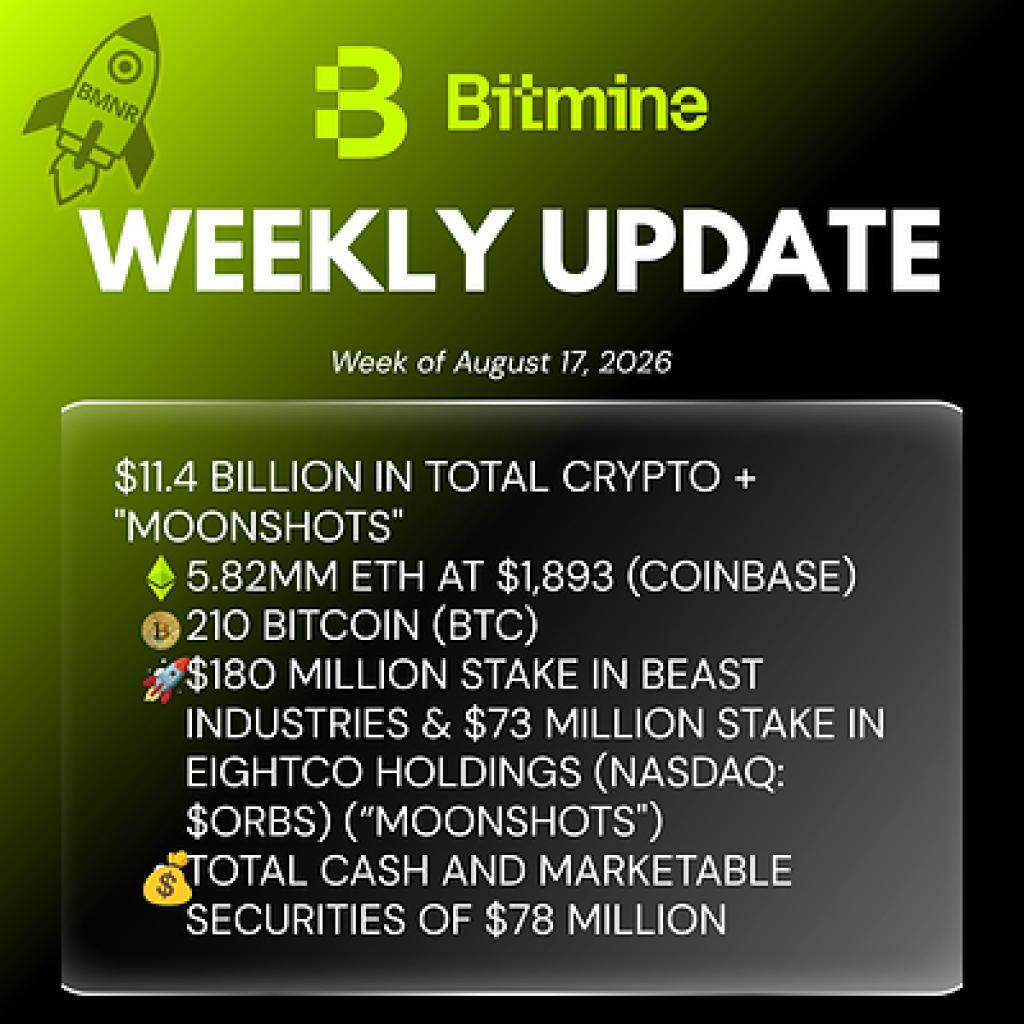
Bitmine Immersion Technologies (BMNR) Announces ETH Holdings Reach 5.82 Million Tokens, and Total Crypto and Total Cash Holdings of $11.4 Billion

BiggerZ: Building a Fairness-First Crypto Casino, Sportsbook and Prediction Markets Platform