2026 Crypto Investor Relations and Token Transparency Report
Crypto investor relations evolved from an afterthought into a strategic function in 2026, driven by new disclosure frameworks, regulatory engagement, and institutional demand for token transparency. Blockworks launched its dedicated Investor Relations platform on March 24, 2026, naming Jito and BNB as inaugural partners, while the broader industry grapples with how to standardize communication between token projects and their holders.
The launch arrived against a backdrop of a $2.62 trillion total crypto market, with Bitcoin dominance hovering near 57.3% and the Fear & Greed Index reading Extreme Fear at 23. Even as market sentiment remained cautious, infrastructure for professional investor communication continued to expand.
Why Crypto Investor Relations Became a Strategic Function in 2026
Crypto investor relations, in practical terms, means the structured process by which token projects communicate treasury health, supply changes, governance decisions, and operational updates to current and prospective holders. Until recently, most projects treated this as an extension of community management, publishing sporadic Discord updates or blog posts with little standardization.
That changed as institutional allocators began demanding the same reporting discipline they expect from public equities. Blockworks recognized this gap early. Its new IR platform launched with three core capabilities: analytics and data-driven storytelling tools, branded investor-relations portals, and white-glove advisory services.
The choice of Jito and BNB as inaugural launch partners signals that both Solana-native and exchange-linked projects see professionalized IR as a competitive advantage, not a compliance burden.
David Rodriguez, in connection with the earlier Lightspeed IR initiative between Blockworks and the Solana Foundation, put the problem bluntly: “Institutions want to buy these tokens, but the industry makes it too hard for them.”
The shift is from hype-led communication toward credibility-led reporting. Projects that once relied on influencer threads and airdrop campaigns to attract holders now face sophisticated token holders who track vesting schedules, treasury movements, and governance votes in real time. This mirrors a similar maturation seen in how Bitcoin’s price stability above $74K has attracted a new class of institutional watchers focused on fundamentals over narratives.
What Token Transparency Means to Investors Now
Token transparency goes beyond publishing a tokenomics page at launch. Investors in 2026 evaluate projects on a rolling basis across five dimensions: supply mechanics, allocation breakdowns, unlock calendars, treasury composition, and governance authority.
Blockworks formalized this with its Token Transparency Framework, introduced on June 18, 2025, as a one-time filing built around 18 disclosure criteria. The initial cohort included Jito, Aerodrome, Raydium, Stride, Jupiter, and Morpho.
Ryan Connor framed the rationale directly: “We believe disclosure and transparency are critical in establishing tokens as investable assets.”
Minimum Viable Token Disclosure
At a minimum, investors now expect clear wallet attribution for team and treasury holdings, a published unlock calendar with exact dates and amounts, plain-language explanations of emission schedules and burn mechanisms, and documentation of governance powers including who can upgrade contracts or change parameters.
The distinction between useful transparency and marketing-heavy dashboards matters. A project that publishes a sleek analytics page but omits insider wallet labels or vesting cliff details is performing transparency without delivering it.
Which Data Points Reduce Investor Uncertainty
Treasury composition ranks among the highest-signal disclosures. Investors want to know not just the total value held but the breakdown between native tokens, stablecoins, and other assets, along with the burn rate and projected runway.
On-chain reserve visibility, where treasury wallets are publicly labeled and trackable, reduces the information asymmetry that has historically plagued crypto investing. Projects in the Token Transparency Framework’s initial cohort committed to exactly this kind of verifiable disclosure.
How a 2026 Report Should Benchmark Disclosure Quality
Evaluating token transparency requires more than a binary “disclosed or not” check. The most useful benchmarking considers four criteria: frequency of updates, auditability of claims, readability for non-technical audiences, and comparability across projects.
Reporting cadence matters as much as one-time transparency filings. A project that publishes a comprehensive tokenomics document at launch but goes silent for six months creates the same trust gap as one that never disclosed at all.
A Scoring Lens for Transparency
The Blockworks IR platform addresses this by hosting curated charts, quarterly reports, call transcripts, events calendars, and token-transparency filings in a single public-facing portal. This consolidation solves a recurring investor pain point: fragmented reporting scattered across blogs, governance forums, and social media threads.
Projects with synchronized off-chain and on-chain disclosures are significantly easier to evaluate. When a governance proposal references a treasury allocation, the corresponding wallet activity should be independently verifiable. When unlock schedules change, the on-chain vesting contracts should reflect the update.
Why Cadence and Context Both Matter
The SEC Crypto Task Force’s engagement with this space underscores the regulatory dimension. Staff from the Task Force met with representatives from Jito Labs and Blockworks on June 13, 2025, to discuss issuer disclosure, market-maker disclosure, scoring methodology, and a proposed timeline for public dissemination.
Blockworks positioned the Token Transparency Framework as complementary to U.S. crypto disclosure discussions rather than a substitute for regulation. This framing matters because it signals that industry-led transparency initiatives and regulatory requirements can coexist, potentially reducing friction for projects that adopt voluntary disclosure early.
Bitcoin’s market capitalization stood at roughly $1.50 trillion during the research period, underscoring the sheer scale of capital now operating in an asset class where most projects still lack basic investor-relations infrastructure.
Common Red Flags in Crypto Investor Communication
Even as disclosure standards improve, several patterns continue to erode investor trust. Recognizing these red flags helps holders and analysts distinguish genuine transparency from performative openness.
Treasury Opacity
Unexplained treasury transfers remain the most damaging transparency failure. When large sums move from labeled project wallets without prior announcement or post-transfer explanation, holders are left to speculate. The result is often a sell-off driven by fear rather than fundamentals, a pattern that recent institutional engagement with crypto has made more consequential as larger capital pools react to the same signals.
Reserve changes that lack context, such as a sudden shift from stablecoins to volatile assets without a published rationale, signal either poor governance or deliberate obfuscation. Both outcomes damage credibility.
Unlock Ambiguity
Vague language around insider holdings and vesting cliffs is another persistent problem. According to one unconfirmed industry estimate, as many as 90% of crypto projects overlook investor relations entirely, though this figure lacks a published methodology. Even among projects that do publish vesting schedules, the details often omit cliff dates, acceleration clauses, or the conditions under which team tokens can be moved early.
Effective unlock planning, which some IR practitioners recommend starting 30 to 50 weeks before major vesting events, requires both calendar transparency and narrative preparation. Holders need to understand not just when tokens unlock but what the project plans to do about potential sell pressure.
Governance Without Accountability
Governance announcements that omit practical tokenholder impact represent a subtler but equally damaging failure. A proposal to “adjust protocol parameters” means little without specifying how it affects emissions, fees, or treasury allocation. Projects that build on transparent protocol infrastructure set a higher bar for what governance communication should include.
The interpretation risk falls entirely on the holder. When governance language is deliberately vague, informed insiders trade on superior information while retail participants absorb the price impact.
FAQ: Crypto Investor Relations and Token Transparency in 2026
What does investor relations mean in crypto?
Crypto investor relations is the practice of systematically communicating a token project’s financial health, supply dynamics, governance decisions, and operational progress to current and prospective holders. It goes beyond marketing or community management by providing structured, verifiable, and recurring disclosures.
What does token transparency include?
Token transparency covers supply breakdowns, allocation details, vesting and unlock schedules, treasury composition, wallet attribution, emission and burn mechanics, and governance authority documentation. The Blockworks Token Transparency Framework specifies 18 disclosure criteria that collectively define a minimum transparency standard.
How often should crypto projects report to investors?
There is no universal standard, but quarterly reporting aligned with treasury snapshots and governance activity summaries has emerged as a baseline expectation among institutional holders. One-time disclosures lose value quickly in a market where supply dynamics and treasury positions change continuously.
What signals poor disclosure in a token project?
The clearest warning signs include unexplained treasury movements, missing or incomplete unlock calendars, governance proposals without impact analysis, inconsistencies between on-chain data and published reports, and extended periods without any investor-facing updates.
Is token transparency the same as regulatory compliance?
No. Voluntary transparency frameworks like the one Blockworks developed are industry-led initiatives designed to build investor confidence. Blockworks has explicitly positioned its framework as complementary to, not a replacement for, regulatory requirements. The SEC Crypto Task Force’s engagement with these frameworks suggests regulators view them as potentially useful inputs, not substitutes for formal compliance obligations.
Disclaimer: This article is for informational purposes only and does not constitute financial or investment advice. Cryptocurrency and digital asset markets carry significant risk. Always do your own research before making decisions.
No tags available.




- China, US Conclude Trade Talks with Focus on Cooperation
- Crypto Weekly: NYSE Backs OKX, Kraken Gets Fed Access, BTC Sells
- Court Upholds Fed’s Rejection of Custodia Bank’s Request
- Former CFO Convicted for $35M Fraudulent Crypto Investment
- DeriW Launches Edge Hour Trading Competition Platform for Derivatives Traders
- Michael Saylor Denies Bitcoin Sell-Off Amid Large BTC Transfer
- Buy Dogecoin on eToro: Step-by-Step Guide for Beginners (2024)
- Kazakhstan Explores Crypto Reserves Backed by National Funds
- JPMorgan Increases Holdings in BlackRock’s Bitcoin ETF
- Nordea Bank Introduces Bitcoin ETP Trading for Nordic Customers
- XRP Spot ETF Launches on Nasdaq Amid Market Fluctuations
- Peter Schiff Challenges Michael Saylor on MSTR’s Business Model
- Thailand Orders Worldcoin to Delete 1.2 Million Biometric Records
- UK Proposes New DeFi Tax Framework to Ease User Burden
- WLFI Under Fire: Analyst Warns Hyperliquid Could Be Next
- Ancient Ethereum Whale Moves $1.19 Billion After Decade
- BlackRock Receives Large Crypto Transfers from Coinbase
- SEC Scrutiny on ALT5 Sigma’s Leadership Disclosure Timing
- Yala Injects $5.5 Million Amid Recovery Efforts
- Radiant Capital Faces $50M Loss in Major Security Breach
- China, US Conclude Trade Talks with Focus on Cooperation
- Crypto Weekly: NYSE Backs OKX, Kraken Gets Fed Access, BTC Sells
- Court Upholds Fed’s Rejection of Custodia Bank’s Request
- Former CFO Convicted for $35M Fraudulent Crypto Investment
- DeriW Launches Edge Hour Trading Competition Platform for Derivatives Traders
- Michael Saylor Denies Bitcoin Sell-Off Amid Large BTC Transfer
- Buy Dogecoin on eToro: Step-by-Step Guide for Beginners (2024)
- Kazakhstan Explores Crypto Reserves Backed by National Funds
- JPMorgan Increases Holdings in BlackRock’s Bitcoin ETF
- Nordea Bank Introduces Bitcoin ETP Trading for Nordic Customers
- XRP Spot ETF Launches on Nasdaq Amid Market Fluctuations
- Peter Schiff Challenges Michael Saylor on MSTR’s Business Model
- Thailand Orders Worldcoin to Delete 1.2 Million Biometric Records
- UK Proposes New DeFi Tax Framework to Ease User Burden
- WLFI Under Fire: Analyst Warns Hyperliquid Could Be Next
- Ancient Ethereum Whale Moves $1.19 Billion After Decade
- BlackRock Receives Large Crypto Transfers from Coinbase
- SEC Scrutiny on ALT5 Sigma’s Leadership Disclosure Timing
- Yala Injects $5.5 Million Amid Recovery Efforts
- Radiant Capital Faces $50M Loss in Major Security Breach
- China, US Conclude Trade Talks with Focus on Cooperation
- Crypto Weekly: NYSE Backs OKX, Kraken Gets Fed Access, BTC Sells
- Court Upholds Fed’s Rejection of Custodia Bank’s Request
- Former CFO Convicted for $35M Fraudulent Crypto Investment
- DeriW Launches Edge Hour Trading Competition Platform for Derivatives Traders
- Michael Saylor Denies Bitcoin Sell-Off Amid Large BTC Transfer
- Buy Dogecoin on eToro: Step-by-Step Guide for Beginners (2024)
- Kazakhstan Explores Crypto Reserves Backed by National Funds
- JPMorgan Increases Holdings in BlackRock’s Bitcoin ETF
- Nordea Bank Introduces Bitcoin ETP Trading for Nordic Customers
- XRP Spot ETF Launches on Nasdaq Amid Market Fluctuations
- Peter Schiff Challenges Michael Saylor on MSTR’s Business Model
- Thailand Orders Worldcoin to Delete 1.2 Million Biometric Records
- UK Proposes New DeFi Tax Framework to Ease User Burden
- WLFI Under Fire: Analyst Warns Hyperliquid Could Be Next
- Ancient Ethereum Whale Moves $1.19 Billion After Decade
- BlackRock Receives Large Crypto Transfers from Coinbase
- SEC Scrutiny on ALT5 Sigma’s Leadership Disclosure Timing
- Yala Injects $5.5 Million Amid Recovery Efforts
- Radiant Capital Faces $50M Loss in Major Security Breach

TDC Sues Illinois to Block Digital Asset Tax Before It Takes Effect

Lightning Labs Launches Wavelength Ark-Style Bitcoin Payment Platform

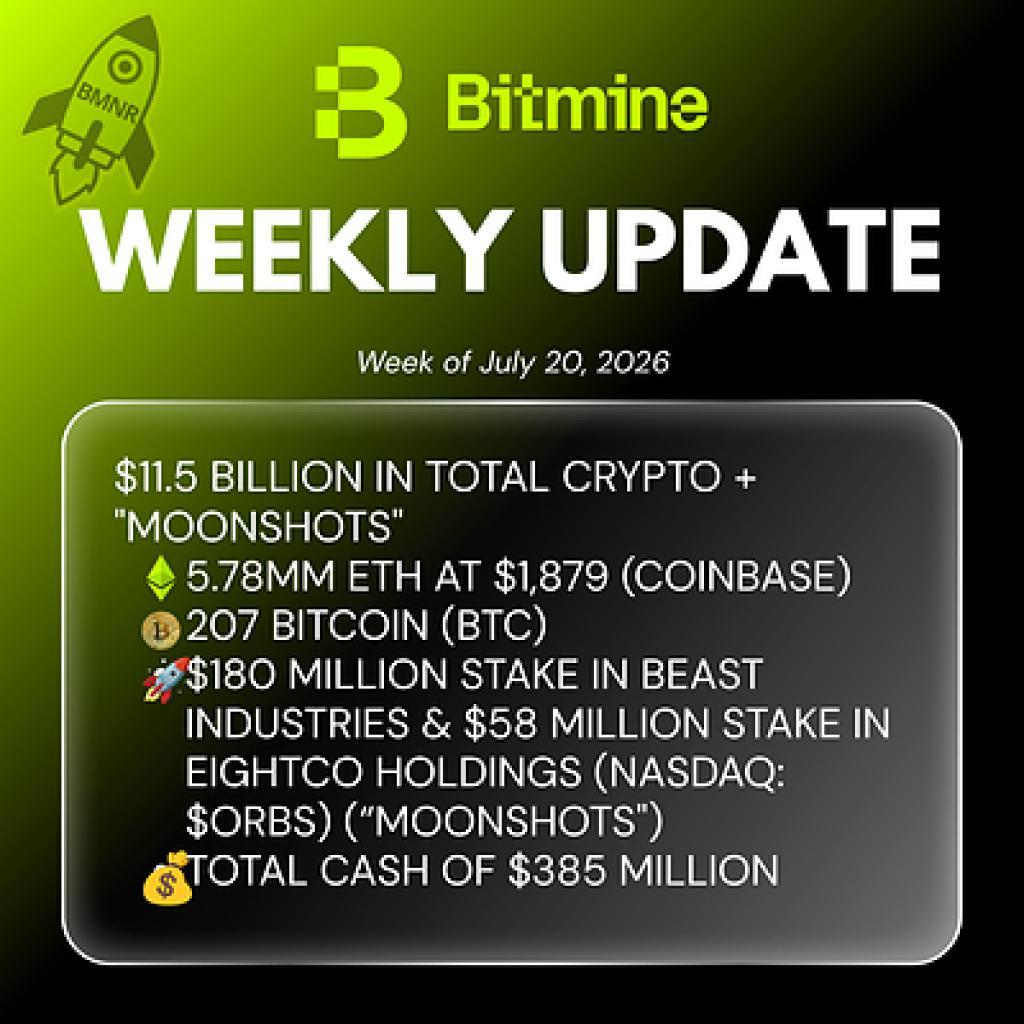
Bitmine Immersion Technologies (BMNR) Announces ETH Holdings Reach 5.78 Million Tokens, and Total Crypto and Total Cash Holdings of $11.5 Billion

GLOBAL MEDIA PROCUREMENT: THE 500-YEAR YIXING ZISHA TEAPOTS PARADIGM