Perp DEX Review 2026: How Perpetual DEXs Work, Security Risks & Honest Verdict
Perp DEXs have become one of the fastest-growing parts of crypto trading because they combine leverage and self-custody in one product. That sounds simple on paper, but in practice perpetual DEXs are not all built the same way.
Some feel like onchain versions of centralized futures exchanges. Others behave more like DeFi-native leverage products. Some compete on privacy, execution quality, or capital efficiency rather than just raw trading volume.
This guide explains what a perp DEX actually is, how perpetual futures work, how the major platforms differ, and what users should understand about fees, liquidation, security, and platform fit before trading. For broader category context, Coincu has also covered venues such as Drift Protocol, KiloEx, and Hyperliquid.

Table of Contents
What Is a Perp DEX?
A perp DEX is a decentralized exchange that lets users trade perpetual futures contracts directly from a self-custody wallet. Instead of buying the underlying asset, the user opens a derivative position that tracks its price. That means you can go long if you expect a rise, go short if you expect a drop, and use leverage to increase position size relative to your collateral.
The perpetual part matters. These contracts do not expire. There is no monthly or quarterly settlement date, which is why perpetuals became the dominant format in crypto derivatives.
In simple terms, a perp DEX is the decentralized version of a crypto futures venue, but the mechanics underneath, especially execution, pricing, and liquidation, can vary sharply from one protocol to another.
How Perp DEX Works
Every perp DEX needs to solve the same basic problem: how to offer leveraged trading without relying on centralized custody and centralized matching infrastructure.
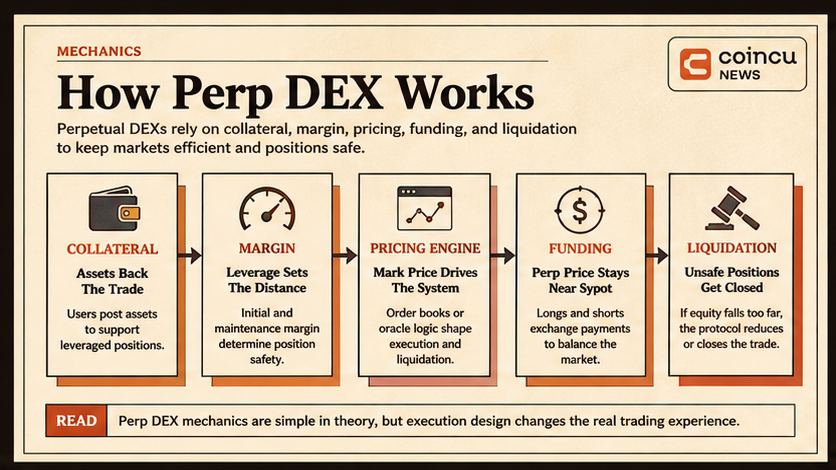
- Collateral supports the position
- Margin determines how large the position can be
- Funding helps keep the perp price near the spot market
- A pricing engine determines mark price and execution behavior
- Liquidation logic protects the protocol when positions become unsafe
That sounds simple until you compare platforms directly. Order-book perp DEXs such as Hyperliquid and dYdX try to replicate a more familiar trading venue where bids and asks interact directly.
Pool- or oracle-based systems such as GMX take a different path, using protocol-defined execution and oracle-linked pricing rather than a traditional book. Aster adds another layer by splitting products into distinct modes with different fee and leverage behavior.
| Core Layer | What It Does | Why It Matters |
|---|---|---|
| Collateral | Assets posted to support a position | Determines how much adverse price movement the account can survive |
| Margin | Sets opening and maintenance thresholds | Controls leverage and liquidation distance |
| Funding | Keeps perp price near spot | Creates an ongoing cost or payment between longs and shorts |
| Pricing Engine | Calculates mark price and execution behavior | Shapes slippage, liquidation logic, and trust assumptions |
| Liquidation System | Reduces or closes unhealthy positions | Protects the protocol, but can be harsh for traders |
What Are Perpetual Futures?
Perpetual futures are derivative contracts that let traders speculate on an asset’s price without holding the underlying token and without dealing with a fixed expiry date. This is why they are widely used for directional trading and hedging in crypto.
A trader can post collateral, open a long or short position, and keep that position open indefinitely as long as the account can satisfy margin requirements and funding costs.
For example, if a trader deposits $1,000 and opens a 10x BTC long, the effective position size is around $10,000. A 5% move in the right direction can produce a meaningful gain. A 5% move the other way can be enough to trigger a major loss or liquidation. A perp DEX changes who holds the assets and how trades are executed, but it does not make leverage safe.
How We Assessed dYdX, GMX, Hyperliquid, and Aster
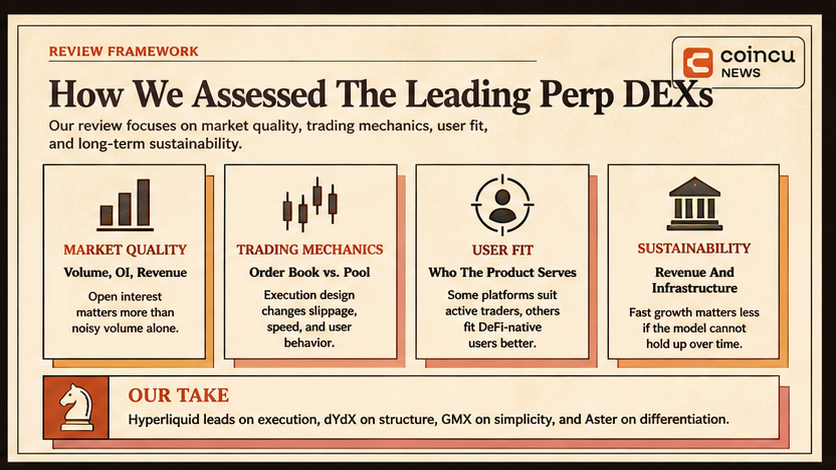
Our assessment of dYdX, GMX, Hyperliquid, and Aster focused on three things: market performance, user experience, and long-term sustainability. Rather than asking which platform is “best” in the abstract, we looked at which one is best suited to different types of traders and different trading priorities.
| Assessment Area | What We Looked At | Why It Matters |
|---|---|---|
| Activity & Market Performance | Trading volume, open interest, revenue | Helps separate real usage from short-term hype |
| Trading Mechanics | Order book vs. pool model, execution quality, settlement speed | Defines how the platform actually behaves in live trading |
| User Experience | Leverage, order tools, simplicity, advanced features | Determines which type of trader the product fits best |
| Economic Sustainability | Tokenomics, governance, revenue use, infrastructure strategy | Shows whether growth may be durable over time |
The first layer was activity and market quality. We focused on trading volume, open interest, and protocol revenue. Among these, open interest mattered most because it better reflects real usage and active positions than raw volume alone.
The second layer was trading mechanics. Hyperliquid and dYdX use order-book models built for speed and exchange-like execution, while GMX relies on a liquidity-pool system that creates a different trading experience. Aster was evaluated more for execution optimization and multi-venue access.
The third layer was user fit. dYdX targets advanced traders, Hyperliquid focuses on speed and trading tools, GMX is more beginner-friendly for DeFi leverage, and Aster appeals to users interested in privacy, execution quality, and cross-chain access.
Finally, we reviewed economic sustainability. We looked at governance, revenue usage, scalability, and long-term infrastructure strategy rather than short-term growth incentives alone.
| Platform | Best For | Model | Key Advantage |
|---|---|---|---|
| Hyperliquid | Active, high-speed traders | Custom L1 order book | Sub-second feel and CEX-like execution |
| dYdX | Institutional and high-leverage traders | Sovereign app-chain | Strong derivatives structure and long track record |
| GMX | Passive income and simpler trading | Shared liquidity pool | No traditional order-book friction and passive yield model |
| Aster | Large trades and cross-chain asset access | Multi-chain aggregator | Best execution logic and broader asset variety |
Market Position and Why It Matters
Perp DEXs matter because some platforms now process trading volume large enough to compete with major crypto exchanges, making liquidity quality, execution reliability, and risk design more important than simple branding.
Public market data makes that shift easy to see. The DefiLlama Hyperliquid perps dashboard shows that Hyperliquid has recently handled roughly $6.64 billion in 24-hour perp volume and around $312.93 billion in 30-day volume. The CoinGecko Hyperliquid futures page offers another lens through 24-hour futures volume, open interest, and pair coverage.
Aster has also recorded significant scale, with approximately $8.54 billion in 24-hour volume and $306.55 billion in 30-day volume. Meanwhile, dYdX and GMX remain smaller in raw volume but still serve important roles through different trading models and user experiences.
| Platform | 24h Perp Volume | 30d Perp Volume | Why It Matters |
|---|---|---|---|
| Hyperliquid | ~$6.64B | ~$312.93B | Shows strong demand for high-speed onchain execution |
| Aster | ~$8.54B | ~$306.55B | Suggests that differentiated perpetual products are gaining traction |
| dYdX | ~$178.83M | ~$7.57B | Smaller scale, but still relevant for serious derivatives users |
| GMX | ~$215.52M | ~$5.74B | Lower raw volume, but still durable as a DeFi-native leverage venue |
This matters for one simple reason: scale changes expectations. A platform doing a few million in volume can still be judged as an experiment. A platform doing billions has to be judged as a market. Coincu’s own reporting on Hyperliquid’s derivatives volume leadership and open interest growth above $5.6 billion reinforces the same point from a market-news perspective.
My Experience Interpreting the Perp DEX Market
After comparing these platforms, the biggest takeaway is simple: there is no single “best” perp DEX. Each platform is designed for a different type of trader, trading style, and market philosophy.
| Platform | Best For | Core Strength | Main Tradeoff |
|---|---|---|---|
| Hyperliquid | Active high-frequency traders | Speed, deep liquidity, exchange-like execution | More optimized for advanced trading behavior |
| dYdX | Structured derivatives traders | Mature futures-style market design | Slightly less frictionless for casual users |
| GMX | DeFi-native users entering leverage | Simpler trading flow and easier onboarding | Different risk/pricing mechanics than order books |
| Aster | Users focused on privacy and execution quality | Cross-venue optimization and differentiated execution | Less familiar compared to traditional perp models |
Perp DEX vs CEX
This is where the category often gets oversimplified. A perp DEX is not simply “a CEX without KYC.” That misses the real tradeoff.
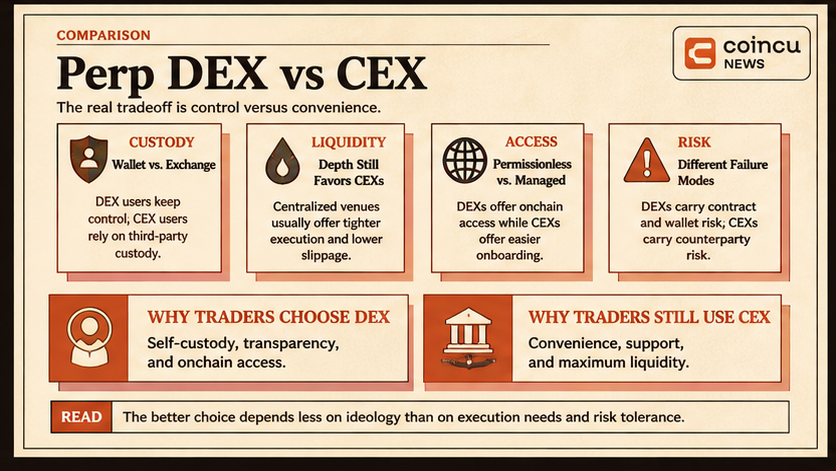
Perp DEXs are stronger for users who want self-custody, permissionless access, and onchain transparency. CEXs are still stronger for users who want deeper liquidity, easier onboarding, and a more predictable support experience.
The tradeoff is that responsibility moves back to the user. On a perp DEX, mistakes around wallet security, approvals, bridging, wrong networks, and leverage management are much more dangerous because there is no centralized support layer to catch them.
| Category | Perp DEX | CEX |
|---|---|---|
| Custody | Self-custody wallet | Exchange custody |
| Onboarding | Harder | Easier |
| KYC | Often lighter or front-end dependent | Usually required |
| Transparency | Higher protocol-level visibility | Depends on exchange disclosures |
| Support | Limited or protocol-led | Centralized customer support |
| Main Risk Shape | Smart contract, oracle, chain, and wallet risk | Counterparty, custody, and regulatory risk |
Security Analysis
Security on a perp DEX is not just about audits. The real risks are spread across smart contracts, price oracles, chain infrastructure, liquidation logic, and user behavior.
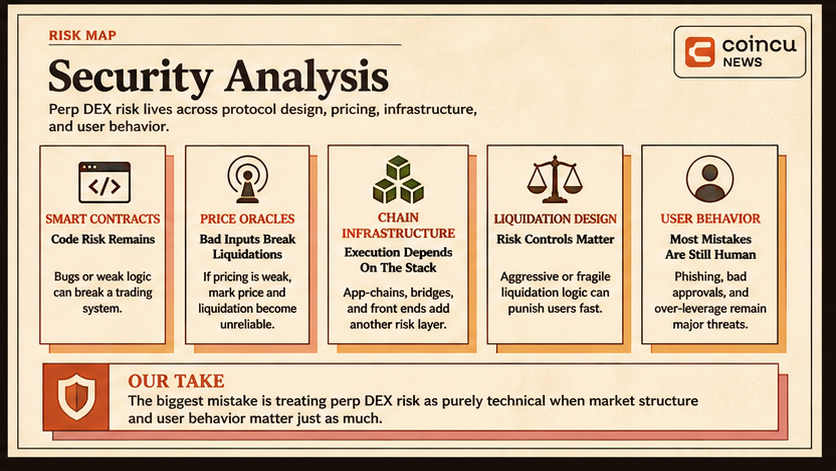
At the protocol level, users should care about whether the platform exposes enough public information to evaluate fees, code, and risk controls. At the market level, oracle design matters because weak pricing can lead to bad liquidations. At the user level, many losses still come from poor approvals, phishing, and bad leverage management rather than protocol failure alone.
- Protocol risk: smart contract bugs, weak liquidation design, bridge or chain dependence
- Market risk: unstable pricing, thin liquidity, funding spikes
- User risk: phishing, wallet mistakes, over-leverage
Risks and Limitations
Perp DEXs are powerful, but they are not forgiving. High leverage can destroy a position quickly. Funding and borrowing costs can quietly eat into returns. Liquidity may look deep in major markets and thin out sharply elsewhere. A protocol can be technically sound and still be difficult to use well if the trader does not understand collateral, funding, and liquidation properly.
There are also structural limits. Even in 2026, many perp DEXs still lag the best CEXs in onboarding simplicity, support, and cross-market consistency. That gap has narrowed, but it has not disappeared.
Expert Insight
The most important thing about a perp DEX is not the word “decentralized.” It is the market structure underneath. The category is splitting into at least two broad camps. One group, including Hyperliquid and dYdX, is trying to bring high-quality exchange behavior onchain. Another group, including GMX and Aster in different ways, is trying to rethink what onchain leverage products should look like rather than simply recreating centralized market structure.
That is why users should ask better questions. Not “Which perp DEX is most popular?” but “Do I want order-book behavior or oracle-based execution? Do I want speed or simplicity? Do I care about privacy, or only about access to leverage?” Those questions usually lead to a better decision than market-share headlines do.
Conclusion
Perp DEXs are now too important to dismiss as a niche DeFi experiment. They are a serious part of crypto market structure. But they are not one uniform category, and users should stop treating them as if they are.
Hyperliquid is strongest if execution quality is the priority. dYdX is strong for users who want a more mature derivatives framework. GMX is easier to approach for DeFi-native users who want leverage without the full order-book mindset. Aster stands out because it is trying to compete on privacy and market-environment quality, not just access.
Perp DEXs are highly useful tools for experienced users, but they are still bad products for casual or unprepared traders. If you do not understand funding, collateral, liquidation, and execution design, a perp DEX will not simplify the risk. It will just move that risk into places you may not yet know how to see.
FAQs
What is a perp DEX?
A perp DEX is a decentralized exchange that allows users to trade perpetual futures contracts from a self-custody wallet.
What does perpetual mean in perp DEX?
It means the contract has no expiry date. Positions can remain open indefinitely, subject to funding and margin requirements.
Is a perp DEX safer than a CEX?
It is safer in terms of custody dependence because users keep control of their funds. But it still carries smart contract, oracle, infrastructure, and operational risk.
What is the difference between perpetual futures and regular futures?
Regular futures expire on a fixed date. Perpetual futures do not. Instead, they use funding payments to keep the contract price near the spot market.
Which perp DEX is best for beginners?
None of them are ideal for true beginners. Some, such as GMX, may feel easier to approach than order-book-heavy platforms, but leveraged trading still requires serious risk understanding.
What is the main difference between dYdX, GMX, Hyperliquid, and Aster?
The biggest difference is architecture and product philosophy. dYdX and Hyperliquid lean more toward exchange-style execution, GMX is more oracle- and pool-driven, and Aster emphasizes privacy and differentiated trading modes.
Can perp DEXs be used for hedging?
Yes. Hedging is one of the most practical use cases. A user can short an asset on a perp DEX while holding spot exposure elsewhere.
Methodology
This article is based on official documentation, public product materials, public dashboards, and public security references reviewed in May 2026. We do not present this article as a guarantee of platform safety or profitability. All perpetual trading involves significant risk.
Disclaimer
This article is for informational purposes only and does not constitute financial advice. We reviewed perpetual DEX platforms using official documentation, public dashboards, and public security materials. This is a research-based explainer and market analysis, not a claim that every platform was traded with live capital in identical market conditions.


- China, US Conclude Trade Talks with Focus on Cooperation
- Crypto Weekly: NYSE Backs OKX, Kraken Gets Fed Access, BTC Sells
- Court Upholds Fed’s Rejection of Custodia Bank’s Request
- Former CFO Convicted for $35M Fraudulent Crypto Investment
- DeriW Launches Edge Hour Trading Competition Platform for Derivatives Traders
- Michael Saylor Denies Bitcoin Sell-Off Amid Large BTC Transfer
- Buy Dogecoin on eToro: Step-by-Step Guide for Beginners (2024)
- Kazakhstan Explores Crypto Reserves Backed by National Funds
- JPMorgan Increases Holdings in BlackRock’s Bitcoin ETF
- Nordea Bank Introduces Bitcoin ETP Trading for Nordic Customers
- XRP Spot ETF Launches on Nasdaq Amid Market Fluctuations
- Peter Schiff Challenges Michael Saylor on MSTR’s Business Model
- Thailand Orders Worldcoin to Delete 1.2 Million Biometric Records
- UK Proposes New DeFi Tax Framework to Ease User Burden
- WLFI Under Fire: Analyst Warns Hyperliquid Could Be Next
- Ancient Ethereum Whale Moves $1.19 Billion After Decade
- BlackRock Receives Large Crypto Transfers from Coinbase
- SEC Scrutiny on ALT5 Sigma’s Leadership Disclosure Timing
- Yala Injects $5.5 Million Amid Recovery Efforts
- Radiant Capital Faces $50M Loss in Major Security Breach
- China, US Conclude Trade Talks with Focus on Cooperation
- Crypto Weekly: NYSE Backs OKX, Kraken Gets Fed Access, BTC Sells
- Court Upholds Fed’s Rejection of Custodia Bank’s Request
- Former CFO Convicted for $35M Fraudulent Crypto Investment
- DeriW Launches Edge Hour Trading Competition Platform for Derivatives Traders
- Michael Saylor Denies Bitcoin Sell-Off Amid Large BTC Transfer
- Buy Dogecoin on eToro: Step-by-Step Guide for Beginners (2024)
- Kazakhstan Explores Crypto Reserves Backed by National Funds
- JPMorgan Increases Holdings in BlackRock’s Bitcoin ETF
- Nordea Bank Introduces Bitcoin ETP Trading for Nordic Customers
- XRP Spot ETF Launches on Nasdaq Amid Market Fluctuations
- Peter Schiff Challenges Michael Saylor on MSTR’s Business Model
- Thailand Orders Worldcoin to Delete 1.2 Million Biometric Records
- UK Proposes New DeFi Tax Framework to Ease User Burden
- WLFI Under Fire: Analyst Warns Hyperliquid Could Be Next
- Ancient Ethereum Whale Moves $1.19 Billion After Decade
- BlackRock Receives Large Crypto Transfers from Coinbase
- SEC Scrutiny on ALT5 Sigma’s Leadership Disclosure Timing
- Yala Injects $5.5 Million Amid Recovery Efforts
- Radiant Capital Faces $50M Loss in Major Security Breach
- China, US Conclude Trade Talks with Focus on Cooperation
- Crypto Weekly: NYSE Backs OKX, Kraken Gets Fed Access, BTC Sells
- Court Upholds Fed’s Rejection of Custodia Bank’s Request
- Former CFO Convicted for $35M Fraudulent Crypto Investment
- DeriW Launches Edge Hour Trading Competition Platform for Derivatives Traders
- Michael Saylor Denies Bitcoin Sell-Off Amid Large BTC Transfer
- Buy Dogecoin on eToro: Step-by-Step Guide for Beginners (2024)
- Kazakhstan Explores Crypto Reserves Backed by National Funds
- JPMorgan Increases Holdings in BlackRock’s Bitcoin ETF
- Nordea Bank Introduces Bitcoin ETP Trading for Nordic Customers
- XRP Spot ETF Launches on Nasdaq Amid Market Fluctuations
- Peter Schiff Challenges Michael Saylor on MSTR’s Business Model
- Thailand Orders Worldcoin to Delete 1.2 Million Biometric Records
- UK Proposes New DeFi Tax Framework to Ease User Burden
- WLFI Under Fire: Analyst Warns Hyperliquid Could Be Next
- Ancient Ethereum Whale Moves $1.19 Billion After Decade
- BlackRock Receives Large Crypto Transfers from Coinbase
- SEC Scrutiny on ALT5 Sigma’s Leadership Disclosure Timing
- Yala Injects $5.5 Million Amid Recovery Efforts
- Radiant Capital Faces $50M Loss in Major Security Breach



Trump Family’s American Bitcoin Tops 8,000 BTC After Record Mining Quarter
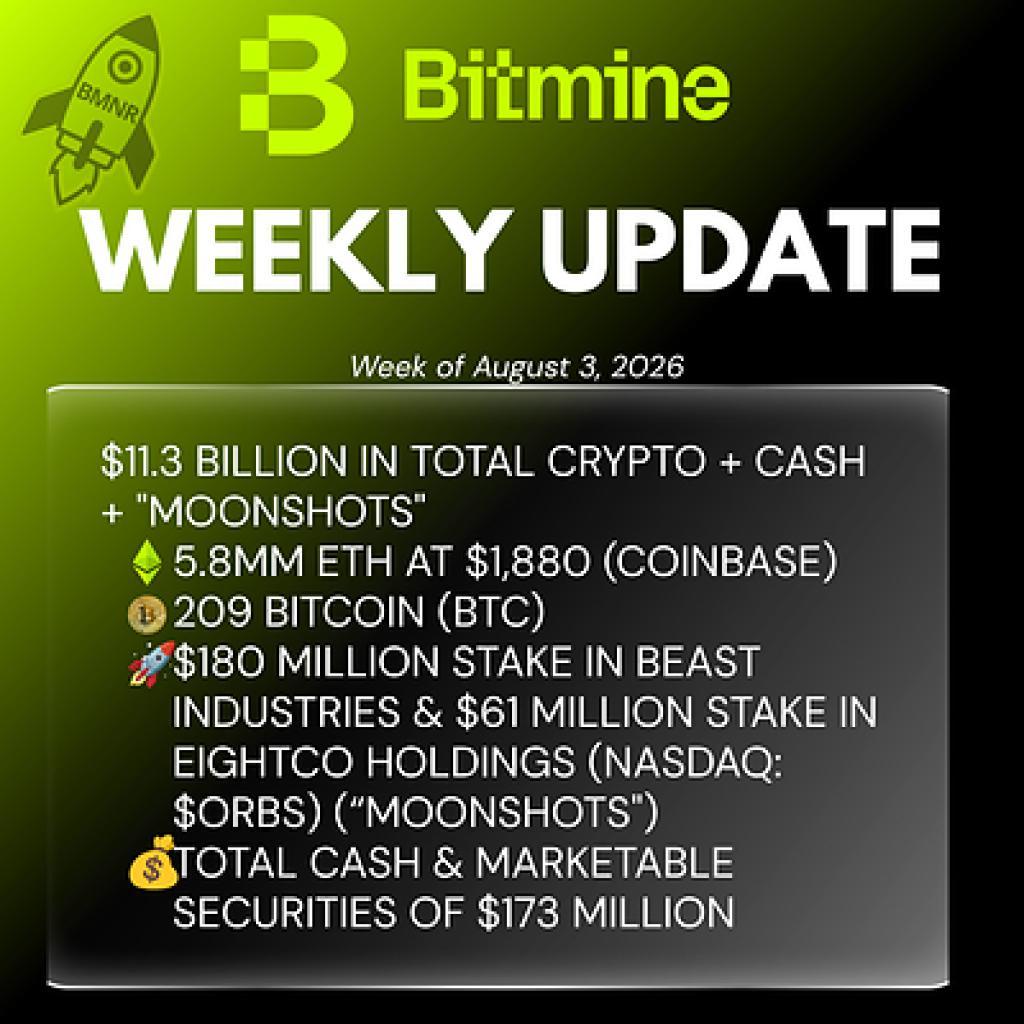
Bitmine Immersion Technologies (BMNR) Announces ETH Holdings Reach 5.8 Million Tokens, and Total Crypto and Total Cash Holdings of $11.3 Billion

Performa Marks One Year Live with Major Upgrade for Digital-Native SMBs