BTC Long Liquidations on Major CEXs Could Hit $857M Below $74,607
Bitcoin long liquidations on major centralized exchanges could reach $857 million if the price falls below $74,607, according to a circulating report citing CoinGlass data. However, accessible English-language sources do not independently confirm that exact pairing, and verified reports point to different downside thresholds and smaller liquidation clusters.
Why $74,607 Is a Key BTC Liquidation Level
BTC traded at $78,207 at the time of research, placing the cited $74,607 trigger roughly 4.6% below spot. A move of that magnitude would push Bitcoin into a zone where concentrated leveraged long positions face margin calls and forced closures across major exchanges.
Long liquidations occur when traders holding leveraged buy positions cannot meet margin requirements as price declines. Exchanges automatically close these positions, selling the underlying collateral into an already falling market, which can accelerate downside momentum.
According to unconfirmed reports from a single Chinese-language source, the $857 million figure is paired specifically with a drop below $74,607. No accessible English-language CoinGlass-derived report has confirmed that exact combination.
What CoinGlass-Linked Reports Actually Show
A KuCoin flash news item published April 19, 2026, citing CoinGlass, reported that BTC falling below $73,000 could trigger $538 million in long liquidations on major CEXs. The same item noted that a move above $77,000 could trigger $607 million in short liquidations.
A separate CryptoRank summary from April 20, 2026, also citing CoinGlass, placed BTC long liquidations at $294.07 million below $73,771 and BTC short liquidations at $190.90 million above $75,514. The discrepancy between the KuCoin and CryptoRank figures likely reflects different snapshot times, as CoinGlass liquidation heatmap data updates continuously based on open interest and leverage ratios.
The public CoinGlass BTC liquidation heatmap confirms the tool exists and describes it as a resource for estimating price ranges where large-scale liquidation events may occur. However, the page does not expose exact dollar-denominated cluster values in its publicly rendered HTML.
The $857 Million Figure Traces to a Separate Realized Event
The only independently verified use of the $857 million figure in the evidence set refers to a realized liquidation event, not a projected one. NewsBTC reported that 167,513 traders were liquidated across crypto markets, with total liquidations reaching $857 million over 24 hours during a period when BTC fell below $88,000.
That event was tied to broader macro risk-off conditions and tariff-related headlines, not to the $74,607 level cited in the current report. Conflating a realized 24-hour liquidation total from a prior price move with a projected liquidation cluster at a different price level is a meaningful distinction that traders should note.
How a BTC Breakdown Could Trigger a Long Squeeze on Major CEXs
When BTC approaches a price zone with dense long-position concentration, the first wave of liquidations can push price further into the cluster. This triggers additional margin calls, creating a feedback loop sometimes called a “long squeeze.”
Major centralized exchanges tracked by CoinGlass, including Binance, OKX, and Bybit, each carry their own pools of leveraged positions. A rapid price decline can hit liquidation walls on multiple exchanges simultaneously, amplifying sell pressure beyond what spot markets alone would produce.
The verified downside clusters, whether $538 million below $73,000 or $294.07 million below $73,771, represent substantial forced selling that could compound any fundamental or sentiment-driven decline. Exchanges that recently recorded net outflows of 5,740.82 BTC over 24 hours may see reduced spot liquidity, which would make any liquidation cascade more impactful on price.
BTC Sentiment Sits in Fear Territory
The Fear and Greed Index read 27 at the time of research, classified as “Fear.” Weak sentiment environments tend to amplify the market impact of liquidation-related headlines, as traders operating with reduced risk appetite may be quicker to de-leverage or exit positions.
BTC 24-hour trading volume stood at approximately $18.3 billion, with a market cap near $1.57 trillion. The 24-hour price change was essentially flat at -0.04%, suggesting the market had not yet priced in a move toward the cited liquidation zones.
The gap between the current $78,207 spot price and the verified $73,000 liquidation cluster represents roughly a 6.7% decline, a move well within Bitcoin’s recent volatility range. Traders evaluating exposure across major Bitcoin platforms and derivatives venues should weigh these liquidation thresholds against their own leverage ratios.
FAQ: BTC Long Liquidations and the $74,607 Trigger
Is the $857 million at $74,607 independently verified?
No. A single unconfirmed report pairs $857 million with a BTC drop below $74,607. Accessible English-language sources citing CoinGlass report different thresholds: $538 million below $73,000 and $294.07 million below $73,771.
What does “major CEXs” refer to?
Major centralized exchanges tracked by CoinGlass typically include Binance, OKX, Bybit, Bitget, and other high-volume derivatives platforms. The liquidation heatmap aggregates open interest data across these venues to estimate where forced closures would concentrate.
How do traders use liquidation heatmaps?
CoinGlass describes its BTC liquidation heatmap as a tool for estimating price ranges where large-scale liquidation events may occur. Traders use these maps to identify support and resistance zones shaped by leverage concentration, which can act as magnets for price or accelerants once breached. Those interested in broader Bitcoin trading and risk management resources can find additional context on how leverage dynamics shape market structure.
Disclaimer: This article is for informational purposes only and does not constitute financial or investment advice. Cryptocurrency and digital asset markets carry significant risk. Always do your own research before making decisions.
No tags available.


Other Posts








- China, US Conclude Trade Talks with Focus on Cooperation
- Crypto Weekly: NYSE Backs OKX, Kraken Gets Fed Access, BTC Sells
- Court Upholds Fed’s Rejection of Custodia Bank’s Request
- Former CFO Convicted for $35M Fraudulent Crypto Investment
- DeriW Launches Edge Hour Trading Competition Platform for Derivatives Traders
- Michael Saylor Denies Bitcoin Sell-Off Amid Large BTC Transfer
- Buy Dogecoin on eToro: Step-by-Step Guide for Beginners (2024)
- Kazakhstan Explores Crypto Reserves Backed by National Funds
- JPMorgan Increases Holdings in BlackRock’s Bitcoin ETF
- Nordea Bank Introduces Bitcoin ETP Trading for Nordic Customers
- XRP Spot ETF Launches on Nasdaq Amid Market Fluctuations
- Peter Schiff Challenges Michael Saylor on MSTR’s Business Model
- Thailand Orders Worldcoin to Delete 1.2 Million Biometric Records
- UK Proposes New DeFi Tax Framework to Ease User Burden
- WLFI Under Fire: Analyst Warns Hyperliquid Could Be Next
- Ancient Ethereum Whale Moves $1.19 Billion After Decade
- BlackRock Receives Large Crypto Transfers from Coinbase
- SEC Scrutiny on ALT5 Sigma’s Leadership Disclosure Timing
- Yala Injects $5.5 Million Amid Recovery Efforts
- Radiant Capital Faces $50M Loss in Major Security Breach
- China, US Conclude Trade Talks with Focus on Cooperation
- Crypto Weekly: NYSE Backs OKX, Kraken Gets Fed Access, BTC Sells
- Court Upholds Fed’s Rejection of Custodia Bank’s Request
- Former CFO Convicted for $35M Fraudulent Crypto Investment
- DeriW Launches Edge Hour Trading Competition Platform for Derivatives Traders
- Michael Saylor Denies Bitcoin Sell-Off Amid Large BTC Transfer
- Buy Dogecoin on eToro: Step-by-Step Guide for Beginners (2024)
- Kazakhstan Explores Crypto Reserves Backed by National Funds
- JPMorgan Increases Holdings in BlackRock’s Bitcoin ETF
- Nordea Bank Introduces Bitcoin ETP Trading for Nordic Customers
- XRP Spot ETF Launches on Nasdaq Amid Market Fluctuations
- Peter Schiff Challenges Michael Saylor on MSTR’s Business Model
- Thailand Orders Worldcoin to Delete 1.2 Million Biometric Records
- UK Proposes New DeFi Tax Framework to Ease User Burden
- WLFI Under Fire: Analyst Warns Hyperliquid Could Be Next
- Ancient Ethereum Whale Moves $1.19 Billion After Decade
- BlackRock Receives Large Crypto Transfers from Coinbase
- SEC Scrutiny on ALT5 Sigma’s Leadership Disclosure Timing
- Yala Injects $5.5 Million Amid Recovery Efforts
- Radiant Capital Faces $50M Loss in Major Security Breach
- China, US Conclude Trade Talks with Focus on Cooperation
- Crypto Weekly: NYSE Backs OKX, Kraken Gets Fed Access, BTC Sells
- Court Upholds Fed’s Rejection of Custodia Bank’s Request
- Former CFO Convicted for $35M Fraudulent Crypto Investment
- DeriW Launches Edge Hour Trading Competition Platform for Derivatives Traders
- Michael Saylor Denies Bitcoin Sell-Off Amid Large BTC Transfer
- Buy Dogecoin on eToro: Step-by-Step Guide for Beginners (2024)
- Kazakhstan Explores Crypto Reserves Backed by National Funds
- JPMorgan Increases Holdings in BlackRock’s Bitcoin ETF
- Nordea Bank Introduces Bitcoin ETP Trading for Nordic Customers
- XRP Spot ETF Launches on Nasdaq Amid Market Fluctuations
- Peter Schiff Challenges Michael Saylor on MSTR’s Business Model
- Thailand Orders Worldcoin to Delete 1.2 Million Biometric Records
- UK Proposes New DeFi Tax Framework to Ease User Burden
- WLFI Under Fire: Analyst Warns Hyperliquid Could Be Next
- Ancient Ethereum Whale Moves $1.19 Billion After Decade
- BlackRock Receives Large Crypto Transfers from Coinbase
- SEC Scrutiny on ALT5 Sigma’s Leadership Disclosure Timing
- Yala Injects $5.5 Million Amid Recovery Efforts
- Radiant Capital Faces $50M Loss in Major Security Breach


BlackRock ETF Wallet Moves $271M in BTC and ETH to Coinbase Prime

Whale Withdraws 30,244 ETH Worth $57.8M From Binance in One Week
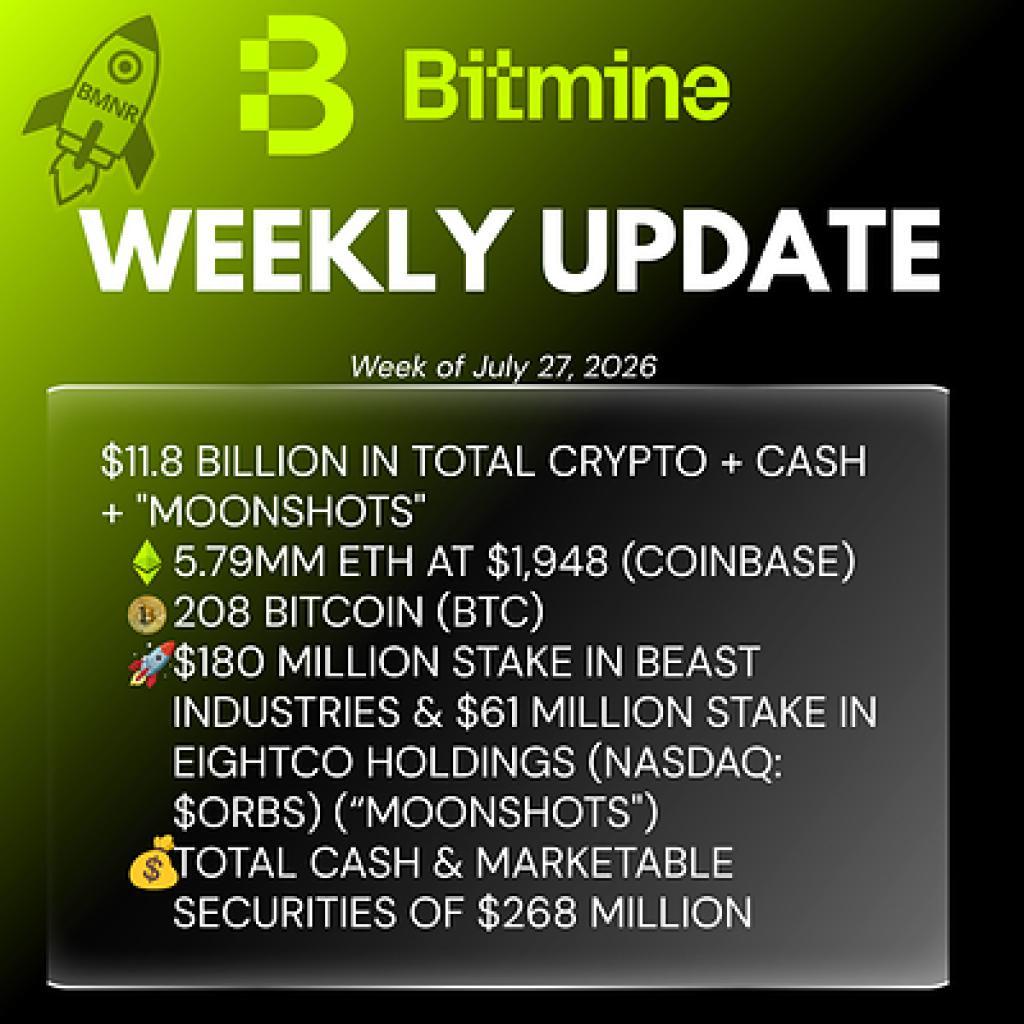
Bitmine Immersion Technologies (BMNR) Announces ETH Holdings Reach 5.79 Million Tokens, and Total Crypto and Total Cash Holdings of $11.8 Billion