U.S. House Representatives have introduced legislation that would establish a Strategic Bitcoin Reserve with a mandatory 20-year minimum holding period, signaling a long-term commitment to treating Bitcoin as a national strategic asset rather than a short-term fiscal tool.
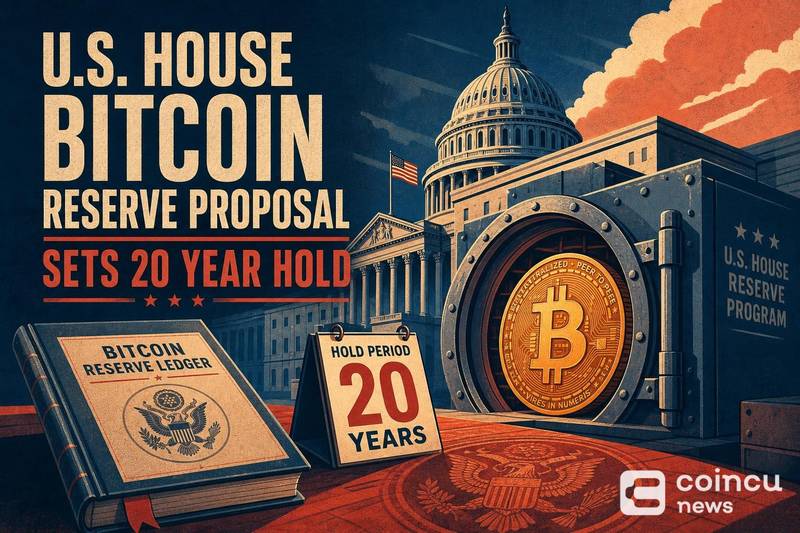
The bill, known as the American Reserve Measures Act (ARMA), is led by Rep. Nick Begich and Rep. Derrick Van Epps, both of whom issued press releases announcing their roles in the effort.
The proposal would direct the federal government to acquire up to 1 million Bitcoin for the reserve. Its defining feature, the 20-year minimum holding period, would legally prevent the government from liquidating reserve holdings before that window expires.
What the 20-year holding requirement would mean in practice
A mandatory two-decade hold would effectively remove the acquired Bitcoin from any near-term budget maneuvering. Unlike a conventional treasury asset that can be bought and sold based on market conditions, Bitcoin held under this rule could not be used to cover deficits, fund programs, or respond to price swings.
The structure frames Bitcoin explicitly as a long-duration store of value, closer in concept to gold reserves than to a tradeable portfolio position. The 20-year floor is notably longer than any comparable holding mandate applied to existing U.S. reserve assets.
This design choice also removes discretionary risk. Future administrations would not be able to sell the reserve opportunistically or under political pressure, at least not until the holding period lapses. The rigidity is both the proposal’s strength and its most likely point of legislative debate. In a broader environment where institutional capital continues flowing into Bitcoin-adjacent infrastructure, the proposal aligns federal policy with a long-horizon investment thesis already embraced by parts of the private sector.
ARMA builds on an existing executive order
The legislative effort follows an executive order signed in March 2025 that established the Strategic Bitcoin Reserve and United States Digital Asset Stockpile at the presidential level. That order created the reserve concept, but executive orders can be reversed by subsequent administrations.
ARMA aims to codify the reserve into federal law, which would make it far more durable than an executive directive. Enshrining the reserve in statute would require a future Congress to pass new legislation to dismantle it, a significantly higher bar than a presidential pen stroke.
The distinction matters for institutional credibility. A reserve backed by statute carries more weight with markets and international observers than one that exists solely at executive discretion.
How the proposal could shape Bitcoin’s institutional narrative
A federal government committing to hold Bitcoin for a minimum of 20 years would represent one of the strongest institutional endorsements of Bitcoin’s store-of-value thesis to date. Even at the proposal stage, the bill reinforces a framing of Bitcoin as a strategic commodity rather than a speculative instrument.
Legislative proposals of this nature often influence market sentiment before they become law. The introduction of ARMA places Bitcoin reserve policy on the congressional agenda, forcing debate and drawing attention from institutional participants who monitor regulatory signals closely. Market participants who have watched how prediction markets and influencer spending shape crypto sentiment know that proposal-stage news can move perception well ahead of policy.
That said, proposal status is not implementation. No Bitcoin has been acquired under this specific bill, no committee votes have been scheduled, and no timeline for floor consideration has been announced. Readers should separate the narrative significance of the proposal from its current legal standing.
What would need to happen before this becomes law
As a House bill, ARMA would first need to pass through the relevant committee, likely the House Financial Services Committee. From there, it would require a floor vote in the House, passage in the Senate (either through a companion bill or reconciliation), and a presidential signature.
At each stage, the bill’s terms could be amended. The 20-year holding period, the 1 million Bitcoin acquisition target, and the reserve’s governance structure are all subject to revision during markup and negotiation. The final version, if one passes, could differ substantially from the introduced text.
Political dynamics add further uncertainty. While the executive order suggests White House alignment with the concept, congressional support across both chambers is not guaranteed. Fiscal hawks may question the acquisition cost, while others may challenge the wisdom of locking public funds into a volatile asset for two decades. Meanwhile, large-scale digital asset movements on exchanges continue to underscore the growing interplay between institutional behavior and crypto policy signals.
FAQ about the House Bitcoin Strategic Reserve proposal
Is the Bitcoin Strategic Reserve already law?
No. An executive order established the concept in March 2025, but the ARMA bill introduced in the House seeks to codify it into federal statute. The bill is at the proposal stage and has not been voted on.
Why is the holding period set at 20 years?
The 20-year minimum is designed to prevent short-term liquidation and signal long-term commitment. It treats Bitcoin as a strategic reserve asset meant to be held across multiple administrations, similar in philosophy to how the U.S. manages its gold reserves.
How much Bitcoin would the reserve hold?
The proposal targets up to 1 million Bitcoin for the reserve. The acquisition timeline and funding mechanism are subject to legislative negotiation.
Who introduced the bill?
Rep. Nick Begich and Rep. Derrick Van Epps are leading the legislation, according to press releases from both offices.
Disclaimer: This article is for informational purposes only and does not constitute financial or investment advice. Cryptocurrency and digital asset markets carry significant risk. Always do your own research before making decisions.
No tags available.


Other Posts








- China, US Conclude Trade Talks with Focus on Cooperation
- Crypto Weekly: NYSE Backs OKX, Kraken Gets Fed Access, BTC Sells
- Court Upholds Fed’s Rejection of Custodia Bank’s Request
- Former CFO Convicted for $35M Fraudulent Crypto Investment
- DeriW Launches Edge Hour Trading Competition Platform for Derivatives Traders
- Michael Saylor Denies Bitcoin Sell-Off Amid Large BTC Transfer
- Buy Dogecoin on eToro: Step-by-Step Guide for Beginners (2024)
- Kazakhstan Explores Crypto Reserves Backed by National Funds
- JPMorgan Increases Holdings in BlackRock’s Bitcoin ETF
- Nordea Bank Introduces Bitcoin ETP Trading for Nordic Customers
- XRP Spot ETF Launches on Nasdaq Amid Market Fluctuations
- Peter Schiff Challenges Michael Saylor on MSTR’s Business Model
- Thailand Orders Worldcoin to Delete 1.2 Million Biometric Records
- UK Proposes New DeFi Tax Framework to Ease User Burden
- WLFI Under Fire: Analyst Warns Hyperliquid Could Be Next
- Ancient Ethereum Whale Moves $1.19 Billion After Decade
- BlackRock Receives Large Crypto Transfers from Coinbase
- SEC Scrutiny on ALT5 Sigma’s Leadership Disclosure Timing
- Yala Injects $5.5 Million Amid Recovery Efforts
- Radiant Capital Faces $50M Loss in Major Security Breach
- China, US Conclude Trade Talks with Focus on Cooperation
- Crypto Weekly: NYSE Backs OKX, Kraken Gets Fed Access, BTC Sells
- Court Upholds Fed’s Rejection of Custodia Bank’s Request
- Former CFO Convicted for $35M Fraudulent Crypto Investment
- DeriW Launches Edge Hour Trading Competition Platform for Derivatives Traders
- Michael Saylor Denies Bitcoin Sell-Off Amid Large BTC Transfer
- Buy Dogecoin on eToro: Step-by-Step Guide for Beginners (2024)
- Kazakhstan Explores Crypto Reserves Backed by National Funds
- JPMorgan Increases Holdings in BlackRock’s Bitcoin ETF
- Nordea Bank Introduces Bitcoin ETP Trading for Nordic Customers
- XRP Spot ETF Launches on Nasdaq Amid Market Fluctuations
- Peter Schiff Challenges Michael Saylor on MSTR’s Business Model
- Thailand Orders Worldcoin to Delete 1.2 Million Biometric Records
- UK Proposes New DeFi Tax Framework to Ease User Burden
- WLFI Under Fire: Analyst Warns Hyperliquid Could Be Next
- Ancient Ethereum Whale Moves $1.19 Billion After Decade
- BlackRock Receives Large Crypto Transfers from Coinbase
- SEC Scrutiny on ALT5 Sigma’s Leadership Disclosure Timing
- Yala Injects $5.5 Million Amid Recovery Efforts
- Radiant Capital Faces $50M Loss in Major Security Breach
- China, US Conclude Trade Talks with Focus on Cooperation
- Crypto Weekly: NYSE Backs OKX, Kraken Gets Fed Access, BTC Sells
- Court Upholds Fed’s Rejection of Custodia Bank’s Request
- Former CFO Convicted for $35M Fraudulent Crypto Investment
- DeriW Launches Edge Hour Trading Competition Platform for Derivatives Traders
- Michael Saylor Denies Bitcoin Sell-Off Amid Large BTC Transfer
- Buy Dogecoin on eToro: Step-by-Step Guide for Beginners (2024)
- Kazakhstan Explores Crypto Reserves Backed by National Funds
- JPMorgan Increases Holdings in BlackRock’s Bitcoin ETF
- Nordea Bank Introduces Bitcoin ETP Trading for Nordic Customers
- XRP Spot ETF Launches on Nasdaq Amid Market Fluctuations
- Peter Schiff Challenges Michael Saylor on MSTR’s Business Model
- Thailand Orders Worldcoin to Delete 1.2 Million Biometric Records
- UK Proposes New DeFi Tax Framework to Ease User Burden
- WLFI Under Fire: Analyst Warns Hyperliquid Could Be Next
- Ancient Ethereum Whale Moves $1.19 Billion After Decade
- BlackRock Receives Large Crypto Transfers from Coinbase
- SEC Scrutiny on ALT5 Sigma’s Leadership Disclosure Timing
- Yala Injects $5.5 Million Amid Recovery Efforts
- Radiant Capital Faces $50M Loss in Major Security Breach

U.S. Spot Bitcoin ETFs See Second Straight Day of $465M Net Outflows

OneBullEx Mastercard Card Launch Targets Digital Asset Payments

Binance Launches TMFUSDT, TBTUSDT, and BITOUSDT Perpetual Contracts

EMCD launches Miner Support Program with up to $30M for miners amid industry’s steepest profitability squeeze
RISEx Launches ‘Ignite’ Season 1 Points Program, Following $3B in Volume During the Early Access Phase