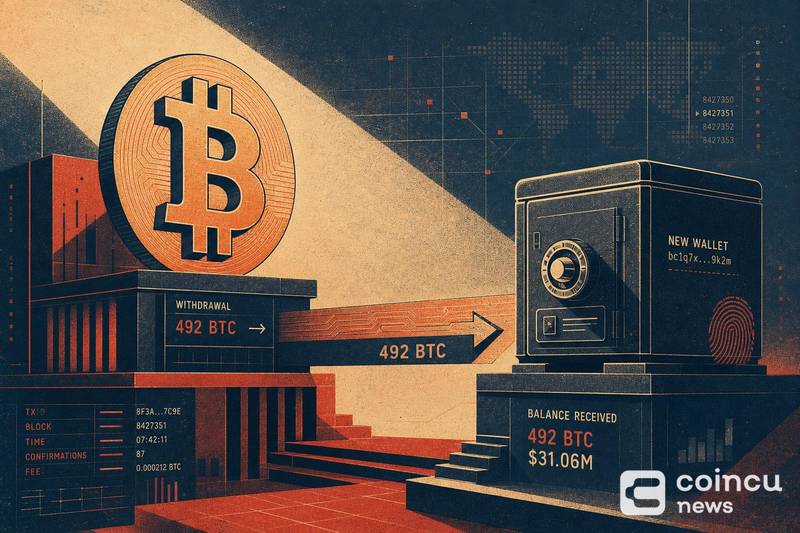
A newly created Bitcoin address withdrew 492 BTC from Binance, a transfer valued at approximately $31.06 million. The movement, flagged by on-chain tracking services, adds to a pattern of large exchange outflows that market participants routinely monitor for sentiment signals.
What the 492 BTC Binance Withdrawal Involved
The transfer moved 492 BTC off Binance to a wallet that had no prior transaction history. At the time of the withdrawal, the coins carried an approximate value of $31.06 million based on prevailing Bitcoin spot prices.
The receiving address is described as newly created, meaning it had not appeared on the Bitcoin blockchain before this transaction. Withdrawals to fresh wallets stand out in on-chain data feeds because they lack the transaction history that analysts use to identify known entities.
Binance served as the source exchange. The transfer was an outflow, meaning the coins moved from the exchange’s custody to an external address controlled by the withdrawing party.
Why a Fresh Wallet Attracts Attention
When a large sum moves to an address with no history, on-chain observers cannot immediately tie it to a known fund, custodian, or individual. That anonymity is what makes the event notable, not any confirmed intent behind it.
A newly created address could belong to an institutional buyer moving coins into cold storage, an existing holder rotating wallets for security, or an internal treasury operation. Without additional blockchain forensics linking the address to a known cluster, the owner’s identity remains unknown.
The size of the transfer, roughly $31 million, places it well above typical retail withdrawal thresholds. Transactions of this scale are commonly categorized as “whale-tier” in on-chain reporting, though that label alone says nothing about motive.
What Exchange Outflows Typically Signal
Bitcoin leaving an exchange is often interpreted as a reduction in immediately available sell-side supply. The logic is straightforward: coins held on an exchange can be sold at any time, while coins withdrawn to private wallets require a deposit back to an exchange before they can be traded.
That said, a single 492 BTC outflow does not constitute a trend. Binance processes thousands of withdrawals daily, and one transfer, however large, does not shift aggregate exchange reserve data in a meaningful way. Broader outflow trends tracked on platforms like CryptoQuant’s exchange reserve charts offer more reliable directional signals than any individual transaction.
Interpreting outflows as inherently bullish is a common oversimplification. Coins may leave exchanges for reasons unrelated to accumulation, including migration to DeFi protocols, over-the-counter settlement, or simply moving between wallets controlled by the same entity.
How Market Participants May Read the Transfer
Several narratives tend to emerge around large Binance withdrawals. The most common is accumulation, where a buyer acquires BTC on the exchange and moves it to self-custody. This is a plausible reading but not a confirmed one.
A second possibility is a custody transfer. Institutional holders and funds routinely move assets between hot wallets and cold storage as part of standard treasury management. Binance itself has conducted internal wallet rotations in the past that triggered similar on-chain alerts.
A third scenario involves over-the-counter trades. Large OTC desks sometimes settle transactions by withdrawing from an exchange on behalf of a buyer, with the coins moving directly to the purchaser’s designated wallet. This would also produce the pattern observed here.
The transfer comes at a time when Binance continues to be one of the most closely watched venues in crypto. The exchange recently announced plans to launch new perpetual contracts, reflecting its ongoing expansion of trading products. Separately, other major exchanges and financial institutions have been active in the digital asset space, with Singapore’s DBS Bank moving into tokenized gold trading and firms like Digital Asset completing a $355 million funding round for blockchain infrastructure.
None of these scenarios can be confirmed or ruled out based on the publicly available on-chain data alone. Readers should treat each as a plausible explanation rather than an established conclusion.
FAQ
Where did the 492 BTC come from?
The Bitcoin was withdrawn from Binance, one of the largest cryptocurrency exchanges by trading volume. The coins moved from Binance’s infrastructure to an external wallet.
How much was the transfer worth?
The 492 BTC carried an approximate value of $31.06 million at the time of the withdrawal, based on Bitcoin’s prevailing market price.
What makes this withdrawal notable?
The destination was a newly created address with no prior transaction history. Large transfers to fresh wallets are flagged by on-chain monitoring tools because they cannot be immediately attributed to a known entity.
Does this transfer prove a bullish move for Bitcoin?
No. A single exchange outflow, regardless of size, does not confirm accumulation or predict price direction. The transfer could reflect custody rotation, OTC settlement, or other routine operations unrelated to directional conviction.
Can the wallet owner be identified?
Not from the publicly available data. The address is new and has not been linked to any known entity through blockchain clustering or other forensic methods. Without additional information, the owner’s identity remains unknown.
Disclaimer: This article is for informational purposes only and does not constitute financial or investment advice. Cryptocurrency and digital asset markets carry significant risk. Always do your own research before making decisions.
No tags available.


Other Posts








- China, US Conclude Trade Talks with Focus on Cooperation
- Crypto Weekly: NYSE Backs OKX, Kraken Gets Fed Access, BTC Sells
- Court Upholds Fed’s Rejection of Custodia Bank’s Request
- Former CFO Convicted for $35M Fraudulent Crypto Investment
- DeriW Launches Edge Hour Trading Competition Platform for Derivatives Traders
- Michael Saylor Denies Bitcoin Sell-Off Amid Large BTC Transfer
- Buy Dogecoin on eToro: Step-by-Step Guide for Beginners (2024)
- Kazakhstan Explores Crypto Reserves Backed by National Funds
- JPMorgan Increases Holdings in BlackRock’s Bitcoin ETF
- Nordea Bank Introduces Bitcoin ETP Trading for Nordic Customers
- XRP Spot ETF Launches on Nasdaq Amid Market Fluctuations
- Peter Schiff Challenges Michael Saylor on MSTR’s Business Model
- Thailand Orders Worldcoin to Delete 1.2 Million Biometric Records
- UK Proposes New DeFi Tax Framework to Ease User Burden
- WLFI Under Fire: Analyst Warns Hyperliquid Could Be Next
- Ancient Ethereum Whale Moves $1.19 Billion After Decade
- BlackRock Receives Large Crypto Transfers from Coinbase
- SEC Scrutiny on ALT5 Sigma’s Leadership Disclosure Timing
- Yala Injects $5.5 Million Amid Recovery Efforts
- Radiant Capital Faces $50M Loss in Major Security Breach
- China, US Conclude Trade Talks with Focus on Cooperation
- Crypto Weekly: NYSE Backs OKX, Kraken Gets Fed Access, BTC Sells
- Court Upholds Fed’s Rejection of Custodia Bank’s Request
- Former CFO Convicted for $35M Fraudulent Crypto Investment
- DeriW Launches Edge Hour Trading Competition Platform for Derivatives Traders
- Michael Saylor Denies Bitcoin Sell-Off Amid Large BTC Transfer
- Buy Dogecoin on eToro: Step-by-Step Guide for Beginners (2024)
- Kazakhstan Explores Crypto Reserves Backed by National Funds
- JPMorgan Increases Holdings in BlackRock’s Bitcoin ETF
- Nordea Bank Introduces Bitcoin ETP Trading for Nordic Customers
- XRP Spot ETF Launches on Nasdaq Amid Market Fluctuations
- Peter Schiff Challenges Michael Saylor on MSTR’s Business Model
- Thailand Orders Worldcoin to Delete 1.2 Million Biometric Records
- UK Proposes New DeFi Tax Framework to Ease User Burden
- WLFI Under Fire: Analyst Warns Hyperliquid Could Be Next
- Ancient Ethereum Whale Moves $1.19 Billion After Decade
- BlackRock Receives Large Crypto Transfers from Coinbase
- SEC Scrutiny on ALT5 Sigma’s Leadership Disclosure Timing
- Yala Injects $5.5 Million Amid Recovery Efforts
- Radiant Capital Faces $50M Loss in Major Security Breach
- China, US Conclude Trade Talks with Focus on Cooperation
- Crypto Weekly: NYSE Backs OKX, Kraken Gets Fed Access, BTC Sells
- Court Upholds Fed’s Rejection of Custodia Bank’s Request
- Former CFO Convicted for $35M Fraudulent Crypto Investment
- DeriW Launches Edge Hour Trading Competition Platform for Derivatives Traders
- Michael Saylor Denies Bitcoin Sell-Off Amid Large BTC Transfer
- Buy Dogecoin on eToro: Step-by-Step Guide for Beginners (2024)
- Kazakhstan Explores Crypto Reserves Backed by National Funds
- JPMorgan Increases Holdings in BlackRock’s Bitcoin ETF
- Nordea Bank Introduces Bitcoin ETP Trading for Nordic Customers
- XRP Spot ETF Launches on Nasdaq Amid Market Fluctuations
- Peter Schiff Challenges Michael Saylor on MSTR’s Business Model
- Thailand Orders Worldcoin to Delete 1.2 Million Biometric Records
- UK Proposes New DeFi Tax Framework to Ease User Burden
- WLFI Under Fire: Analyst Warns Hyperliquid Could Be Next
- Ancient Ethereum Whale Moves $1.19 Billion After Decade
- BlackRock Receives Large Crypto Transfers from Coinbase
- SEC Scrutiny on ALT5 Sigma’s Leadership Disclosure Timing
- Yala Injects $5.5 Million Amid Recovery Efforts
- Radiant Capital Faces $50M Loss in Major Security Breach

SOON Security Incident Review Finds No Impact on User Assets, Mainnet RPC Restored

South Korean Police Raid Former Incheon Mayor Over 21,000 Allegedly Hidden Crypto Assets


Bitmine Immersion Technologies (BMNR) Announces ETH Holdings Reach 5.79 Million Tokens, and Total Crypto and Total Cash Holdings of $11.8 Billion
Eightco Holdings (NASDAQ: ORBS) Announces its Participation in World Foundation’s $52.5M funding round as World Shifts From Building the Network to Scaling Utility